Bus Arbitration Explained: Methods, Types, and Examples
When several devices need to use the same communication path, they cannot all drive it at once. Bus arbitration is the hardware process that selects one device to become the bus master while the others wait. It prevents conflicts, shapes latency, and helps ensure lower-priority work gets a fair chance to run.
What is bus arbitration?
A computer bus is a shared route for moving addresses, data, and control signals between components. A CPU, DMA controller, storage interface, network adapter, or accelerator may all need access to that route. If two potential bus masters transmit simultaneously, their signals can conflict, and the transfer can fail.
Bus arbitration answers one question: which requester may control the shared bus next? The circuit or protocol that makes that decision is called a bus arbiter.
A typical sequence works like this:
- One or more devices request the bus.
- The arbiter evaluates pending requests using a priority or fairness policy.
- It grants ownership to one requester after the bus is available.
- The winning device completes its transfer and releases the bus.
- Arbitration repeats if requests remain.
This coordination is essential in a multi-master system, where more than one device can initiate a transaction. Arbitration chooses the initiating device; addressing identifies the transfer’s destination.
Why bus arbitration matters
An effective arbitration scheme must do more than avoid collisions. It also defines how the system behaves under load.
- Data integrity: Only the selected master drives the shared resource at a given time.
- Latency: Urgent traffic can receive access quickly when the policy supports it.
- Fairness: A well-designed policy prevents one busy requester from blocking every other device indefinitely.
- Predictability: Real-time designs need an understandable upper bound on wait time.
- Scalability and cost: Extra logic and signaling can improve performance but add complexity.
In modern system-on-chip designs, the shared resource may be an interconnect segment, a memory-controller port, or another shared path rather than a traditional board-level bus. The same arbitration principles still apply.
How does it work? (a simple example)
Imagine a CPU, a DMA engine, and a graphics accelerator all request a shared memory bus.
| Time | Pending requesters | Arbiter action | Result |
|---|---|---|---|
| T0 | CPU, DMA, graphics | Receives requests | Compares eligible requesters |
| T1 | CPU, DMA, graphics | Grants one requester | The winner becomes bus master |
| T2 | DMA, graphics | Bus is busy | Remaining requesters wait |
| T3 | DMA, graphics | Winner releases bus | A new decision is made |
With fixed priority, the CPU might win every time it is pending. With round-robin arbitration, the arbiter rotates the first opportunity among requesters so that the most recent winner moves behind the others.
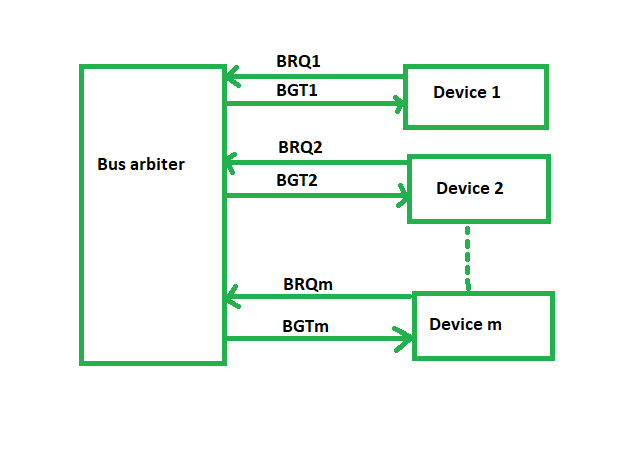
Centralized bus arbitration
In centralized bus arbitration, one arbiter makes the selection. It may be a dedicated hardware block or part of a controller. All potential bus masters send requests to the same decision point.
Centralized designs are straightforward to reason about because the policy lives in one place. The trade-off is that the arbiter can become a scaling limit or single point of failure unless the system addresses that risk.
Daisy-chain arbitration
In a daisy-chain design, the grant signal passes through devices in sequence. A requesting device that receives the grant captures it; a device with no request passes the grant onward.
The device nearest the arbiter sees the grant first, so it has the highest priority. Daisy chaining is inexpensive and easy to implement, but has limitations:
- Priorities are usually fixed by position.
- A device near the end can experience long delays or starvation.
- Grant propagation adds delay in long chains.
- A fault in the chain can affect downstream devices without bypass or fault-tolerance measures.
Daisy-chain arbitration is useful in small systems where the priority order is intentional and bounded.
Parallel centralized arbitration
With parallel arbitration, each potential master has a separate request path to the central arbiter. The arbiter examines active requests and asserts a grant for the selected device.
This approach supports flexible policies such as fixed priority, round robin, or configurable quality-of-service rules. Its trade-off is extra signal paths and more capable arbitration logic.
Distributed bus arbitration
In distributed bus arbitration, there is no single central decision maker. Each participating device helps determine the winner by observing and driving shared arbitration signals under a common protocol.
A common approach has devices place priority identifiers or request bits onto arbitration lines. Each contender compares the observed value with its own; a device that detects a higher-priority contender withdraws. The highest-priority eligible requester remains and takes control of the bus.
Distributed arbitration reduces reliance on one arbiter and can improve resilience. However, it requires careful timing, well-defined electrical behavior, and consistent logic at every participant.
Centralized vs. distributed bus arbitration
| Factor | Centralized arbitration | Distributed arbitration |
|---|---|---|
| Decision point | One arbiter selects a master | Participants collectively select a master |
| Design simplicity | Usually easier to implement and verify | Requires coordinated logic across devices |
| Priority flexibility | High, especially with parallel requests | Depends on protocol and signaling |
| Single point of failure | Possible | Reduced at the arbiter level |
| Best fit | Configurable policies and controlled designs | Decentralized control or resilience needs |
Neither model is universally better. The right choice depends on the number of masters, traffic pattern, availability requirements, latency targets, and hardware budget.
Design considerations for a bus arbiter
Before selecting or implementing an arbitration scheme, answer these questions:
- How many masters can request access?
- Which traffic is latency-critical?
- What does fairness mean: no starvation, bounded waiting time, or a minimum service share?
- Where are the transaction boundaries for safe handoff?
- How will the system recover if a requester disappears or holds the bus too long?
- How will you test simultaneous requests, reset behavior, request withdrawal, and ownership transitions?
A common mistake is optimizing only for average throughput. A design can perform well on average while still allowing a low-priority device to miss a critical deadline. Measure worst-case wait time as well.
Bus arbitration vs. bus contention
Bus arbitration is the preventive decision process that selects the master allowed to use a shared path. Bus contention is the unwanted condition in which multiple devices attempt to drive the same resource incompatibly. Proper arbitration makes contention unlikely during normal operation, while electrical safeguards and protocol checks help contain faults or invalid behavior.
Key takeaways
Bus arbitration makes multi-master sharing safe and orderly. Centralized arbitration offers a clear decision point and flexible policies, while distributed arbitration spreads the decision among participants. Fixed priority favors urgency, round robin favors fairness, and time-aware methods support predictable latency. The best bus arbiter is not simply the fastest one. It is the one whose policy matches the system’s traffic, timing, fault-handling, and verification requirements.