Broadband Transmission: How It Works, Types, and Benefits
Broadband transmission is the movement of data, voice, video, and other digital signals over a communication medium with substantial capacity. It is a foundation of modern connectivity, supporting everything from home internet and video meetings to cloud applications, smart devices, and business networks. The term can be slightly confusing because it is used in two related ways. In communications engineering, broadband transmission generally describes sending information across a wide range of frequencies—often allowing multiple signals or channels to share a medium. In everyday use, “broadband” usually means high-speed internet access delivered through fiber, cable, fixed wireless, satellite, or other network technologies.
Understanding broadband transmission helps consumers compare internet services and helps businesses make better decisions about performance, reliability, and network growth.
What Is Broadband Transmission?
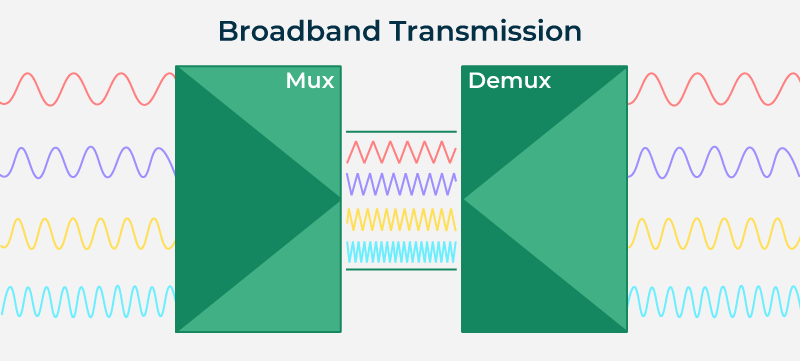
Broadband transmission is a high-capacity method of carrying information across wired or wireless media. Instead of relying on a single narrow channel, a broadband system can use a broad range of frequencies or multiple separated channels to carry data efficiently.
Depending on the technology, broadband transmission may use techniques such as:
- Frequency-division multiplexing (FDM), which assigns different signals to separate frequency bands
- Wavelength-division multiplexing (WDM), which sends multiple optical signals through a fiber using different wavelengths of light
- Orthogonal frequency-division multiplexing (OFDM), which divides data across many closely spaced subcarriers
- Advanced modulation, which encodes more bits into each signal change when channel conditions permit
In practical terms, broadband transmission makes it possible to carry high volumes of traffic at once. A single connection may support web browsing, video streaming, cloud backups, voice calls, online gaming, and smart-home devices simultaneously.
Broadband Transmission vs. Broadband Internet
Broadband transmission and broadband internet are related, but they are not identical.
| Term | Meaning |
|---|---|
| Broadband transmission | The technical process of transporting information over a high-capacity communications medium. |
| Broadband internet | The consumer or business service that provides access to the internet through a broadband-capable network. |
| Baseband transmission | A transmission approach that sends a digitally encoded signal directly across a medium, typically using its available channel for that signal. |
For example, a fiber network can use broadband transmission techniques such as WDM to carry many optical channels. An internet provider can then use that network to deliver broadband internet access to homes, offices, and mobile towers.
The Federal Communications Commission distinguishes between transmission capability and the internet access service delivered to end users. This distinction matters because a high-capacity connection can carry many kinds of services—not only public internet access.
How Does Broadband Transmission Work?
Although the details vary by technology, most broadband transmission systems follow a similar process.
- Data is converted into signals: A device creates digital data in the form of bits. Network equipment packages those bits into frames or packets, then prepares them for transmission across copper cables, optical fiber, radio spectrum, or satellite links.
- The signal is encoded and modulated: The network converts data into signals appropriate for the transmission medium. In a wireless link, information may be carried on radio waves. In fiber-optic cable, data travels as pulses of light. In cable networks, data can move across defined radio-frequency channels within coaxial cable.
- Capacity is shared efficiently: Broadband systems often divide available capacity among multiple users, devices, services, or channels. This sharing can occur through frequency bands, time slots, wavelengths, or other multiplexing methods. For example, a cable network may allocate separate frequency ranges to downstream data, upstream data, television, and voice services. Fiber networks can use different light wavelengths to increase capacity on the same strand of fiber.
- Network equipment receives and routes the data: At the destination, a modem, optical network terminal, router, or wireless receiver interprets the signal and forwards the data to the correct device or service.
Main Types of Broadband Transmission Technology
Broadband can be delivered over several physical media. Each option has different strengths in speed, latency, reliability, coverage, and cost.
Fiber-optic broadband
Fiber-optic broadband transmits data as pulses of light through glass or plastic fiber. It is widely regarded as the highest-capacity fixed broadband medium and is well suited to demanding applications such as cloud computing, 4K streaming, telehealth, and large-file transfers.
Fiber can also deliver strong upload performance, making it especially valuable for remote workers, creators, and businesses that regularly send data to the cloud. The U.S. National Telecommunications and Information Administration identifies fiber as a medium that transmits data using pulses of light and offers very high capacity over long distances.
Cable broadband
Cable broadband commonly uses a hybrid fiber-coaxial (HFC) network. Fiber carries traffic close to a neighborhood, while coaxial cable delivers service to individual premises.
This infrastructure is common in many urban and suburban areas. Cable connections can provide strong download speeds, though performance can be influenced by local network demand and the design of the shared coaxial segment.
DSL broadband
Digital Subscriber Line, or DSL, sends data over existing copper telephone lines. It can be practical where newer infrastructure is unavailable, but its performance generally depends heavily on line quality and distance from the provider’s equipment.
DSL is less common in new deployments as fiber replaces older copper-based networks, but it remains relevant in some regions.
Fixed wireless broadband
Fixed wireless access sends data through radio waves between a provider’s network and a fixed receiver at a home or business. It can be deployed more quickly than new cable or fiber infrastructure and can be useful in rural, remote, or difficult-to-build areas.
Performance may depend on available spectrum, distance, terrain, weather, interference, and whether there is a clear line of sight between the receiver and the network.
Satellite broadband
Satellite broadband sends data between a user terminal, an orbiting satellite, and a ground station. It can make broadband available in places where terrestrial infrastructure is limited or unavailable.
Latency and performance vary by satellite system and network conditions. Low Earth orbit systems generally have a shorter signal path than traditional geostationary satellite systems, which can help reduce delay.
What Determines Broadband Transmission Performance?
A broadband plan’s advertised speed is important, but it is not the only measure of network quality. Real-world performance depends on several factors.
- Bandwidth and throughput – Bandwidth refers to the capacity available for transmitting data. Throughput is the amount of data that actually moves successfully across the connection during real use. A plan may advertise a high maximum speed, but actual throughput can vary due to congestion, Wi-Fi limitations, device performance, and network conditions.
- Latency – Latency is the delay between sending data and receiving a response. Low latency is especially important for video calls, real-time collaboration, online gaming, voice services, financial transactions, and remote control systems.
- Jitter and packet loss – Jitter is variation in delay, while packet loss occurs when transmitted data does not reach its destination successfully. Both can harm real-time services even when a speed test reports high download performance.
- Signal quality – Wireless and copper-based connections can be affected by interference, distance, signal attenuation, line conditions, and environmental factors. Fiber is generally less vulnerable to electromagnetic interference than copper media.
- Network congestion – Many broadband services share parts of the network among multiple users. Performance can decline during periods of high demand if available capacity is limited.
Benefits of Broadband Transmission
Broadband transmission supports a wide range of personal, commercial, and public services.
- Faster communication: Enables rapid transfer of large files, video, voice, and cloud data.
- Multiple simultaneous uses: Supports households and workplaces with many active devices and applications.
- Scalability: Allows providers to expand capacity through infrastructure upgrades, additional spectrum, new wavelengths, or improved network equipment.
- Business continuity: Helps organizations run cloud platforms, backup systems, remote-work tools, and customer-facing applications.
- Access to digital services: Supports online education, telemedicine, e-commerce, streaming media, and government services.
The FCC’s broadband map lets users review availability by address and compare technologies such as DSL, cable, fiber, fixed wireless, and satellite.
How to Choose the Right Broadband Connection
The best broadband technology depends on your location and how you use the connection.
For a household, consider:
- Number of people and connected devices
- Streaming, gaming, remote work, or video-conferencing needs
- Download and upload speed requirements
- Monthly data limits
- Router and in-home Wi-Fi quality
For a business, also consider:
- Symmetrical upload and download needs
- Service-level agreements and repair response times
- Static IP addresses and security options
- Backup connectivity or automatic failover
- Latency, jitter, and packet-loss requirements
- Future growth in cloud usage, users, and locations
Fiber is often the strongest choice where it is available, particularly when consistent upload performance and long-term capacity matter. However, cable, fixed wireless, and satellite may be better fits in locations where fiber is unavailable, or installation costs are high.
Conclusion
Broadband transmission is the technology behind modern high-capacity connectivity. Whether data travels as light through fiber, radio waves through the air, electrical signals through coaxial cable, or signals through satellite links, the goal is the same: move information quickly, reliably, and efficiently. For users, the most important question is not simply whether a connection is labeled “broadband.” It is whether that service delivers the speed, upload capacity, latency, reliability, and scalability required for real-world needs.