Baseband Transmission: Definition, Types, Benefits, and Applications
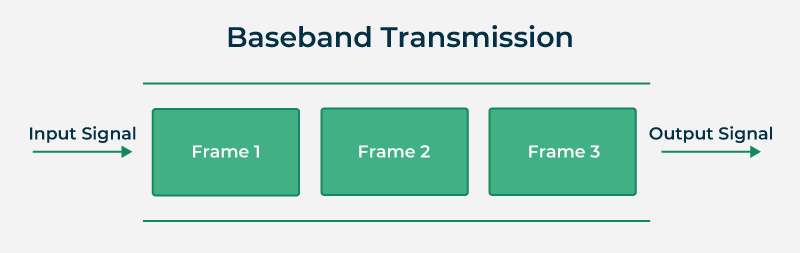
Baseband transmission is a method of sending a digital signal directly over a communication channel using the channel’s full available bandwidth. Instead of splitting the medium into multiple frequency bands, baseband systems typically send one signal at a time across the connection. It is a foundational concept in computer networking and digital communication. Traditional Ethernet networks, local-area networks (LANs), and many short-distance data links use baseband transmission because it is efficient, reliable, and relatively straightforward to implement.
What Is Baseband Transmission?
In baseband transmission, data is transmitted as electrical or optical pulses without shifting the signal to a higher carrier frequency. The original digital signal occupies the full bandwidth of the transmission medium.
For example, a network cable can carry a sequence of binary values—ones and zeros—as changing voltage levels or light pulses. The receiving device interprets those changes and reconstructs the transmitted data.
Because the channel is generally dedicated to one signal, devices commonly share it through timing, switching, or network access rules rather than by assigning each service a separate frequency range.
How Does It Work?
Baseband transmission starts with digital data, such as a file, voice packet, or network request. The data is converted into a signal that can travel through a physical medium, including copper wiring, fiber-optic cable, or a circuit board trace.
The typical process includes:
- Data encoding: Binary data is converted into an electrical or optical signal.
- Line coding: The signal is shaped into a format suitable for the transmission medium.
- Transmission: The signal travels through the entire available channel bandwidth.
- Reception and decoding: The receiving device identifies the signal pattern and converts it back into digital data.
The quality of a baseband connection depends on factors such as cable length, signal strength, interference, equipment quality, and the selected encoding method.
Common Baseband Transmission Methods
Baseband systems use line coding to represent digital bits accurately and maintain synchronization between sender and receiver.
- Non-Return-to-Zero (NRZ) – NRZ represents binary values with different voltage levels. It is simple and bandwidth-efficient, but long runs of identical bits can make clock synchronization more difficult.
- Manchester Encoding – Manchester encoding includes a transition in the middle of each bit period. This helps the receiver stay synchronized with the sender, making it useful for some Ethernet standards. Its trade-off is that it requires more bandwidth than simpler encoding methods.
- Differential Manchester Encoding – Differential Manchester encoding represents data through transitions rather than fixed voltage levels. It is more resistant to polarity reversal and supports reliable timing recovery.
- Pulse Amplitude Modulation (PAM) – Pulse Amplitude Modulation uses different signal amplitudes to represent multiple bit values. Modern Ethernet technologies use advanced PAM variants to increase data rates over existing cabling.
Baseband Transmission vs. Broadband Transmission
Baseband and broadband transmission use bandwidth differently.
| Feature | Baseband Transmission | Broadband Transmission |
|---|---|---|
| Channel use | One signal uses the full channel | Multiple signals use separate frequency bands |
| Signal type | Usually digital pulses | Often modulated carrier signals |
| Common use | LANs, Ethernet, short-range data links | Cable networks, radio, television, internet access |
| Complexity | Typically simpler | Requires frequency allocation and multiplexing |
| Capacity sharing | Managed by timing or network access | Managed through separate channels |
It is important not to confuse baseband transmission with the term “baseband internet.” In networking, baseband describes the signal transmission method, while broadband internet describes high-capacity connectivity services delivered through technologies such as cable, fiber, wireless, or satellite.
Advantages of Baseband Transmission
Baseband transmission remains widely used because it offers several benefits:
- Simple design: It does not require multiple carrier frequencies or complex frequency-division equipment.
- Efficient for local networks: It works well across short distances where dedicated high-speed communication is needed.
- Lower equipment cost: Baseband systems can often use simpler transmitters and receivers.
- Reliable data transfer: Proper line coding and error detection can support stable digital communication.
- Low latency: Direct signal transmission can reduce processing overhead in local connections.
Limitations of Baseband Transmission
Despite its strengths, baseband transmission may not be the best choice for every network. A single baseband channel does not naturally carry many separate services at once. Signal quality can also degrade over longer distances because of attenuation, noise, and interference. For this reason, repeaters, switches, or signal regeneration may be necessary as networks grow.
Broadband transmission is often more suitable when a provider must deliver many channels or services through a shared medium over a larger area.
Real-World Applications of Baseband Transmission
Baseband transmission supports a broad range of communication systems, including:
- Ethernet LANs in homes, offices, schools, and data centers
- Direct device-to-device communication links
- Internal connections on circuit boards
- Industrial control and automation networks
- Digital sensor and measurement systems
- Fiber-optic data connections
- Legacy coaxial Ethernet systems
In modern switched Ethernet networks, each device can have a dedicated link to a switch. This allows simultaneous communication across different links while each individual link still uses a baseband signal.
Conclusion
Baseband transmission is a core digital communication method that sends one signal directly across an entire channel. Its simplicity, low latency, and reliability make it especially valuable in Ethernet networks and short-distance data connections. By understanding baseband transmission and how it differs from broadband transmission, businesses and network users can make more informed decisions about communication technology, network design, and connectivity requirements.