Thread-Based Multitasking: Definition, How It Works, Benefits, and Examples
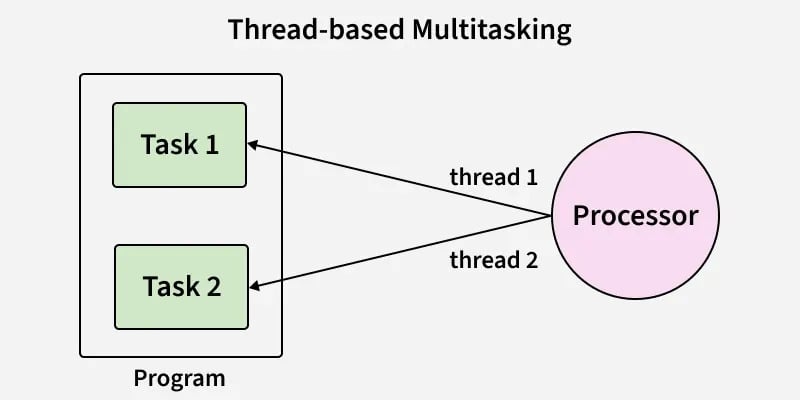
Thread-based multitasking is a programming and operating system technique that allows multiple threads within a single process to execute concurrently. Each thread represents an independent sequence of instructions, sharing the same process resources while maintaining its own execution state, stack, and program counter. This approach enables applications to perform multiple tasks simultaneously or concurrently, improving responsiveness, resource utilization, and overall performance. Thread-based multitasking is widely used in modern operating systems, web servers, database systems, and multithreaded applications.
Understanding how thread-based multitasking works, its advantages and limitations, and how it differs from process-based multitasking is essential for developers and system administrators working with modern computing environments.
What Is Thread-Based Multitasking?
Thread-based multitasking is a form of multitasking in which an operating system or runtime environment manages multiple threads within a single process. Instead of creating separate processes for individual tasks, an application divides its work into smaller execution units called threads.
A thread is the smallest unit of CPU execution that can be scheduled independently. Threads belonging to the same process share resources such as:
- Memory space: Threads share the process’s address space.
- Code section: All threads can execute instructions from the same program.
- Data section: Threads can access shared global and static variables.
- Open files: Threads can use file descriptors and other process-level resources.
- Process resources: Threads share resources allocated to their parent process.
However, each thread maintains its own program counter, CPU registers, stack, and execution state.
For example, a web browser may use separate threads to handle user input, render web pages, download files, and execute background operations. These activities can proceed concurrently without requiring a separate process for every task.
How Does It Work?
Thread-based multitasking works by dividing a program into multiple threads that can execute independently while sharing the resources of the same process.
The operating system’s thread scheduler determines when each thread receives CPU time. On a single-core processor, threads typically execute through rapid context switching, creating the appearance of simultaneous execution. On a multicore processor, multiple threads can execute in parallel on different CPU cores.
The process generally involves the following steps:
1. Thread Creation
When an application starts, it typically creates an initial thread. The application can then create additional threads to handle different tasks.
Each newly created thread receives its own execution context, including a stack and CPU register state.
2. Thread Scheduling
The operating system scheduler determines which threads should run and allocates CPU time to them based on scheduling policies and priorities.
Threads may move between different execution states, including:
- New: The thread has been created but has not started execution.
- Ready: The thread is waiting for CPU time.
- Running: The thread is currently executing.
- Blocked or Waiting: The thread is waiting for an event or resource.
- Terminated: The thread has completed execution.
3. Concurrent Execution
The scheduler allows multiple threads to make progress independently. Threads can perform different operations, such as processing user requests, handling network communication, or executing background calculations.
On multicore systems, threads may run simultaneously, increasing application throughput.
4. Resource Sharing and Synchronization
Because threads within the same process share memory and other resources, they can exchange information efficiently.
However, concurrent access to shared resources can create problems such as race conditions and data corruption.
Synchronization mechanisms, including mutexes, semaphores, locks, and condition variables, help coordinate thread execution and protect shared data.
5. Thread Termination
A thread terminates when it completes its assigned task or is explicitly stopped through an appropriate mechanism. Its execution resources can then be released or reclaimed by the operating system.
The remaining threads in the process may continue executing independently.
Advantages of Thread-Based Multitasking
Thread-based multitasking offers several benefits for modern software applications and operating systems.
- Improved Application Responsiveness: Applications can perform background operations without interrupting their primary activities. For example, a desktop application can continue responding to user input while another thread downloads files or processes data.
- Better CPU Utilization: Multiple threads can keep CPU cores busy by executing different tasks concurrently. This is particularly useful for applications with independent workloads.
- Lower Resource Consumption: Threads share the memory space and resources of their parent process. Creating multiple threads generally requires fewer resources than creating multiple independent processes.
- Faster Communication: Threads can communicate through shared memory without relying on more complex inter-process communication mechanisms. This makes exchanging information between related tasks more efficient, although synchronization is still necessary.
- Improved Scalability: Multithreaded applications can take advantage of multicore and multiprocessor systems. Developers can distribute workloads across multiple threads to improve performance as hardware capabilities increase.
- Efficient Background Processing: Applications can assign background activities to separate threads, including logging, file operations, data processing, and network communication. This helps prevent long-running operations from blocking the main application workflow.
Disadvantages of Thread-Based Multitasking
Despite its advantages, thread-based multitasking introduces several challenges.
- Synchronization Complexity: Multiple threads accessing shared data can cause race conditions, inconsistent results, and unexpected application behavior. Developers must use appropriate synchronization techniques to coordinate access to shared resources.
- Deadlocks: A deadlock occurs when two or more threads wait indefinitely for resources held by one another. For example, Thread A may hold Lock 1 while waiting for Lock 2, while Thread B holds Lock 2 and waits for Lock 1.
- Debugging Difficulties: Multithreaded applications can produce errors that are difficult to reproduce because thread execution order may change between runs. Race conditions and timing-related bugs can make debugging particularly challenging.
- Context-Switching Overhead: Switching between threads requires saving and restoring execution states. Creating too many threads can increase scheduling overhead and reduce overall performance.
- Shared Memory Risks: Since threads share the same address space, an error in one thread can affect shared application data or other threads. This makes proper memory management and synchronization essential.
Thread-Based Multitasking vs. Process-Based Multitasking
Thread-based and process-based multitasking are two approaches used by operating systems to execute multiple tasks.
The primary difference is that process-based multitasking uses multiple independent processes, while thread-based multitasking uses multiple threads within one or more processes.
| Feature | Thread-Based Multitasking | Process-Based Multitasking |
|---|---|---|
| Execution unit | Thread | Process |
| Memory space | Shared within a process | Separate address spaces by default |
| Resource sharing | Easier through shared memory | Requires IPC mechanisms |
| Creation overhead | Generally lower | Generally higher |
| Context switching | Generally lighter | Generally heavier |
| Communication | Shared memory and synchronization | Pipes, sockets, shared memory, and other IPC |
| Fault isolation | Lower between threads in the same process | Generally stronger between processes |
| Synchronization | Requires careful coordination | Also requires coordination when sharing resources |
| Example | Multiple threads in a web server | Multiple independent applications |
Both approaches are important in modern operating systems. Applications often combine process-based and thread-based multitasking to achieve better isolation, performance, and resource management.
Some Real-World Examples
Thread-based multitasking is commonly used across different computing environments.
- Web Servers: Web servers can use multiple threads to process incoming client requests concurrently. Each thread may handle a separate connection or request, allowing the server to serve multiple users efficiently.
- Web Browsers: Modern browsers use a combination of processes and threads to manage page rendering, JavaScript execution, network communication, and background operations.
- Database Management Systems: Database systems use threads to handle client connections, execute queries, manage transactions, and perform background maintenance.
- Video and Image Processing: Multithreaded applications can divide large processing tasks into smaller operations and distribute them across multiple CPU cores.
- Operating Systems: Modern operating systems use threads internally for tasks such as device management, background services, system operations, and application execution.
Thread-Based Multitasking in Modern Operating Systems
Most modern operating systems support multithreading as a fundamental execution mechanism.
- Windows: Supports kernel-level threads and provides APIs for creating and managing multithreaded applications.
- Linux: Uses kernel-managed tasks and supports multithreaded applications through interfaces such as POSIX Threads (pthreads).
- macOS: Provides multithreading support through technologies such as Grand Central Dispatch (GCD) and POSIX Threads.
- Android: Supports multithreading through Java and Kotlin concurrency APIs.
These platforms allow developers to build applications that perform multiple operations concurrently while taking advantage of modern multicore processors.
Best Practices for Implementing Thread-Based Multitasking
Developers should follow several best practices to build reliable and efficient multithreaded applications:
- Avoid unnecessary threads: Creating too many threads can increase memory consumption and scheduling overhead.
- Use thread pools: Reuse a predefined collection of worker threads instead of repeatedly creating and destroying threads.
- Protect shared resources: Use mutexes, locks, or other synchronization mechanisms when accessing shared data.
- Prevent deadlocks: Establish consistent lock acquisition orders and avoid holding locks longer than necessary.
- Minimize shared mutable state: Reducing shared data can help prevent race conditions and simplify synchronization.
- Monitor performance: Measure CPU utilization, memory consumption, thread count, and application response times.
- Handle thread termination properly: Ensure threads can complete or shut down safely without leaving resources unreleased.
Following these practices helps improve application stability, scalability, and performance.
Conclusion
Thread-based multitasking is an essential technique in modern computing that allows multiple threads within a single process to execute concurrently. By sharing memory and process resources, threads enable efficient communication, lower resource overhead, and improved application responsiveness. Although thread-based multitasking introduces challenges such as synchronization complexity, race conditions, and deadlocks, proper thread management and synchronization techniques can help overcome these issues.
From web servers and database systems to desktop applications and operating systems, thread-based multitasking plays a significant role in making modern software more efficient and responsive.