Asynchronous Transmission: How It Works, Benefits, and Applications
Asynchronous transmission is a method of sending data between devices without requiring a continuous shared clock signal. Instead, each unit of data—usually a character or byte—is sent independently with timing information added around it. This approach is a foundation of serial communication. It is widely used in UART connections, embedded systems, RS-232 interfaces, industrial equipment, and device debugging. Although newer communication technologies can transmit far more data, asynchronous transmission remains valuable because it is simple, dependable, and inexpensive to implement.
What Is Asynchronous Transmission?
In asynchronous transmission, data is transmitted one character or byte at a time. The sender and receiver agree in advance on settings such as:
- Baud rate
- Number of data bits
- Parity option
- Number of stop bits
Unlike synchronous transmission, the devices do not share a constant clock signal throughout the exchange. Instead, the receiver uses special bits at the beginning and end of each data unit to identify when data starts and stops.
Despite its name, asynchronous transmission still requires both devices to use compatible timing. They simply do not need to remain synchronized continuously between every character.
How Asynchronous Transmission Works
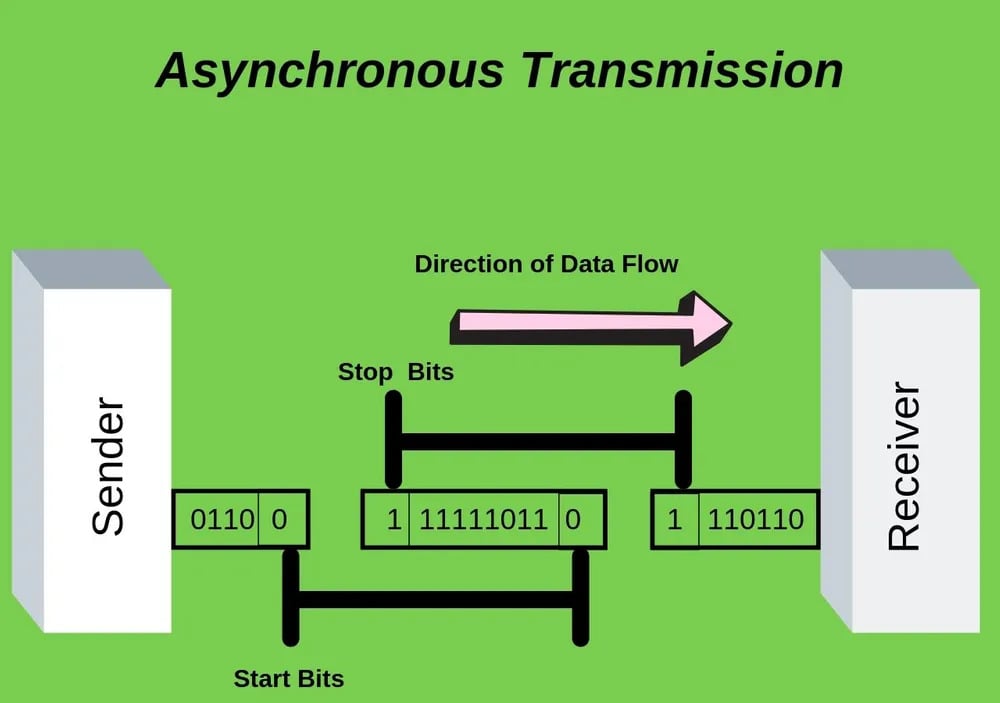
Each transmitted character is packaged into a small frame. A typical asynchronous serial frame contains the following parts:
- Start bit – The start bit tells the receiving device that a new character is beginning. It is usually represented by a logic low signal.
- Data bits – These bits carry the actual information. A frame commonly contains 7 or 8 data bits, though other configurations are possible.
- Optional parity bit – A parity bit can provide basic error detection. It helps identify whether a bit may have changed during transmission, but it does not correct the error.
- Stop bit or stop bits – Stop bits mark the end of the character and give the receiver time to prepare for the next one. They are generally represented by a logic high signal.
For example, an 8N1 configuration means:
- 8 data bits
- No parity bit
- 1 stop bit
This is one of the most common UART configurations.
Why Start and Stop Bits Matter
Start and stop bits make asynchronous transmission possible. When no data is being sent, the communication line stays in an idle state. The receiver watches for a change that signals a start bit, then samples the following data bits according to the agreed baud rate. At the end of the frame, the stop bit confirms that the character was received and that the line has returned to its idle state.
Because every character has its own start and stop markers, devices can send data at irregular intervals. This makes asynchronous transmission particularly useful for systems that send short messages, commands, sensor readings, or occasional updates.
Asynchronous vs. Synchronous Transmission
The primary difference between asynchronous and synchronous transmission is how devices coordinate timing.
| Feature | Asynchronous Transmission | Synchronous Transmission |
|---|---|---|
| Timing | Uses start and stop bits per character | Uses a shared or recovered clock |
| Data flow | Sends data as needed | Often sends continuous blocks or frames |
| Overhead | Higher because each character is framed | Lower per byte over large transfers |
| Complexity | Relatively simple | More complex |
| Best for | Short, intermittent messages | High-speed, continuous data streams |
Synchronous transmission is usually more efficient for large volumes of data because it avoids adding start and stop bits to every byte. However, asynchronous transmission is often the better choice when simplicity and low cost matter more than maximum throughput.
Advantages of Asynchronous Transmission
- Simple hardware design – Asynchronous serial communication can often be implemented with minimal hardware. UART modules are common in microcontrollers, making it easy to connect devices such as sensors, GPS receivers, modems, and serial consoles.
- Cost-effective communication – Because it does not require a separate continuous clock line, asynchronous transmission can reduce wiring and system complexity.
- Well suited to intermittent data – Many devices do not need to transmit information constantly. A temperature sensor, for example, may send a reading every few seconds. Asynchronous transmission handles this burst-style communication efficiently from a design perspective.
- Flexible and widely supported – UART-based asynchronous communication is supported by many computers, microcontrollers, development boards, and industrial devices. Its long history also makes it easy to troubleshoot with serial monitors and terminal tools.
Limitations of Asynchronous Transmission
- Lower efficiency – Start, stop, and optional parity bits create overhead. With an 8N1 frame, each 8-bit byte occupies 10 transmitted bits: one start bit, eight data bits, and one stop bit.
- Limited speed for demanding workloads – Asynchronous transmission works well for many applications, but high-bandwidth systems often use other technologies when they need faster or more efficient data transfer.
- Sensitivity to timing mismatch – The sender and receiver must use sufficiently similar baud rates. If their clocks differ too much, the receiver may sample bits at the wrong time and produce framing errors or corrupted data.
- Basic error detection only – Parity can detect some errors, but it is limited. Reliable protocols may add checksums, acknowledgments, retries, or stronger error-detection methods on top of the basic serial frame.
Common Applications of Asynchronous Transmission
Asynchronous transmission remains common across consumer, commercial, and industrial systems.
- UART communication – Universal Asynchronous Receiver-Transmitter (UART) interfaces are among the best-known examples. UART is commonly used for communication between a microcontroller and another device, such as a Wi-Fi module, Bluetooth module, display, or GPS receiver.
- RS-232 serial connections – RS-232 is a classic serial communication standard that frequently uses asynchronous transmission. It has been widely used in computers, networking equipment, point-of-sale systems, laboratory instruments, and industrial machinery.
- Embedded-system debugging – Developers often use an asynchronous serial connection to view diagnostic messages from a microcontroller. This makes UART an essential tool for testing firmware and identifying hardware issues.
- Industrial automation – Programmable logic controllers, sensors, meters, and control equipment may use asynchronous serial communication for configuration, monitoring, and command exchange.
- Peripheral communication – Some devices use asynchronous transmission to exchange short command-and-response messages with peripherals. This is useful when the system does not require continuous high-speed data transfer.
Example of an Asynchronous Data Frame
Suppose a device sends the letter “A” using an 8N1 serial configuration.
The frame includes:
- One start bit
- Eight data bits representing the character
- One-stop bit
The receiving device detects the start bit, samples each of the eight data bits at the configured baud rate, and verifies the stop bit at the end. If the frame is valid, the receiver converts the bit pattern back into the original character.
This process repeats for every character sent.
When Should You Use Asynchronous Transmission?
Asynchronous transmission is a strong choice when your system needs simple, low-cost communication and does not require high throughput. It is especially useful for:
- Microcontroller-to-module communication
- Serial configuration ports
- Device diagnostics
- Sensor readings
- Command-and-response systems
- Low-volume industrial data exchange
For large files, real-time video, high-speed networking, or continuous data streams, a more efficient synchronous or packet-based communication method may be more appropriate.
Conclusion
Asynchronous transmission is a practical serial communication method that sends independently framed characters using start and stop bits. Its simplicity, low hardware cost, and broad compatibility make it a lasting choice for UART connections, embedded devices, industrial systems, and diagnostic tools. While it is less efficient than synchronous transmission for large, continuous data streams, asynchronous transmission remains ideal for systems that exchange small amounts of data at irregular intervals.