Code Division Multiplexing (CDM): How It Works, Benefits and Examples
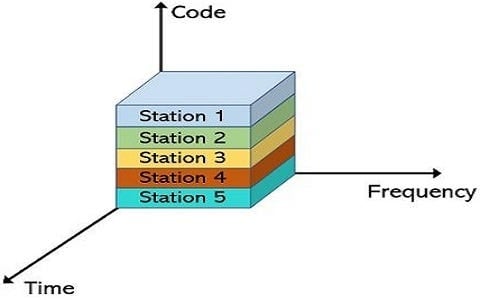
Code division multiplexing (CDM) is a communication technique that allows several signals to use the same transmission channel at the same time. Instead of giving each user a separate time slot or frequency band, CDM assigns every signal a unique code. The receiver uses the matching code to recover the intended signal from the combined transmission. This makes CDM useful in wireless networks, GPS, satellite communication, and other systems where spectrum efficiency and interference resistance are important.
What Is Code Division Multiplexing?
In code division multiplexing, each data stream is spread across the available channel with a distinct code sequence. All encoded streams are transmitted together. At the receiver, the system uses the correct code to isolate the intended signal from the shared transmission.
In simple terms, CDM separates users by code rather than by time, frequency, or a physical connection.
CDM is closely related to code division multiple access (CDMA), a technique used to let many users communicate over the same network resources.
How Does Code Division Multiplexing Work?
CDM uses codes designed to be distinguishable from one another. Ideally, these codes are orthogonal, meaning they do not interfere with each other when processed correctly.
The process generally works as follows:
- Each user or device receives a unique spreading code.
- The transmitter combines its data with that code.
- Multiple encoded signals are sent through the same channel simultaneously.
- The receiver applies the code associated with the desired signal.
- The original data is recovered while other coded signals are reduced as interference.
For example, imagine several people speaking in the same room, each in a different language. A listener who understands only one language can focus on the conversation they recognize. In CDM, the unique code acts like a recognizable language.
CDM vs. Other Multiplexing Techniques
| Technique | How signals are separated | Common use |
|---|---|---|
| Time division multiplexing (TDM) | Different time slots | Digital telephony |
| Frequency division multiplexing (FDM) | Different frequency bands | Radio and cable TV |
| Wavelength division multiplexing (WDM) | Different light wavelengths | Fiber-optic networks |
| Code division multiplexing (CDM) | Different codes | CDMA and GPS |
Unlike TDM, CDM does not require users to wait for a dedicated time slot. Unlike FDM, it does not assign each user an exclusive frequency band. Instead, all users can operate simultaneously across the same bandwidth.
Advantages of Code Division Multiplexing
- Efficient use of bandwidth – CDM allows multiple users to share the same spectrum at the same time. This can make channel use more efficient, particularly when transmission demand changes frequently.
- Resistance to interference – Because CDM signals are spread across a wider bandwidth, narrowband interference affects only part of the transmitted signal. The receiver can often reduce the impact of that interference during signal recovery.
- Supports simultaneous communication – Multiple devices can transmit at the same time without needing separate time slots or frequencies. This is especially valuable in shared wireless environments.
- Improved privacy – A spread signal can resemble background noise to a receiver without the right code. However, code division multiplexing should not be considered a replacement for encryption.
- Useful in multipath environments – Wireless signals may arrive through several paths after reflecting from buildings, terrain or other objects. CDM systems can use these separate signal paths to improve reliability.
Limitations of Code Division Multiplexing
Despite its advantages, CDM requires careful system design.
- The near-far problem – A strong nearby transmitter can overpower a weaker, more distant signal. Even if both signals use different codes, the receiver may struggle to detect the weaker one.
- Multiple-access interference – As more users share the same channel, interference between coded signals can increase. This may reduce signal quality and limit the practical number of supported users.
- Complex receivers – CDM systems need accurate synchronization, code management, and signal processing. This makes them more complex than some simpler multiplexing methods.
- Power control requirements – Wireless CDMA systems often require precise power control so that no device transmits much more strongly than another.
Real-World Applications of CDM
- Cellular networks – CDMA-based cellular networks used code division techniques to allow many subscribers to share the same radio spectrum.
- GPS – GPS satellites transmit on shared frequencies but use different pseudo-random noise codes. A GPS receiver identifies individual satellites by matching their assigned codes.
- Satellite communication – Satellite systems can use CDM to support multiple data streams over limited spectrum resources.
- Military and secure communication – Spread-spectrum communication is useful where resistance to interference and lower detectability are important. Strong encryption is still necessary for secure communications.
- Wireless and IoT systems – Code-based spreading continues to be relevant in specialized wireless links, low-power devices, and shared-spectrum research.
CDM, CDMA and Spread Spectrum: What’s the Difference?
These terms are related but have slightly different meanings:
- Code division multiplexing (CDM): The general technique of separating signals with unique codes.
- Code division multiple access (CDMA): An application of CDM that enables multiple users to share one communication channel.
- Spread spectrum: A method that spreads a signal over a wider bandwidth than the original data requires. CDMA commonly uses spread-spectrum techniques.
Conclusion
Code division multiplexing enables multiple signals to share a communication channel by assigning each one a unique code. Its ability to support simultaneous access, improve spectrum use, and resist some types of interference has made it important in CDMA networks, GPS and satellite communications. The main principle is straightforward: instead of dividing the channel by time or frequency, CDM divides it by code.