Datagram Network: How It Works, Benefits, and Real-World Uses
A datagram network is a type of packet-switched network that sends data without first establishing a dedicated connection between devices. Each packet—called a datagram—travels independently and includes the addressing information needed to reach its destination. The Internet Protocol (IP) is the best-known example of a datagram-based network. This approach makes networks flexible and resilient, but it can also result in delayed, lost, duplicated, or out-of-order packets.
What Is a Datagram Network?
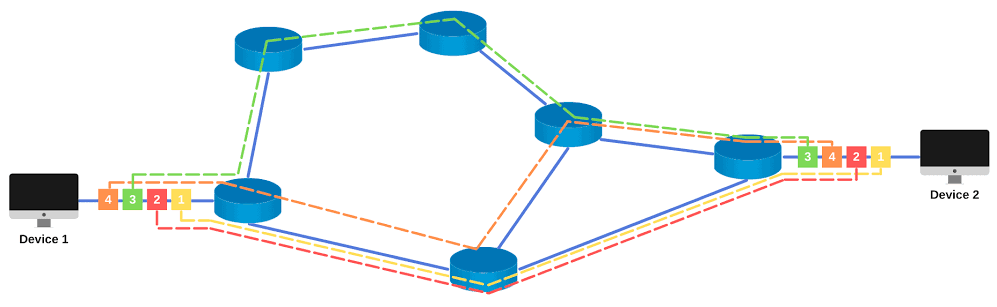
In a datagram network, a sender divides information into small packets called datagrams. Every datagram contains a destination address, and routers use that address to forward it toward the receiving device.
Unlike a connection-oriented network, the sender does not reserve a path or establish a session before transmitting data. Routers can make forwarding decisions for each packet individually, so two datagrams from the same message may follow different routes.
A datagram network is often described as a connectionless network because delivery does not require a pre-established connection.
How Does It Work?
The basic process is straightforward:
- An application creates data to send.
- The network divides the data into datagrams.
- Each datagram receives source and destination addressing information.
- Routers forward each datagram based on current routing information.
- The receiving device reassembles or processes the datagrams.
Because routers can choose routes dynamically, a network can work around congestion or failures. However, the network itself generally does not guarantee that packets will arrive in the correct order—or arrive at all.
Key Characteristics of Datagram Networks
A datagram network has several defining features:
- Connectionless delivery: No setup phase is required before sending information.
- Independent routing: Each datagram can take a different route.
- No delivery guarantee: Packets can be dropped, delayed, duplicated, or delivered out of sequence.
- Addressing in every packet: Each datagram carries enough information for routers to forward it.
- Best-effort service: The network attempts delivery but does not promise reliability by itself.
Higher-level protocols can add reliability when needed. For example, TCP uses IP underneath while adding sequencing, acknowledgments, retransmissions, and flow control.
Datagram Network vs. Virtual Circuit Network
A datagram network differs from a virtual circuit network in how it manages paths and connections.
| Feature | Datagram Network | Virtual Circuit Network |
|---|---|---|
| Connection setup | Not required | Required before sending data |
| Path selection | Can vary for each packet | Usually fixed for the session |
| Router state | Minimal per-flow state | Routers maintain connection state |
| Delivery order | Not guaranteed | More likely to be maintained |
| Example | Internet Protocol (IP) | Frame Relay, ATM |
Datagram networks prioritize flexibility and scalability. Virtual circuit networks prioritize predictable paths and more controlled traffic handling.
Advantages of Datagram Networks
- Flexibility – Packets can be rerouted when a path becomes unavailable or congested. This helps networks remain functional during outages.
- Scalability – Routers do not need to maintain detailed state for every active connection. That makes datagram networking well suited to large, distributed networks such as the Internet.
- Efficient for Short Communications – Applications can send a small amount of data immediately without waiting for connection setup. This is useful for DNS lookups, online games, voice traffic, and IoT device communication.
- Resilience – Since packets can take alternate paths, a single failed link does not necessarily interrupt all communication between two devices.
Some Disadvantages
The flexibility of a datagram network also creates challenges:
- Packets may arrive out of order.
- Some packets may be lost during congestion.
- Duplicate packets may occasionally occur.
- Applications may need to handle retransmission or reassembly.
- Real-time traffic can be affected by variable delay, also called jitter.
For applications that require complete and ordered data—such as web pages, file transfers, or email—reliability is commonly handled by TCP or another protocol above IP.
Common Uses of Datagram Networks
Datagram networks support a wide range of modern services, including:
- Internet communication: IP routes packets between networks worldwide.
- Domain Name System (DNS): Many DNS queries use UDP datagrams for fast request-response exchanges.
- Streaming and online gaming: Applications may prefer low latency over perfect delivery.
- Voice and video calls: Real-time media often uses UDP because retransmitting an old packet may be less useful than continuing playback.
- Internet of Things (IoT): Lightweight devices benefit from low-overhead communication.
- Network monitoring: Protocols such as SNMP often use datagram-based transport.
Datagram Network Example
Suppose a user sends a message through an online chat app. The message may be split into multiple packets before leaving the user’s device. Each packet is addressed to the chat service and forwarded by routers across several networks. One packet might travel through Router A and Router B, while another might use Router A and Router C due to changing network conditions. If the application needs every part of the message in order, a higher-level protocol ensures the data is reconstructed correctly.
Conclusion
A datagram network sends independently routed packets without requiring a dedicated connection. Its connectionless design makes it scalable, adaptable, and resilient—qualities that helped make the modern internet possible. While datagram networks do not guarantee delivery or packet order, protocols such as TCP can add those protections when applications need them. Understanding the datagram network model is essential for anyone learning how internet communication, routing, and packet switching work.