Multiple Access Protocols: Types, Working Principles, and Real-World Applications
Multiple access protocols are fundamental communication rules that allow multiple devices to share the same transmission medium efficiently. In modern computer networks, wireless systems, and telecommunications, these protocols help avoid collisions, improve bandwidth utilization, and ensure reliable data transmission. From Ethernet and Wi-Fi to satellite and mobile networks, multiple access protocols are used everywhere data communication occurs. Understanding how they work is essential for students, network engineers, and IT professionals.
What Are Multiple Access Protocols?
Multiple access protocols are techniques used in networking that enable multiple devices or users to access and share a common communication channel. When several devices attempt to transmit data simultaneously over the same medium, data collisions can occur. Multiple access protocols manage these transmissions by coordinating channel access and minimizing interference.
These protocols are mainly used in:
- Local Area Networks (LANs)
- Wireless networks
- Cellular communication systems
- Satellite communication
- Shared broadband environments
Why Multiple Access Protocols Are Important
Without proper channel access control, networks would experience frequent collisions, congestion, and packet loss. Multiple access protocols provide several advantages:
- Efficient bandwidth utilization
- Reduced transmission collisions
- Improved network performance
- Fair resource allocation
- Better scalability
- Reliable communication between devices
They are critical in environments where many devices share a single communication medium.
Main Categories of Multiple Access Protocols
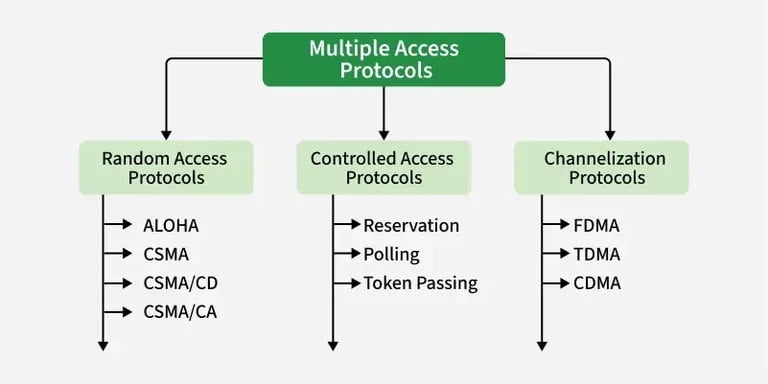
Multiple access protocols are generally divided into three major categories: Random Access Protocols, Controlled Access Protocols, and Channelization Protocols.
1. Random Access Protocols
In random access methods, devices can transmit data whenever they have data to send. Since transmissions are not centrally controlled, collisions may occur. These protocols rely on collision detection or collision avoidance mechanisms.
Characteristics of Random Access Protocols:
- Decentralized communication
- Simple implementation
- Suitable for bursty traffic
- Possible packet collisions
- Dynamic channel sharing
2. Controlled Access Protocols
Controlled access methods coordinate communication more strictly to avoid collisions entirely. Devices must obtain permission before transmitting.
3. Channelization Protocols
Channelization divides the communication channel into multiple portions so several users can communicate simultaneously.
Comparison of Multiple Access Protocols
| Protocol | Collision Handling | Medium Type | Efficiency | Common Usage |
|---|---|---|---|---|
| ALOHA | Retransmission | Wireless | Low | Early wireless systems |
| CSMA/CD | Collision detection | Wired | Moderate | Ethernet |
| CSMA/CA | Collision avoidance | Wireless | High | Wi-Fi |
| Token Passing | Collision-free | Wired | High | Token Ring |
| FDMA | Separate frequencies | Wireless | Moderate | Radio systems |
| TDMA | Time slots | Wireless | High | GSM |
| CDMA | Unique codes | Wireless | Very High | 3G networks |
| OFDMA | Orthogonal subcarriers | Wireless | Excellent | LTE, 5G |
Applications of Multiple Access Protocols
Multiple access techniques are essential in many technologies.
Computer Networks
Ethernet and LAN systems use CSMA/CD and switched communication methods.
Wireless Networks
Wi-Fi networks rely heavily on CSMA/CA.
Mobile Communication
Cellular technologies use:
- FDMA
- TDMA
- CDMA
- OFDMA
Satellite Communication
Satellite systems often implement TDMA and FDMA.
Internet of Things (IoT)
IoT devices use lightweight access protocols for efficient communication in dense environments.
Challenges in Multiple Access Protocols
Despite their advantages, multiple access protocols face several challenges:
- Network congestion
- Scalability limitations
- Synchronization issues
- Hidden terminal problems
- Interference management
- Latency optimization
- Security concerns
Modern research focuses on improving efficiency for high-density wireless networks and 5G/6G communication systems.
Future Trends in Multiple Access Technologies
The evolution of networking technologies continues to drive innovation in channel access methods.
Emerging trends include:
- AI-driven network optimization
- Dynamic spectrum allocation
- Massive IoT access protocols
- Non-Orthogonal Multiple Access (NOMA)
- 6G wireless communication
- Ultra-low latency protocols
These advancements aim to support billions of connected devices with faster and more reliable communication.
Conclusion
Multiple access protocols are essential building blocks of modern communication systems. They enable multiple users and devices to share communication resources efficiently while minimizing collisions and maximizing performance. From early ALOHA systems to advanced OFDMA used in 5G networks, these protocols have evolved significantly to meet growing networking demands. Understanding multiple access protocols helps network professionals design scalable, reliable, and high-performance communication systems across wired and wireless environments.