Parallel Transmission in Computer Networks: How It Works, Benefits, and Examples
Parallel transmission is a method of sending multiple bits of data at the same time through separate communication paths. Instead of moving one bit after another over a single channel, a sender uses several channels simultaneously. This approach can transfer a complete group of bits – such as a byte – during one clock cycle. In computer networking, parallel transmission helped shape early high-speed connections between nearby devices and components. It is still useful in specific short-distance applications, although most modern network links use serial transmission because it is more practical over long distances.
This guide explains parallel transmission in computer networks, how it works, its advantages and disadvantages, and where it is used today.
What Is Parallel Transmission?
Parallel transmission is a data communication technique in which several bits travel simultaneously on separate wires, lines, or channels. For example, an 8-bit parallel connection can send all eight bits of one byte at the same time. Think of it as an eight-lane highway: eight vehicles can travel side by side toward the same destination. Serial transmission, by contrast, is like a one-lane road where vehicles travel one behind another.
For parallel transmission to work reliably, the receiving device must identify which bits belong together. A shared clock signal or timing mechanism keeps the sender and receiver synchronized.
How Parallel Transmission Works
Parallel transmission divides a data unit into individual bits and assigns each bit to its own path. The receiving device collects those bits at the other end and reconstructs the original data.
Here is a simple example using one byte:
| Bit position | Data sent | Transmission path |
|---|---|---|
| 7 | 1 | Line 1 |
| 6 | 0 | Line 2 |
| 5 | 1 | Line 3 |
| 4 | 1 | Line 4 |
| 3 | 0 | Line 5 |
| 2 | 0 | Line 6 |
| 1 | 1 | Line 7 |
| 0 | 0 | Line 8 |
All eight bits leave the sender together. Ideally, they reach the receiver together as well. In real systems, small timing differences between lines can cause one bit to arrive earlier or later than the others. This issue is known as clock skew or signal skew.
The longer the cable and the faster the signal, the harder it becomes to keep every line perfectly synchronized. That limitation is one reason serial links became dominant in modern networking.
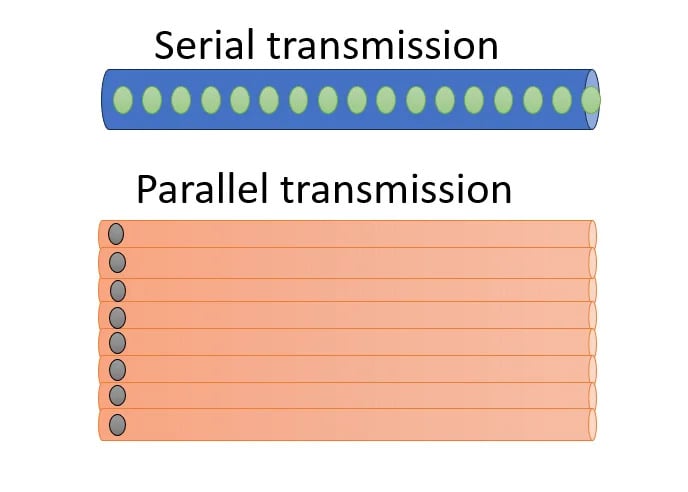
Parallel Transmission vs. Serial Transmission
| Feature | Parallel transmission | Serial transmission |
| Data movement | Multiple bits at once | One bit at a time per channel |
| Number of wires | Multiple data lines | Usually one pair or a small number of lines |
| Best distance | Short distances | Short and long distances |
| Timing challenge | High; lines must remain synchronized | Lower; timing is recovered from the serial signal |
| Cable size and cost | Usually higher | Usually lower |
| Modern network use | Limited and specialized | Very common |
It may seem that sending multiple bits simultaneously must always be faster. In practice, modern serial connections can operate at extremely high signaling rates and may use multiple lanes. This lets them outperform older parallel systems while using fewer wires and avoiding severe skew problems.
Advantages of Parallel Transmission
- High Throughput Over Short Distances – Because multiple bits move at once, parallel transmission can move large amounts of data in a single clock cycle. This was especially valuable in early computer buses and peripheral interfaces.
- Simple Concept for Grouped Data – A byte, word, or other group of bits can be placed on separate lines and read as one unit. This makes the design intuitive for communication between nearby hardware components.
- Useful for Internal Computer Connections – Short traces on a circuit board are easier to match and synchronize than long external cables. Parallel designs have therefore been common inside computers and other electronic equipment.
Disadvantages of Parallel Transmission
- Signal Skew – Individual wires can have slightly different lengths or electrical properties. As a result, bits that were sent together may not arrive at exactly the same moment. The receiver can then read an incorrect value if the timing window is too small.
- More Wires and Larger Cables – Every extra bit requires another data line. A parallel cable may also need control, timing, and grounding lines, making it bulky and more expensive than a comparable serial cable.
- Electromagnetic Interference and Crosstalk – Signals traveling close together can interfere with one another. As data rates rise, this crosstalk can reduce reliability and require additional shielding or stricter cable design.
- Limited Distance – Parallel links work best over short, controlled connections. Longer runs amplify timing and noise problems, which make the technology less suitable for typical Ethernet networks and wide-area connections.
Is Ethernet Parallel or Serial?
Modern Ethernet is primarily based on high-speed serial signaling over twisted-pair copper or fiber-optic links. However, some Ethernet standards use multiple physical pairs or lanes at the same time to increase total capacity.
That does not make Ethernet a traditional parallel bus. Each lane is engineered as a high-speed serial channel, and the system coordinates the lanes to deliver the required network speed. This approach combines high performance with better distance, reliability, and cable efficiency than classic parallel transmission.
When Should Parallel Transmission Be Used?
Parallel transmission is most appropriate when:
- Devices are physically close together.
- The connection needs to carry several bits simultaneously.
- Cable or board routing can be precisely controlled.
- The benefits of a wide data path outweigh the added cost and complexity.
For most external computer networks, serial technologies such as Ethernet, fiber links, USB, and SATA are the better choice. They are simpler to cable, more resilient over distance, and capable of very high data rates.
Key Takeaway
Parallel transmission sends multiple bits simultaneously across separate paths. It can provide strong performance for short-distance communication, especially inside computers and tightly controlled hardware systems. Its main drawbacks – signal skew, cable complexity, interference, and distance limits – explain why serial transmission is the standard for most modern networks.