Parse Server: Complete Guide to the Open-Source Backend Platform
Parse Server is an open-source backend-as-a-service (BaaS) platform that helps developers build, manage, and scale mobile, web, and IoT applications faster. Originally created by Parse, Inc. and later released as an open-source project after Facebook acquired Parse, Parse Server provides a flexible alternative to proprietary backend solutions. With features such as database management, user authentication, cloud functions, file storage, push notifications, and APIs, Parse Server allows developers to focus on building applications instead of creating backend infrastructure from scratch. This article explains what Parse Server is, how it works, its features, benefits, architecture, and common use cases.
What Is Parse Server?
Parse Server is a Node.js-based open-source backend framework that provides ready-to-use backend services through APIs. It allows developers to connect applications to databases and access backend functionality without manually writing complex server-side code.
Unlike traditional backend development, where developers must create authentication systems, database APIs, and server logic independently, Parse Server provides these capabilities out of the box.
Parse Server supports applications built with:
- Mobile platforms: iOS and Android
- Web applications
- IoT devices
- JavaScript applications
- Cross-platform frameworks
Developers can host Parse Server on their own infrastructure, giving them full control over data, security, and customization.
How Does ItWork?
Parse Server acts as a middleware layer between an application and a database.
The basic workflow is:
- A client application sends a request to Parse Server.
- Parse Server processes the request using APIs and business logic.
- Data is stored or retrieved from the connected database.
- Parse Server sends the response back to the application.
A typical architecture includes:
Client Application → Parse Server → Database → Response
Parse Server commonly uses:
- REST API
- GraphQL API
- JavaScript SDK
- Mobile SDKs
Key Features of Parse Server
1. Database Management
Parse Server simplifies database operations by providing an object-based data model.
Developers can create, read, update, and delete data using simple APIs.
Example data objects include:
- Users
- Products
- Messages
- Posts
- Transactions
Parse Server supports databases such as:
- MongoDB
- PostgreSQL
2. User Authentication
Parse Server provides built-in user management features.
Developers can easily implement:
- User registration
- Login systems
- Password recovery
- Session management
- Role-based permissions
Authentication providers can include:
- Email/password
- Social login providers
- Custom authentication systems
3. Cloud Functions
Cloud Functions allow developers to execute server-side code without managing separate backend services.
Common uses include:
- Data validation
- Payment processing
- Custom business logic
- Automated workflows
Example:
A shopping application can use a Cloud Function to automatically calculate discounts when a user places an order.
4. File Storage
Parse Server supports file handling for applications that need to store:
- Images
- Videos
- Documents
- User uploads
Files can be stored using:
- Local storage
- Cloud storage providers
5. Push Notifications
Parse Server includes support for sending push notifications.
Applications can send notifications for:
- Messages
- Updates
- Marketing campaigns
- Alerts
It supports mobile notification services such as:
- Apple Push Notification Service (APNs)
- Firebase Cloud Messaging (FCM)
6. GraphQL Support
Parse Server provides GraphQL capabilities, allowing developers to query data more efficiently.
Advantages of GraphQL include:
- Flexible queries
- Reduced data transfer
- Improved API performance
GraphQL is useful for applications with complex data relationships.
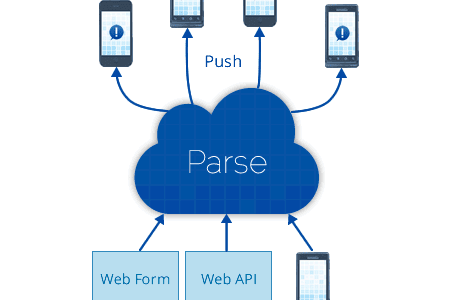
Parse Server Architecture
A typical Parse Server environment contains several components:
Client SDK
The client application communicates with Parse Server using SDKs.
Examples:
- JavaScript SDK
- Android SDK
- iOS SDK
Parse Server Core
The main backend engine handles:
- API requests
- Authentication
- Database operations
- Cloud code execution
- Security rules
Database Layer
The database stores application data.
Common choices include:
- MongoDB
- PostgreSQL
Dashboard
Developers can manage applications using the Parse Dashboard interface.
The dashboard allows:
- Viewing database records
- Managing users
- Monitoring applications
- Creating queries
Advantages of Using Parse Server
1. Open Source and Flexible
Because Parse Server is open source, developers can:
- Modify the source code
- Customize backend behavior
- Host it anywhere
This reduces dependency on a single cloud provider.
2. Faster Development
Parse Server provides many backend features immediately.
Developers do not need to build:
- Authentication systems
- API layers
- Database models
- Notification systems
This speeds up application development.
3. Self-Hosting Capability
Unlike many BaaS platforms, Parse Server can run on your own servers.
Benefits include:
- Full data ownership
- Custom infrastructure
- Better control over privacy
4. Scalable Architecture
Parse Server can scale with growing applications by using:
- Multiple server instances
- Database optimization
- Cloud hosting platforms
It can support both small projects and large production systems.
Parse Server vs Firebase
Parse Server and Firebase are both backend platforms, but they have different approaches.
| Feature | Parse Server | Firebase |
|---|---|---|
| Source code | Open source | Proprietary |
| Hosting | Self-hosted or cloud | Google Cloud |
| Database | MongoDB/PostgreSQL | Firestore/Realtime Database |
| Customization | High | Limited |
| Backend control | Full control | Managed service |
| Learning curve | Moderate | Easier for beginners |
Parse Server is often preferred by developers who need more control over infrastructure and data.
Some Common Use Cases
Mobile Applications
Parse Server is widely used for:
- Social apps
- Messaging apps
- Productivity tools
- Mobile games
Web Applications
Developers use Parse Server for:
- SaaS platforms
- Online marketplaces
- Community websites
IoT Applications
Parse Server can manage:
- Device data
- User accounts
- Real-time events
Prototypes and Startups
Startups use Parse Server to quickly build minimum viable products (MVPs).
Installing Parse Server
A basic Parse Server setup usually involves:
- Installing Node.js
- Installing Parse Server package
- Connecting a database
- Configuring security settings
- Deploying the server
Example installation:
npm install -g parse-serverStart a server:
parse-server --appId YOUR_APP_ID --masterKey YOUR_MASTER_KEYParse Server Security Best Practices
To protect applications, developers should:
- Enable class-level permissions
- Use role-based access control
- Protect master keys
- Validate user input
- Encrypt sensitive data
- Monitor API usage
Security configuration is essential because self-hosted backends require proper management.
Some Limitations
Although Parse Server is powerful, it has some challenges:
Requires Server Management
Unlike fully managed backend platforms, developers must handle:
- Hosting
- Updates
- Scaling
- Security
Database Knowledge Needed
Managing MongoDB or PostgreSQL may require additional expertise.
Smaller Ecosystem
Compared with large cloud platforms, Parse Server has a smaller ecosystem and community.
Future of Parse Server
Parse Server continues to be maintained as an open-source backend solution. Its flexibility makes it attractive for developers who want:
- Backend control
- Data ownership
- Custom infrastructure
- Reduced vendor lock-in
As applications increasingly require scalable and customizable backends, open-source BaaS platforms like Parse Server remain valuable alternatives.
Conclusion
Parse Server is a powerful open-source backend platform that simplifies application development by providing APIs, authentication, database management, cloud functions, and notifications. Its self-hosting capability and flexibility make it an excellent choice for developers who want more control than traditional managed backend services.
Whether building a mobile app, web platform, IoT solution, or startup MVP, Parse Server provides a reliable foundation for creating modern applications with a customizable backend architecture.