Point Coordination Function (PCF): How It Works in Wi‑Fi Networks
Point Coordination Function (PCF) is a legacy IEEE 802.11 Wi‑Fi medium-access method designed to give an access point more predictable control over when devices transmit. Instead of letting every device compete for airtime, the access point polls devices and grants them turns to send data. PCF was intended to support time-sensitive traffic such as voice and video by reducing collisions and making access to the wireless channel more orderly. Although it is important for understanding the history and design of Wi‑Fi quality of service, it was optional and saw little real-world deployment.
What is Point Coordination Function?
Point Coordination Function, commonly shortened to PCF, is a centralized medium access control mechanism in IEEE 802.11 wireless LANs.
In a typical Wi‑Fi network, laptops, phones, cameras, and other stations share the same wireless channel. If multiple devices attempt to transmit simultaneously, their transmissions can interfere. PCF addresses this by assigning a Point Coordinator—normally the wireless access point (AP)—to control access to the medium.
Rather than allowing stations to contend freely for airtime, the point coordinator polls stations one at a time. A station transmits only after receiving permission through a polling frame.
Early IEEE 802.11 documentation describes PCF as an optional access method that operates above the Distributed Coordination Function (DCF), using a point coordinator to decide which station may transmit.
How PCF Works
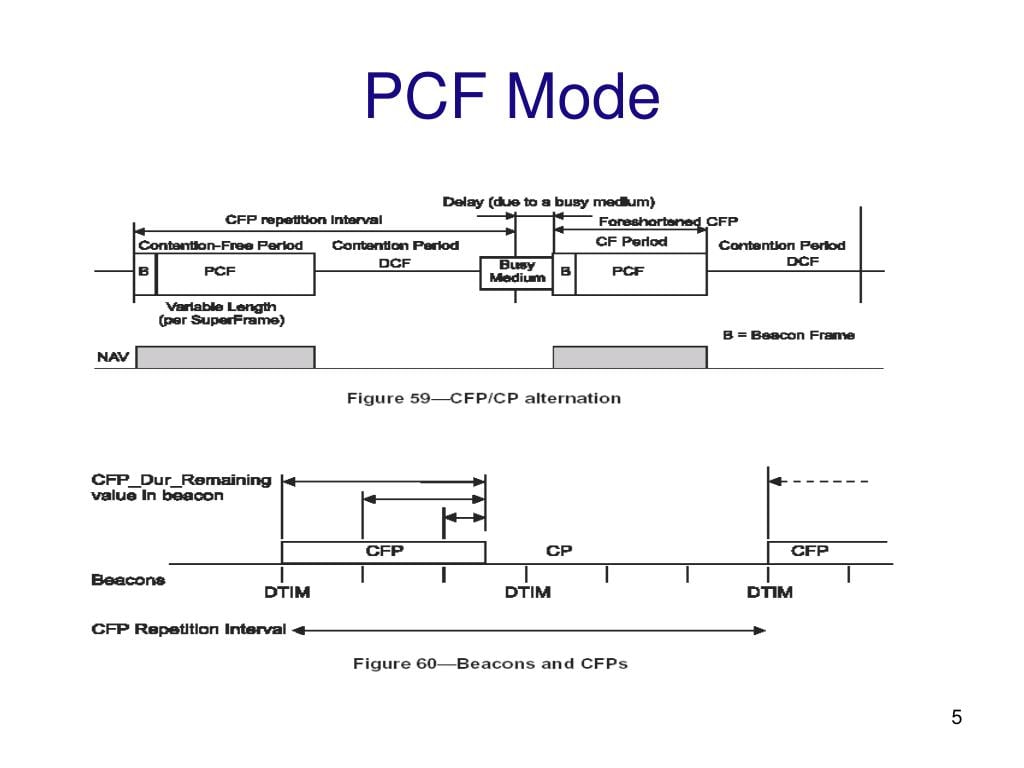
Point Coordination Function divides time into repeating intervals that include two distinct phases:
- Contention-Free Period (CFP): The access point controls the medium and polls eligible stations.
- Contention Period (CP): Devices use the normal contention-based DCF method.
At the beginning of a contention-free period, the access point sends a beacon that announces the CFP. Other stations recognize that the channel is under centralized control and avoid competing for access.
The point coordinator then moves through a polling list. A typical sequence looks like this:
- The access point polls a station.
- The station sends data if it has data waiting.
- If it has nothing to send, it returns a null response.
- The access point acknowledges the transmission and polls the next station.
- Once the CFP ends, the network returns to ordinary contention-based access.
This approach is often compared with a moderator calling on people in a meeting: rather than everyone speaking at once, each participant speaks when invited.
Why Point Coordination Function Has Priority Over DCF
PCF uses a shorter waiting period called the PCF Interframe Space (PIFS). DCF stations normally wait for the longer Distributed Interframe Space (DIFS) before trying to transmit.
Because PIFS is shorter than DIFS, the point coordinator can access an idle channel before stations using DCF can begin contention. This timing advantage lets the access point retain control during the contention-free period.
In simple terms:
| Access method | Who controls transmission? | Typical behavior |
|---|---|---|
| PCF | Access point / point coordinator | Polling-based and centrally scheduled |
| DCF | All stations | Devices contend for airtime using CSMA/CA |
PCF vs. DCF
The main difference between Point Coordination Function and Distributed Coordination Function is who makes the access decision.
With DCF, each device independently listens for an idle channel, waits, selects a random backoff period, and then attempts transmission. This distributed approach is flexible and forms the foundation of conventional Wi‑Fi operation.
With PCF, the access point coordinates each station’s opportunity to transmit. This can reduce contention during the CFP and make channel access more predictable.
PCF’s advantages include:
- More controlled access to the wireless medium
- Lower risk of collisions during the contention-free period
- More predictable transmission opportunities
- Potential suitability for delay-sensitive traffic
However, PCF also has important drawbacks:
- Polling introduces overhead, especially when stations have no data to send.
- The access point becomes responsible for scheduling.
- Support was optional, so interoperability was limited.
- It was not broadly implemented in commercial Wi‑Fi equipment.
Was PCF Used for Voice and Video Traffic?
PCF was designed with traffic requiring predictable timing in mind. Voice calls, video streams, and industrial data can be negatively affected by variable delay, jitter, and collisions.
By reserving a contention-free period and polling stations, PCF could offer more orderly access than a purely contention-based network. However, PCF did not become the mainstream answer for Wi‑Fi quality of service.
Later IEEE 802.11 quality-of-service work focused on other mechanisms, including the Hybrid Coordination Function (HCF). The IEEE 802.11 Working Group’s 2018 revision activity also recorded approval to remove PCF from the draft revision, reflecting its legacy status.
Why Point Coordination Function Is Rarely Used Today
PCF is mainly a historical and educational concept in modern networking. Several factors limited adoption:
- Optional implementation – Neither access points nor client devices were universally required to support PCF. A feature that depends on both sides supporting it is difficult to deploy broadly.
- Added complexity – Polling, contention-free periods, and station management add implementation complexity compared with normal distributed access.
- Limited practical benefit – For many Wi‑Fi environments, DCF and later QoS enhancements provided a more practical balance between performance, cost, and compatibility.
- Evolution of Wi‑Fi standards – Newer Wi‑Fi technologies and scheduling approaches have shifted attention away from classic PCF. Current IEEE 802.11 work focuses on advances in throughput, latency, reliability, and modern spectrum use rather than making PCF a central deployment model.
A Simple PCF Example
Imagine a wireless network with an access point and three devices: a security camera, a voice handset, and a laptop.
During a PCF contention-free period:
- The access point sends a beacon to start the period.
- It polls the security camera, which sends a video packet.
- It polls the voice handset, which sends voice data.
- It polls the laptop, which has no queued data and sends a null response.
- The access point ends the CFP.
- All devices then return to normal DCF-based contention.
The key idea is that each device gets a controlled opportunity to transmit instead of competing simultaneously.
Key Takeaway
Point Coordination Function was an early IEEE 802.11 approach to making Wi‑Fi access more predictable. By letting an access point poll stations during a contention-free period, PCF could reduce contention and support time-sensitive traffic. In practice, optional support, polling overhead, and the emergence of newer Wi‑Fi QoS mechanisms kept PCF from becoming widely deployed. For network students and engineers, PCF remains useful because it illustrates the trade-off between distributed access and centrally coordinated scheduling in wireless networks.