Radio Transmission: How Wireless Communication Travels Through the Air
Radio transmission is one of the most important technologies in modern communication. It enables information to travel wirelessly through electromagnetic waves, making possible everything from AM/FM radio broadcasting and television to mobile phones, Wi-Fi, satellite communications, and emergency services. As the foundation of wireless networking and telecommunications, radio transmission allows devices to communicate over short and long distances without requiring physical cables. In this article, we will explore radio transmission, how it works, its different types, advantages, limitations, and practical applications.
What Is Radio Transmission?
Radio transmission is the process of sending information through radio waves, a type of electromagnetic radiation. These waves carry signals from a transmitter to a receiver through the atmosphere or space.
The transmitted information may include:
- Voice communications
- Audio broadcasts
- Video signals
- Digital data
- Control commands
Radio transmission operates across a wide range of frequencies within the radio frequency (RF) spectrum, typically from 3 kHz to 300 GHz.
How Does It Work?
Radio transmission involves several key components working together to transfer information wirelessly.
1. Signal Generation
The process begins with information such as:
- Voice
- Music
- Video
- Computer data
This information is converted into an electrical signal.
2. Modulation
The electrical signal is combined with a high-frequency carrier wave using a technique called modulation.
Common modulation methods include:
- Amplitude Modulation (AM)
- Frequency Modulation (FM)
- Phase Modulation (PM)
3. Transmission
The modulated signal is amplified and sent to an antenna. The antenna converts electrical energy into radio waves that propagate through space.
4. Propagation
Radio waves travel through:
- Air
- Vacuum
- Atmospheric layers
The signal may travel directly, reflect off objects, or bounce from the ionosphere, depending on frequency and environmental conditions.
5. Reception
A receiving antenna captures the radio waves and converts them back into electrical signals.
6. Demodulation
The receiver removes the carrier wave and extracts the original information for playback or processing.
Basic Radio Transmission System
A typical radio communication system includes:
Information Source
        ↓
   Modulator
        ↓
   Transmitter
        ↓
     Antenna
        ↓
   Radio Waves
        ↓
Receiving Antenna
        ↓
    Receiver
        ↓
  Demodulator
        ↓
 Destination
Each component plays a critical role in ensuring reliable communication.
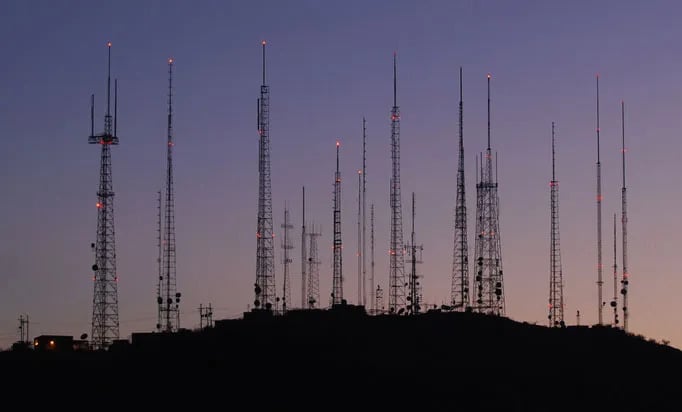
Types of Radio Transmission
Radio transmission can be classified based on signal type, propagation method, and communication purpose.
Analog Radio Transmission
Analog systems transmit continuously varying signals.
Examples include:
- AM radio
- FM radio
- Traditional television broadcasting
Characteristics:
- Simpler technology
- More susceptible to noise
- Lower spectral efficiency
Digital Radio Transmission
Digital systems transmit information as binary data.
Examples include:
- Digital television
- Wi-Fi networks
- Cellular communications
- Digital radio broadcasting
Characteristics:
- Better signal quality
- Improved security
- Efficient bandwidth usage
- Error correction capabilities
Radio Wave Propagation Methods
Radio transmission relies on different propagation mechanisms.
Ground Wave Propagation
Ground waves follow the Earth’s surface.
Features:
- Effective at low frequencies
- Common in AM broadcasting
- Reliable for medium-distance communication
Skywave Propagation
Skywaves are reflected by the ionosphere back to Earth.
Benefits:
- Long-distance communication
- International radio broadcasting
- Amateur radio operations
Line-of-Sight Propagation
Signals travel directly between antennas.
Common applications:
- Cellular networks
- Wi-Fi
- Microwave communication
- Television broadcasting
Satellite Propagation
Signals are transmitted through satellites orbiting Earth.
Uses include:
- GPS systems
- Satellite TV
- Global communications
- Weather monitoring
Radio Frequency Spectrum
The radio spectrum is divided into several frequency bands.
| Band | Frequency Range | Common Applications |
|---|---|---|
| VLF | 3–30 kHz | Navigation systems |
| LF | 30–300 kHz | Maritime communication |
| MF | 300 kHz–3 MHz | AM radio |
| HF | 3–30 MHz | Shortwave radio |
| VHF | 30–300 MHz | FM radio, TV |
| UHF | 300 MHz–3 GHz | Mobile networks, Wi-Fi |
| SHF | 3–30 GHz | Radar, satellite communication |
| EHF | 30–300 GHz | Advanced wireless systems |
Each frequency band offers different coverage, penetration, and bandwidth characteristics.
Advantages of Radio Transmission
Radio transmission provides numerous benefits.
Wireless Connectivity
No physical cables are required, reducing infrastructure costs.
Wide Coverage
Radio signals can cover:
- Buildings
- Cities
- Countries
- Entire continents
Mobility Support
Users can communicate while moving.
Examples include:
- Smartphones
- Vehicle communication systems
- Public safety networks
Rapid Deployment
Wireless systems can be installed faster than wired networks.
Scalability
Networks can easily expand by adding transmitters and receivers.
Disadvantages of Radio Transmission
Despite its advantages, radio transmission has limitations.
Signal Interference
Signals may be affected by:
- Weather conditions
- Buildings
- Electronic devices
- Other radio transmissions
Limited Spectrum Availability
Frequency bands are finite and regulated by government agencies.
Security Concerns
Wireless signals can potentially be intercepted if not properly encrypted.
Signal Attenuation
Radio waves weaken over distance and may require repeaters or amplifiers.
Applications of Radio Transmission
Radio transmission powers many modern technologies.
Broadcasting
Examples:
- AM radio
- FM radio
- Digital radio
- Television broadcasting
Mobile Communications
Cellular technologies use radio transmission extensively.
Examples include:
- 4G networks
- 5G networks
- Mobile voice services
Wireless Networking
Radio transmission enables:
- Wi-Fi
- Bluetooth
- Wireless LANs
- IoT devices
Emergency Services
Critical communication systems rely on radio technology.
Used by:
- Police departments
- Fire services
- Ambulance networks
- Disaster response teams
Satellite Communications
Supports:
- Navigation systems
- Satellite television
- Space communications
- Global internet access
Military Applications
Radio transmission is vital for:
- Tactical communication
- Radar systems
- Command and control networks
- Electronic warfare systems
Radio Transmission in Modern Networking
Modern wireless networks depend heavily on radio transmission.
Examples include:
Wi-Fi Networks
Wi-Fi uses radio frequencies to connect devices to local networks.
Benefits:
- Fast deployment
- Flexible connectivity
- High-speed internet access
Cellular Networks
Mobile operators use radio transmission to connect smartphones and other wireless devices.
Internet of Things (IoT)
Smart devices communicate using radio technologies such as:
- Zigbee
- LoRaWAN
- Bluetooth Low Energy (BLE)
- NB-IoT
5G Networks
Fifth-generation mobile networks use advanced radio transmission techniques to deliver:
- Ultra-fast speeds
- Low latency
- Massive device connectivity
Best Practices for Effective Radio Transmission
Organizations can improve radio communication performance by:
- Selecting appropriate frequency bands
- Using high-quality antennas
- Minimizing interference sources
- Implementing signal encryption
- Conducting regular maintenance
- Optimizing transmitter power levels
These practices help maximize coverage, reliability, and security.
Future of Radio Transmission
Radio transmission continues to evolve with emerging technologies.
Key trends include:
- 5G and beyond
- 6G research
- Cognitive radio systems
- Software-defined radio (SDR)
- Massive IoT deployments
- Satellite internet networks
- AI-driven spectrum management
These innovations will further enhance wireless communication capabilities worldwide.
Conclusion
Radio transmission is the backbone of modern wireless communication, enabling the transfer of voice, video, and data through radio waves. From traditional broadcasting and cellular networks to Wi-Fi, IoT, and satellite communications, radio transmission supports countless technologies that keep people and devices connected. As wireless technologies continue to advance with 5G, software-defined radio, and next-generation communication systems, radio transmission will remain a critical component of global connectivity and digital transformation.