Rate Adaptation in Wireless Networks: How Wi‑Fi Chooses the Best Data Rate
Rate adaptation is the process a wireless device uses to select the best transmission rate for current radio conditions. Rather than transmitting every packet at a fixed speed, a Wi‑Fi client or access point continually adjusts its modulation, coding, and related transmission settings to balance speed, reliability, and delay. It is one of the reasons Wi‑Fi can remain usable when a person walks between a laptop and an access point, when interference appears, or when devices move farther from the router. The highest advertised Wi‑Fi speed is not always the best choice. A slightly lower physical-layer rate that sends packets successfully on the first try can deliver more real-world throughput than an aggressive rate that creates retries and packet loss.
What is rate adaptation?
In wireless networking, rate adaptation—also called rate control or link adaptation—is a feedback-driven mechanism that chooses a transmission mode for each device and, in some implementations, for individual packets.
A transmission mode may combine several settings, including:
- Modulation and coding scheme (MCS)
- Channel width
- Guard interval
- Number of spatial streams
- Transmit power
- Retry behavior
The goal is not simply to select the largest number of megabits per second. The goal is to maximize useful data delivered over time while keeping errors, retransmissions, and latency within acceptable limits.
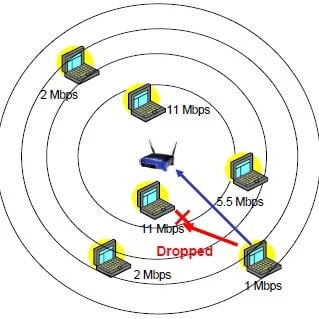
For example, a client close to an access point may reliably use a high-order modulation and multiple spatial streams. As that client moves away or encounters interference, the same setting may produce failed frames. Rate adaptation detects the poorer results and selects a more robust option.
Why fixed wireless data rates perform poorly
Wireless channels change constantly. Signal quality can be affected by distance, walls, people, reflections, neighboring networks, device orientation, and competing traffic. A rate that works well one second can be inefficient moments later.
Using a fixed high rate may cause excessive retries when the channel worsens. Using a fixed low rate avoids some errors, but consumes more airtime than necessary and reduces capacity for every device sharing the channel.
Rate adaptation solves this trade-off by observing actual link behavior. In a typical Wi‑Fi system, the sender uses transmission feedback—such as acknowledgments, failed attempts, and retry counts—to estimate which supported rates are working best.
How rate adaptation works in Wi‑Fi
Although implementations vary by chipset, driver, and vendor, most rate adaptation systems follow a similar loop:
- Measure link performance. The transmitter records successful frames, failed frames, retry counts, signal information, and sometimes channel-quality indicators.
- Estimate each rate’s value. It calculates whether a particular rate is likely to deliver more useful data than the alternatives.
- Choose a primary rate. The algorithm selects the rate, or MCS, expected to provide the best throughput or reliability.
- Build a fallback plan. If the first attempt fails, the radio can retry at one or more alternative rates.
- Probe other rates. The system occasionally tests rates that are not currently preferred, so it can discover when conditions improve.
This exploration matters. If a device only used its current “safe” rate, it might never notice that the channel is now clean enough to support a faster one.
The signals used for rate adaptation
Rate control algorithms can rely on several inputs. No single metric is perfect, so strong designs usually combine direct transmission results with radio measurements.
Packet delivery success
Acknowledged transmissions provide direct evidence that a given setting worked. Repeated failures or retries are strong signals that the selected rate may be too aggressive.
Throughput estimate
A low rate can have an excellent delivery probability but still be a poor choice because each frame stays on the air for longer. Effective throughput considers both the chance of success and the time required to transmit.
A simplified concept is:
Expected throughput = probability of success × useful data delivered ÷ transmission time
This is why “the most reliable rate” and “the fastest rate” are not necessarily the same answer.
Signal quality and SNR
Received signal strength indicator (RSSI) and signal-to-noise ratio (SNR) can help predict whether a link can sustain a mode. However, signal strength alone can be misleading because multipath, hidden-node collisions, and bursty interference can cause losses even with a strong signal.
Retries and frame error rate
A rising retry count may indicate a weak link, interference, congestion, or collisions. The challenge is identifying the cause. Dropping the rate helps when noise or fading causes errors, but it may not solve contention from many devices sharing the same channel.
Mobility and channel variation
A stationary desktop often has stable conditions. A phone in motion can experience fast changes in fading and signal level. Mobile environments require algorithms that respond quickly without overreacting to one unlucky packet.
Common rate adaptation approaches
Threshold-based algorithms
Early and simple systems use thresholds. For example, an algorithm may step down after a defined number of failures and step up after a defined number of successes.
These approaches are easy to implement, but they can be slow to recover from change and may confuse collision-related loss with poor radio quality.
Loss-based algorithms
Loss-based designs use frame failures, retries, or packet delivery ratio to choose rates. They work well when failures strongly correlate with channel quality, but can make poor decisions in busy networks where collisions—not weak signal—cause loss.
Signal-based algorithms
Signal-based rate adaptation maps RSSI or SNR values to a recommended rate. This can react quickly, especially when a device moves, but the mapping is highly environment-dependent.
A strong RSSI reading does not guarantee a low-error channel, particularly in reflective indoor spaces or congested spectrum.
Throughput-driven algorithms
Throughput-based systems estimate how much data each option can deliver over time, then prefer the setting with the best expected result. They commonly use sampling to test alternatives and moving averages to give greater weight to recent performance.
Minstrel, a widely documented Linux Wi‑Fi rate-control algorithm, is an example of this approach: it maintains per-peer rate statistics, estimates throughput, uses a retry chain, and probes alternatives instead of assuming a slower rate is always more reliable.
Machine-learning-assisted adaptation
Newer research explores contextual and machine-learning approaches that use richer signals and can adapt to complex radio conditions. The practical trade-off is clear: more sophisticated decisions may improve performance, but they need reliable data, careful testing, and enough processing headroom.
Rate adaptation vs. adaptive modulation and coding
The terms are closely related but not identical.
Adaptive modulation and coding (AMC) changes the physical-layer format, such as modulation order and coding strength. Rate adaptation is the broader decision process that selects among available transmission modes using link feedback.
In modern Wi‑Fi, the chosen rate may be represented by an MCS index, but the overall decision can also involve channel width, spatial streams, and retry settings. In cellular networks, link adaptation similarly selects coding and modulation based on channel feedback, scheduling, and quality targets.
Why rate adaptation affects user experience
Good rate adaptation improves more than peak throughput. It can influence:
- Video-call stability and jitter
- Cloud application responsiveness
- Gaming latency
- Battery efficiency on mobile devices
- Total Wi‑Fi capacity in dense environments
- Roaming performance as clients move between access points
Poor rate adaptation can create a frustrating pattern: the device reports a strong Wi‑Fi signal, but applications still feel slow. The issue may be an unsuitable MCS choice, excessive retries, hidden-node interference, congestion, or a client that is slow to respond to changing conditions.
How to improve its performance
Network administrators typically cannot tune every device’s rate-control algorithm directly, but they can improve the environment in which it operates.
- Improve access point placement – Place access points where clients have a clean, usable signal path. Avoid enclosing an AP in cabinets, placing it near large metal objects, or concentrating all coverage in one corner of a building.
- Reduce co-channel interference – Too many nearby networks on the same channel raise contention and collisions. Plan channels carefully, especially in apartments, offices, classrooms, and venues with many access points.
- Match channel width to the environment – Wider channels can raise peak throughput, but they may be more vulnerable to interference and leave fewer clean channel choices in a dense deployment. A narrower, cleaner channel can outperform a wider, congested one.
- Keep infrastructure and clients current – Access-point firmware, wireless drivers, and client operating systems can affect compatibility, roaming, and radio behavior. Test updates before broad deployment, especially in business-critical networks.
- Diagnose airtime, retries, and latency—not just RSSI – A high signal reading does not prove that the link is healthy. Monitor retransmission rates, airtime utilization, latency, packet loss, and client distribution alongside RSSI.
Conclusion
Rate adaptation is the intelligence that lets wireless devices trade raw speed for dependable delivery in real time. Effective algorithms do not simply chase the highest advertised rate; they learn from actual transmission results, balance exploration with stability, and use fallbacks when conditions change. For network teams, the practical lesson is equally important: rate adaptation works best when the wireless environment is well designed. Clean spectrum, appropriate access-point placement, sensible channel planning, and modern client devices give the algorithm better choices—and give users faster, more reliable connectivity.