Resilient Packet Ring (RPR): Definition, How It Works, Benefits, and Applications
A Resilient Packet Ring (RPR) is a network technology designed to transport data efficiently over a ring topology while providing high bandwidth utilization, fast fault recovery, and reliable network connectivity. Standardized as IEEE 802.17, RPR was developed to address the limitations of traditional ring networks, particularly in metropolitan area networks (MANs) that require high performance and network resilience. Unlike conventional ring networks, which may reserve bandwidth for protection or allow traffic to travel in only one direction, Resilient Packet Ring technology uses intelligent bandwidth management and protection mechanisms to improve network efficiency. It supports data traffic such as IP packets and Ethernet frames while maintaining connectivity when a network link or node fails. In this article, we will explore what Resilient Packet Ring is, how it works, its key features, advantages, limitations, and common applications.
What Is Resilient Packet Ring (RPR)?
Resilient Packet Ring (RPR) is a Layer 2 networking technology standardized by the Institute of Electrical and Electronics Engineers (IEEE) under the IEEE 802.17 standard. It is designed to provide efficient packet transport over a bidirectional ring network.
RPR combines the benefits of ring-based network architecture with packet-switching capabilities. It enables multiple nodes to share ring bandwidth dynamically, reducing wasted capacity and improving overall network performance.
The technology was primarily designed for metropolitan and regional networks that need to transport large amounts of data between geographically distributed locations.
Key characteristics of Resilient Packet Ring include:
- Ring topology: Network nodes are connected in a ring configuration.
- Bandwidth efficiency: Spatial reuse allows bandwidth to be reused across different sections of the ring.
- Fault tolerance: Protection mechanisms help maintain connectivity when links or nodes fail.
- Quality of Service (QoS): Traffic can receive different levels of priority based on service requirements.
- Packet-based transmission: The network efficiently transports packet traffic, including IP and Ethernet data.
- Distributed control: Nodes coordinate access to shared ring resources.
These characteristics make RPR suitable for networks that require reliable, efficient, and scalable packet transport.
How Does It Work?
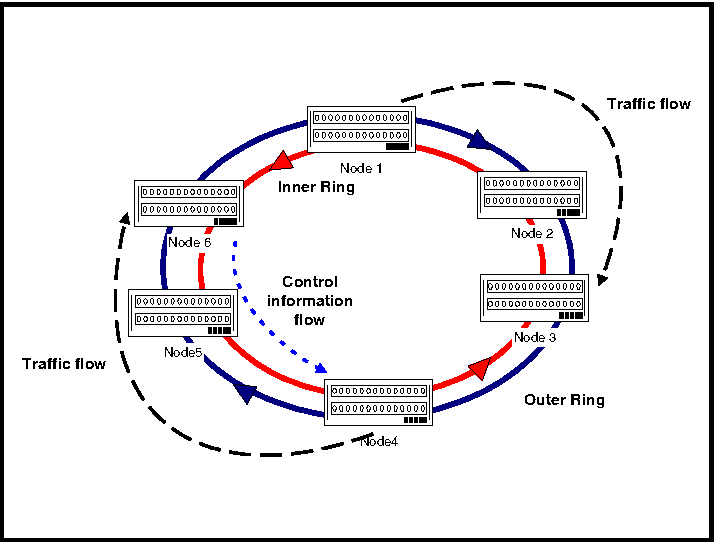
Resilient Packet Ring operates by connecting network nodes through two counter-rotating rings. Each node can transmit and receive traffic using the ring infrastructure, while distributed mechanisms manage bandwidth allocation and traffic forwarding.
1. Dual Counter-Rotating Rings
An RPR network typically consists of two rings:
- Ringlet 0: Carries traffic in one direction around the ring.
- Ringlet 1: Carries traffic in the opposite direction.
The counter-rotating design provides alternative paths for traffic and supports network protection when a link or node fails.
Under normal conditions, the network can use both ringlets to transport traffic. If a failure occurs, protection mechanisms can redirect affected traffic through an alternative route.
2. Packet Transmission
When a node receives data to transmit, it determines the destination and selects an appropriate ringlet and route.
The packet travels through intermediate nodes until it reaches the destination. Nodes along the path inspect forwarding information and handle traffic according to the network’s configuration and resource-management rules.
Unlike traditional circuit-oriented transport systems, RPR is designed to transport packet traffic efficiently and allocate bandwidth according to demand.
3. Spatial Reuse
One of the most important features of RPR is spatial reuse.
In a conventional shared ring, traffic may consume network resources even after passing its intended destination. This can reduce the capacity available to other nodes.
RPR addresses this problem by allowing a node to remove traffic from the ring when it reaches its destination. The released capacity can then be reused by other nodes on the remaining ring segments.
For example, if Node A sends data to Node C, the traffic can be removed at Node C. Nodes beyond Node C can then use the available bandwidth for other transmissions.
Spatial reuse improves overall ring utilization, particularly when traffic flows between nearby nodes rather than across the entire ring.
4. Bandwidth Management
RPR includes distributed bandwidth-management mechanisms that help nodes share ring capacity.
The IEEE 802.17 architecture defines different service classes to support traffic with varying performance requirements. These classes distinguish among traffic that requires reserved bandwidth, traffic that can use excess capacity, and lower-priority traffic.
This approach helps the network accommodate multiple applications while managing congestion.
5. Fault Detection and Recovery
Network failures can occur when a fiber link is damaged, a node becomes unavailable, or a network component stops functioning correctly.
RPR uses protection mechanisms to maintain connectivity by redirecting traffic around a failed segment or node when the topology permits.
Depending on the failure and protection method, traffic can be rerouted over the opposite ringlet. This helps reduce service interruptions and improve network availability.
Some Key Features
Resilient Packet Ring incorporates several features designed to improve network performance and reliability.
1. High Bandwidth Utilization
RPR uses spatial reuse and distributed bandwidth management to make more effective use of available ring capacity.
Instead of dedicating bandwidth exclusively to individual connections, the network can allocate resources dynamically according to traffic demand and service requirements.
2. Fast Protection Switching
RPR supports protection mechanisms intended to restore connectivity quickly after network failures.
Its dual-ring architecture provides an alternative path that can help maintain communication without requiring a completely separate physical network.
Actual recovery performance depends on the implementation, topology, and failure conditions.
3. Quality of Service (QoS)
RPR supports multiple traffic classes, enabling different types of data to receive appropriate treatment.
For example, latency-sensitive voice traffic may require different handling from bulk data transfers or best-effort internet traffic.
QoS mechanisms help network operators manage congestion and prioritize important applications.
4. Spatial Bandwidth Reuse
Spatial reuse allows multiple transmissions to use different segments of the ring simultaneously when their paths do not conflict.
This capability increases aggregate network capacity beyond what would be possible if every transmission occupied the entire ring.
5. Distributed Network Control
RPR uses distributed mechanisms for functions such as bandwidth management and topology discovery.
This reduces reliance on a single central controller for certain network operations and helps nodes coordinate access to ring resources.
6. Support for Packet-Based Services
RPR was designed to transport packet traffic efficiently, making it suitable for networks carrying IP-based services, Ethernet traffic, and other data applications.
It was particularly relevant during the transition from traditional circuit-based metropolitan transport networks to packet-oriented infrastructure.
Advantages of Resilient Packet Ring
Resilient Packet Ring offers several advantages for network environments that require efficient bandwidth utilization and protection against failures.
- Improved Bandwidth Efficiency – Spatial reuse allows bandwidth to be reused on different ring segments. This can increase aggregate capacity and reduce the inefficiencies associated with conventional shared-ring designs.
- Enhanced Network Resilience – The dual-ring architecture provides alternative paths for traffic. When a link fails, the network can use protection mechanisms to maintain connectivity where an alternate route is available.
- Efficient Packet Transport – RPR was designed for packet-oriented traffic, making it suitable for carrying data services across metropolitan networks.
- Support for Different Traffic Priorities – Multiple service classes help network operators manage traffic with different bandwidth, latency, and priority requirements.
- Reduced Need for Separate Protection Infrastructure – Because the ring architecture incorporates protection mechanisms, RPR can provide resilience without necessarily requiring an entirely separate physical network for every protected connection.
The actual infrastructure savings depend on network design and protection requirements.
Limitations of Resilient Packet Ring
Despite its advantages, Resilient Packet Ring has several limitations.
- Limited Adoption in Modern Networks – RPR was developed to address metropolitan Ethernet and packet transport requirements during an earlier stage of network evolution. Many operators have since adopted technologies such as Ethernet ring protection, MPLS-based transport, and Carrier Ethernet solutions. Consequently, RPR is less common in newly deployed networks than many newer alternatives.
- Ring Topology Constraints – RPR depends on a ring-based architecture. Although ring networks can provide efficient transport and protection, they may be less flexible than mesh or other topologies when connecting complex, geographically distributed infrastructure.
- Implementation Complexity – Configuring bandwidth allocation, traffic priorities, topology behavior, and protection mechanisms requires appropriate planning and operational expertise.
- Hardware and Ecosystem Availability – Because RPR has a smaller role in modern network deployments, finding compatible equipment, ongoing vendor support, and specialized technical expertise may be more difficult than for widely deployed Ethernet and IP networking technologies.
- Alternative Technologies May Be More Suitable – Modern Ethernet transport, MPLS, and other packet-networking technologies can provide comparable or more appropriate capabilities depending on requirements such as scalability, interoperability, service isolation, and operational simplicity.
Resilient Packet Ring vs. Traditional Ring Networks
Although both technologies use ring topologies, RPR introduces packet-oriented mechanisms to improve bandwidth utilization and resilience.
| Feature | Resilient Packet Ring | Traditional Ring Networks |
|---|---|---|
| Network architecture | Dual counter-rotating rings | Varies by technology |
| Data transport | Packet-oriented | May use circuit-oriented or packet-oriented transport |
| Bandwidth utilization | Supports spatial reuse | Depends on the specific ring technology |
| Fault recovery | Uses ring protection mechanisms | Depends on the protection architecture |
| Traffic management | Supports multiple service classes | Varies by technology |
| Resource allocation | Distributed bandwidth management | May use fixed or dynamically allocated resources |
| Typical historical use | Metropolitan packet transport | Access, transport, and other ring-based networks |
The comparison depends on which traditional ring technology is being considered. Not every conventional ring uses fixed bandwidth allocation or lacks effective protection.
Resilient Packet Ring vs. Ethernet Ring Protection
Resilient Packet Ring and Ethernet ring protection both address the challenges of providing reliable connectivity over ring topologies, but they serve different architectural purposes.
Resilient Packet Ring defines a packet-ring architecture with distributed bandwidth management, multiple service classes, spatial reuse, and protection mechanisms.
Ethernet ring protection, including mechanisms standardized by ITU-T G.8032, focuses on preventing loops in Ethernet ring networks while enabling rapid recovery after certain failures.
Key differences include:
- Bandwidth utilization: RPR incorporates spatial reuse and distributed bandwidth management into its architecture.
- Ethernet integration: Ethernet ring protection works with Ethernet bridging and associated ring-control mechanisms.
- Network deployment: Ethernet ring protection is more relevant to many contemporary Ethernet access and aggregation deployments.
- Technology ecosystem: Equipment availability and vendor support often favor Ethernet-based solutions in modern networks.
The appropriate choice depends on existing infrastructure, traffic requirements, protection objectives, and long-term support considerations.
Is Resilient Packet Ring Still Used Today?
Resilient Packet Ring remains an important networking concept for understanding the development of packet-based metropolitan transport systems. However, its practical use in new deployments is limited compared with more widely adopted modern technologies.
Several factors have contributed to this shift:
- Ethernet technologies have become increasingly capable and cost-effective.
- MPLS and other packet transport technologies provide flexible traffic engineering and service separation.
- Modern optical transport systems offer high-capacity links for metropolitan and long-distance networks.
- Ethernet ring protection provides established mechanisms for protecting ring-based Ethernet deployments.
- Network operators often prefer technologies with broader equipment availability and vendor support.
Whether RPR remains relevant in a particular environment depends on the installed equipment, operational requirements, and availability of technical support.
Organizations maintaining legacy RPR infrastructure should evaluate compatibility, replacement options, and long-term support requirements before planning a migration.
Conclusion
Resilient Packet Ring (RPR) is a networking technology designed to improve bandwidth utilization, fault tolerance, and packet transport efficiency in ring-based networks. Standardized as IEEE 802.17, it introduced capabilities such as spatial reuse, distributed bandwidth management, multiple service classes, and protection using counter-rotating rings. Although RPR played a role in the evolution of metropolitan packet networks, its use in new deployments has declined as Ethernet protection, MPLS, and modern optical transport technologies have become more prevalent. Understanding RPR remains valuable for network engineers, telecommunications professionals, and IT students studying ring topologies, network resilience, and the evolution of packet-based transport infrastructure.