Serial Transmission: How It Works, Types, Benefits, and Uses
Serial transmission is a method of sending data one bit at a time over a communication channel. It is widely used in computers, industrial equipment, networking devices, embedded systems, and telecommunications because it can transfer information reliably with fewer physical connections than parallel transmission. Whether data travels between a microcontroller and a sensor, from a computer to a peripheral device, or across a long-distance network, serial communication often provides an efficient and cost-effective solution.
What Is Serial Transmission?
In serial transmission, bits are transmitted sequentially through a single communication line or a small set of lines. For example, instead of sending eight bits at once through eight separate wires, serial transmission sends those eight bits one after another.
A simple data sequence might look like this:
1 → 0 → 1 → 1 → 0 → 0 → 1 → 0
The receiving device reads the bits in the correct order and reconstructs the original data.
Serial transmission is especially useful when devices are separated by distance. Fewer wires reduce cost, simplify installation, and help limit interference between signals.
How Does It Work?
A serial transmission system usually includes:
- A sending device, which converts data into a serial bit stream
- A communication medium, such as a cable, circuit trace, fiber-optic link, or wireless signal
- A receiving device, which interprets the incoming bits and rebuilds the original information
To communicate accurately, both devices must agree on rules known as a communication protocol. These rules define factors such as data speed, timing, bit order, error checking, and the beginning and end of each message.
The data rate is commonly measured in bits per second (bps). Higher speeds allow more information to move in less time, although system design, cable quality, distance, and interference can affect performance.
Types of Serial Transmission
Serial transmission is generally divided into three main types: asynchronous, synchronous, and isochronous transmission.
Asynchronous Serial Transmission
Asynchronous serial transmission sends data one character or byte at a time. Each unit usually includes a start bit, data bits, an optional parity bit, and one or more stop bits.
Because every byte carries its own timing markers, the sender and receiver do not need to share a continuous clock signal.
Common uses include:
- UART communication
- RS-232 connections
- GPS modules
- Microcontrollers and development boards
- Legacy computer peripherals
Asynchronous transmission is simple and reliable for low- to medium-speed communication, but the start and stop bits add some overhead.
Synchronous Serial Transmission
Synchronous serial transmission sends data in a continuous stream while the sender and receiver stay synchronized using a shared clock signal or timing information embedded in the signal.
This approach is more efficient than asynchronous transmission because it does not require start and stop bits for every byte.
Common synchronous serial interfaces include:
- SPI
- I²C
- Ethernet
- USB
- High-speed network links
Synchronous communication is well suited to systems that need faster and more predictable data transfer.
Isochronous Serial Transmission
Isochronous transmission delivers data at regular time intervals. Its priority is consistent timing rather than retransmitting every lost bit or packet.
This approach is often used for real-time data, including:
- Audio streaming
- Video conferencing
- Digital media devices
- Industrial control systems
For example, a brief delay in an audio stream may be more noticeable than a minor loss of data. Isochronous transmission helps maintain a steady flow.
Serial Transmission vs. Parallel Transmission
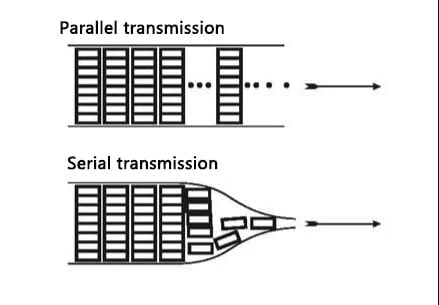
Parallel transmission sends multiple bits simultaneously through multiple separate channels. Historically, this made sense for short-distance connections, such as internal computer buses. However, parallel communication becomes more difficult over longer distances. Differences in signal arrival times, known as clock skew, can cause errors. More wires also increase the cost and the chance of electromagnetic interference.
Serial transmission avoids many of these problems. Modern serial technologies can operate at extremely high speeds, making serial communication the preferred choice for many modern systems.
| Feature | Serial Transmission | Parallel Transmission |
|---|---|---|
| Data transfer | One bit at a time | Multiple bits at once |
| Number of wires | Low | High |
| Long-distance use | Excellent | Limited |
| Cost and complexity | Lower | Higher |
| Modern high-speed use | Very common | Less common |
Advantages of Serial Transmission
Serial transmission offers several important benefits:
- Fewer wires and connectors, reducing hardware cost
- Better suitability for long-distance communication
- Lower risk of timing errors between separate data lines
- Easier installation and troubleshooting
- Strong compatibility with modern protocols and devices
- High-speed performance with technologies such as USB, Ethernet, and PCI Express
For these reasons, serial communication remains central to both consumer electronics and industrial automation.
Some Disadvantages
Despite its benefits, serial transmission also has limitations. Because data moves sequentially, older or low-speed serial connections may transfer data more slowly than a comparable parallel connection. Communication can also fail when the sender and receiver use mismatched settings, such as different baud rates, parity options, or stop-bit configurations.
However, modern serial interfaces overcome much of the historical speed limitation by using very high signaling rates and advanced encoding methods.
Common Applications of Serial Transmission
Serial transmission appears in a wide range of technologies, including:
- Computers and laptops through USB, Ethernet, and internal serial buses
- Embedded systems using UART, SPI, and I²C
- Industrial machines and programmable logic controllers
- Medical devices and monitoring equipment
- Automotive electronics and vehicle networks
- Networking hardware, routers, and switches
- Telecommunications systems
- Smart-home devices, sensors, and Internet of Things equipment
For example, an Arduino board may use serial communication to receive sensor data, while a factory control system may use serial links to monitor machinery over long distances.
Conclusion
Serial transmission is one of the most important methods of digital communication. Sending data sequentially, it enables reliable connections between devices while reducing wiring complexity and supporting both short-range and long-distance communication. From simple microcontroller projects to global network infrastructure, serial transmission continues to provide the foundation for efficient, scalable, and high-speed data exchange.