Simplex Communication in Computer Networks: Definition, Examples, and Uses
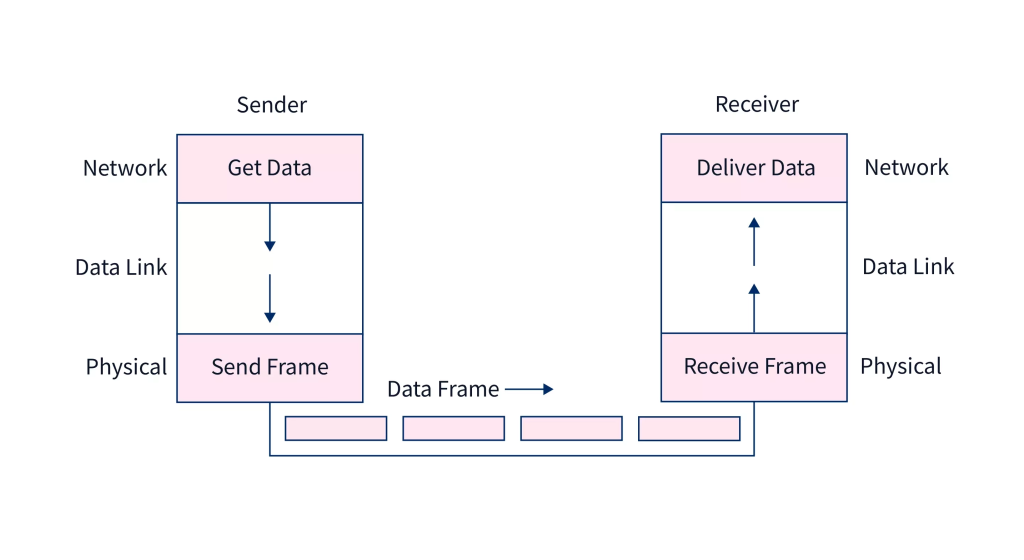
Simplex communication is a one-way method of data transmission in which one device only sends data and the other device only receives it. In computer networking, the term “simplex protocol” is often used informally, although simplex is more accurately a communication mode or transmission direction than a standalone protocol such as TCP or HTTP. Understanding simplex communication helps network learners compare it with half-duplex and full-duplex systems, choose suitable network designs, and recognize where one-way data flow improves simplicity or security.
What Is Simplex Communication?
In a simplex connection, data travels in only one direction:
Sender ─────────────► ReceiverThe sender cannot receive a reply through that same simplex connection, and the receiver cannot transmit back to the sender. A broadcaster sending a signal to many listeners is a common example.
Simplex operation is fundamentally different from the back-and-forth communication used by most modern applications. Web browsing, video calls, cloud services, and messaging normally require a return path for requests, acknowledgments, error handling, or user input.
How Does a Simplex Protocol Work?
A simplex system has two distinct roles:
- Transmitter: creates and sends the data.
- Receiver: accepts the data but does not send data back over the same path.
The sender may transmit continuously, at scheduled intervals, or when an event occurs. Since the receiver has no return channel, the sender cannot directly confirm that the receiver got the message correctly.
For example, a temperature sensor may continuously send readings to a display panel:
Temperature sensor ─────────────► Monitoring displayIf the display needs to acknowledge receipt or ask for a retransmission, an additional return channel is required. At that point, the overall system is no longer purely simplex.
Simplex Communication Examples
Common examples of simplex communication include:
- Radio and television broadcasting: A station transmits content to many receivers.
- Digital signage: A central system sends advertisements, schedules, or announcements to display screens.
- Public-address systems: A microphone or audio source sends sound to speakers.
- One-way sensor telemetry: A device sends measurements to a monitoring system without receiving commands.
- Data diodes: Security-focused devices designed to permit data flow in one direction only.
In networking, simplex is especially useful when recipients only need to consume information and do not need to respond.
Advantages of Simplex Communication
- Simple design – A one-way connection is easier to design because it does not need two-way coordination, turn-taking, or response handling on the same channel.
- Efficient for broadcast delivery – One sender can distribute the same information to many receivers, making simplex well suited to announcements, media broadcasts, and status displays.
- Reduced attack surface in some environments – A physically enforced one-way path, such as a data diode, can help prevent information or malicious traffic from travelling back into a protected network.
- Predictable traffic direction – Network administrators know exactly which direction data should travel. This can make traffic analysis, access control, and capacity planning simpler.
Limitations of Simplex Communication
The biggest limitation is the lack of feedback.
- The sender cannot receive acknowledgments over the same path.
- The receiver cannot request missing data or retransmission.
- Interactive applications cannot operate through a simplex-only link.
- Error detection may be possible, but error recovery requires another mechanism or a separate channel.
- The sender may not know whether the receiver is online or successfully processing data.
For this reason, pure simplex communication is less common in everyday computer networks than duplex communication.
Simplex vs. Half-Duplex vs. Full-Duplex
| Communication mode | Direction of data flow | Can both endpoints send? | Example |
|---|---|---|---|
| Simplex | One direction only | No | Radio broadcast |
| Half-duplex | Both directions, one at a time | Yes, alternately | Walkie-talkie |
| Full-duplex | Both directions simultaneously | Yes | Modern switched Ethernet |
In half-duplex communication, each device can send and receive, but not simultaneously. In full-duplex communication, both devices can transmit and receive at the same time. Modern switched Ethernet typically uses full-duplex links, which avoid the collision behavior associated with shared half-duplex Ethernet.
Is Simplex Used in Modern Computer Networks?
Yes, but usually for specialized purposes rather than general user communication.
Modern networks often contain one-way flows—for example, a streaming service sending video data to a viewer. However, the overall service is usually not simplex because the viewer’s device also sends requests, acknowledgments, and control data back to the service.
Pure simplex communication remains useful where interaction is unnecessary, undesirable, or prohibited. It is particularly relevant in broadcast systems, industrial monitoring, display networks, and high-security environments that require one-way data transfer.
Simplex Communication and Network Security
Simplex design can support security goals when a network must export information without accepting incoming connections. A one-way gateway can, for example, allow operational data to leave a protected environment while reducing the chance of external commands reaching that environment.
Still, simplex alone does not guarantee security. Organizations should also use authentication, encryption, monitoring, secure configuration, and physical controls. Security depends on the complete design—not just the direction of data flow.
Conclusion
Simplex communication is a one-way transmission model in which a sender delivers data to a receiver without a return path on the same connection. Although it is not suitable for interactive applications, it remains valuable for broadcasting, telemetry, digital signage, and security-sensitive one-way data transfer.
Knowing the difference between simplex, half-duplex, and full-duplex communication is a core networking concept. It helps engineers select the right communication model for performance, reliability, cost, and security requirements.