Sink Tree in Computer Networks: Definition, Working, Uses, and Example
A sink tree is a network-routing structure that directs data from multiple devices toward one destination node, called the sink. It is especially useful when many devices need to send information to a central server, gateway, base station, or data collector. Sink trees appear in wireless sensor networks, mesh networks, Internet of Things (IoT) deployments, and destination-based routing systems. By giving every node a defined next hop toward the sink, the network can move data efficiently while avoiding routing loops.
What Is a Sink Tree?
A sink tree is a rooted tree in which all communication paths lead inward to a single root node: the sink.
Each device in the network selects a parent, or next-hop node, that moves its data closer to the sink. As a result, every node has one clear forwarding path to the final destination.
For example:
Device A ─┐
          ├─ Router C ─┐
Device B ─┘            │
                       ├─ Gateway E (Sink)
Device D ──────────────┘
In this example, Devices A and B forward data through Router C, while Device D sends data directly to Gateway E. All paths eventually converge at the sink.
How Does It Work?
A sink tree works by organizing the network around a destination rather than around a source.
The sink first becomes the root of the routing structure. Other nodes then calculate the best path toward that root based on criteria such as:
- Lowest hop count
- Lowest latency
- Best link quality
- Lowest energy consumption
- Lowest routing cost
- Highest reliability
Once a node chooses its preferred parent, it forwards all sink-bound traffic through that parent. The parent, in turn, forwards the traffic farther up the tree until it reaches the sink.
This process is often called convergecast because data from many distributed nodes converges on one central destination.
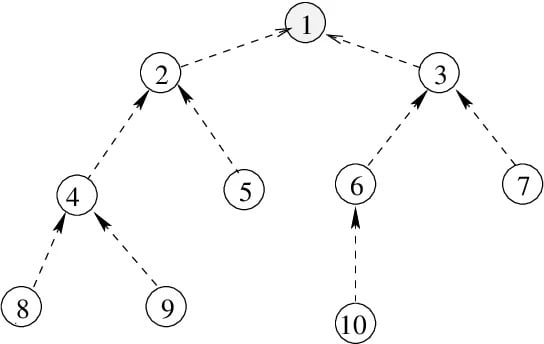
Sink Tree Example
Consider a smart agriculture network with soil-moisture sensors spread across a farm. Every sensor must report its readings to one gateway connected to the internet.
Sensor 1 ─┐
          ├─ Relay Node A ─┐
Sensor 2 ─┘                │
                           ├─ Farm Gateway (Sink)
Sensor 3 ── Relay Node B ──┘
Instead of every sensor needing a direct wireless connection to the gateway, sensors can use nearby relay nodes. This extends the network’s coverage and can reduce power use for battery-operated devices.
Sink Tree vs. Spanning Tree
A sink tree and a spanning tree are related concepts, but they serve different purposes.
| Feature | Sink Tree | Spanning Tree |
|---|---|---|
| Main goal | Route traffic toward one destination | Connect all nodes without loops |
| Root node | A sink, gateway, or destination | A selected bridge or root node |
| Traffic direction | Toward the root | May be used in multiple directions |
| Common use | Data collection and destination routing | Layer 2 Ethernet loop prevention |
| Path selection | Often based on cost, hops, energy, or quality | Often based on bridge priorities and path cost |
A spanning tree guarantees a loop-free topology. A sink tree focuses on efficiently delivering data to one central node. In practice, a sink tree may be built on top of a loop-free network topology.
Benefits of a Sink Tree
A well-designed sink tree provides several networking advantages.
- Efficient data collection – A sink tree gives every node a predictable route to a shared destination. This makes it ideal for networks where many devices collect and report data.
- Reduced routing complexity – Nodes do not need to maintain complete routes to every other node. They only need to know their next hop toward the sink.
- Loop avoidance – Because every node forwards data along a parent path toward the root, a properly constructed sink tree prevents routing loops.
- Lower energy consumption – In wireless sensor and IoT networks, nodes can choose low-energy or high-quality paths. This helps extend battery life and reduce retransmissions.
- Scalable network design – New devices can join the tree by selecting a suitable parent node. This makes sink trees useful in expanding sensor, industrial, and smart-building networks.
How Is a Sink Tree Constructed?
The exact method depends on the routing protocol and network type, but the basic process is similar.
- The sink advertises itself as the root or destination.
- Neighboring devices calculate the cost of reaching the sink.
- Each device chooses the best parent based on the routing metric.
- Devices farther away repeat the process through nearby nodes.
- The network updates parent choices when links fail, or better paths become available.
For a weighted network, the sink tree may be a shortest-path tree. In that case, each node selects the least-cost route to the sink. Routing algorithms such as Dijkstra’s algorithm can help calculate these paths.
In directed networks, the routing system may calculate paths on a reversed version of the graph so it can determine the best inbound route from every node to the sink.
Some Common Uses
Sink trees are widely used where traffic flows from many endpoints to one central location.
- Wireless sensor networks – Environmental sensors, factory monitors, and smart-meter devices often send readings to a central base station.
- Internet of Things networks – IoT devices can use a sink tree to report telemetry, alerts, and operating data to an edge gateway or cloud-connected hub.
- Mesh networks – Mesh nodes can form routes toward an internet gateway, allowing devices outside the gateway’s direct range to stay connected.
- Data-center and enterprise monitoring – Network devices, servers, and applications may send logs, metrics, or telemetry toward centralized monitoring systems.
- Routing toward a destination – Some routing designs effectively create a sink tree for a particular destination, with each router choosing the best next hop toward that destination.
Challenges of Sink Tree Networks
Although sink trees are useful, they also introduce design challenges.
The nodes nearest the sink may become overloaded because they forward traffic for many other devices. This can create congestion, drain batteries faster, and make those nodes critical points of failure.
A single sink can also become a bottleneck. Larger networks may use multiple sinks, backup gateways, or load-balancing mechanisms to improve availability.
Network changes can require the tree to be rebuilt. If a parent node fails, its child nodes must find alternative paths to the sink. Routing protocols should therefore support fast and reliable parent reselection.
Best Practices for Designing a Sink Tree
When designing a sink tree in a computer network, consider these practices:
- Use reliable and well-connected nodes near the sink.
- Select routing metrics that match the network’s goals, such as latency, energy efficiency, or link quality.
- Provide backup parent nodes where possible.
- Monitor congestion near the sink.
- Use multiple sinks for larger or high-availability deployments.
- Secure routing updates to prevent malicious devices from advertising false routes.
- Test how the network reacts when links, relay nodes, or the sink fail.
Conclusion
A sink tree is a practical routing structure that guides traffic from many network nodes toward one central destination. It supports efficient data collection, simplifies routing decisions, and is especially valuable in sensor networks, IoT systems, and mesh deployments. By choosing strong routing metrics, avoiding overload near the sink, and providing backup paths, network designers can use sink trees to build reliable and scalable communication systems.