Thick Ethernet: Definition, Features, Advantages, and How It Works
What Is Thick Ethernet?
Thick Ethernet, also known as 10BASE5, is an early Ethernet networking technology that uses thick coaxial cable to connect devices within a local area network (LAN). Introduced in the early days of Ethernet, it was designed to support data transmission at speeds of up to 10 Mbps over relatively long distances.
Thick Ethernet was one of the first widely recognized Ethernet standards and played an important role in the development of computer networking. Although modern networks primarily use twisted-pair copper cables and fiber optics, understanding Thick Ethernet provides valuable insight into the evolution of Ethernet technology.
The name 10BASE5 describes its main characteristics:
- 10: A maximum data rate of 10 Mbps.
- BASE: Baseband transmission, in which the cable carries digital signals using a single transmission channel.
- 5: A maximum cable segment length of approximately 500 meters.
Thick Ethernet was standardized as part of the original IEEE 802.3 Ethernet family and is now considered a legacy networking technology.
How Does Thick Ethernet Work?
Thick Ethernet uses a thick, 50-ohm coaxial cable as a shared communication medium. Multiple network devices connect to the same cable segment through specialized hardware.
In a traditional Thick Ethernet network, all connected devices share the available bandwidth. Ethernet originally used the Carrier Sense Multiple Access with Collision Detection (CSMA/CD) mechanism to manage access to the shared medium.
The communication process works as follows:
- Signal transmission: A network device prepares an Ethernet frame and transmits it through a transceiver connected to the coaxial cable.
- Signal propagation: The electrical signal travels along the shared cable segment.
- Signal reception: Other connected devices receive the signal, but only the device whose MAC address matches the destination address processes the frame as intended.
- Collision detection: If two devices transmit simultaneously, their signals may collide. The devices detect the collision and retransmit after waiting for a randomly selected interval.
Thick Ethernet typically uses external transceivers called Medium Attachment Units (MAUs). These transceivers connect to the main coaxial cable through vampire taps, which make electrical contact with the cable without requiring conventional inline connectors.
A separate attachment unit interface (AUI) cable connects each transceiver to its network device.
Key Features of Thick Ethernet
Thick Ethernet has several distinctive characteristics that separate it from modern Ethernet implementations.
| Feature | Description |
|---|---|
| Standard | IEEE 802.3 10BASE5 |
| Maximum data rate | 10 Mbps |
| Cable type | 50-ohm thick coaxial cable |
| Maximum segment length | 500 meters |
| Transmission method | Baseband |
| Network topology | Physical bus |
| Access method | CSMA/CD |
| Device connection | External transceivers and vampire taps |
| Typical use | Early Ethernet LANs |
One notable feature is its relatively long cable reach compared with other early Ethernet implementations. A single 10BASE5 cable segment can extend up to 500 meters, making it suitable for connecting devices across large rooms, buildings, or industrial environments.
However, its physical installation requirements and limited bandwidth eventually made it less practical than newer Ethernet technologies.
Thick Ethernet Cable and Connectors
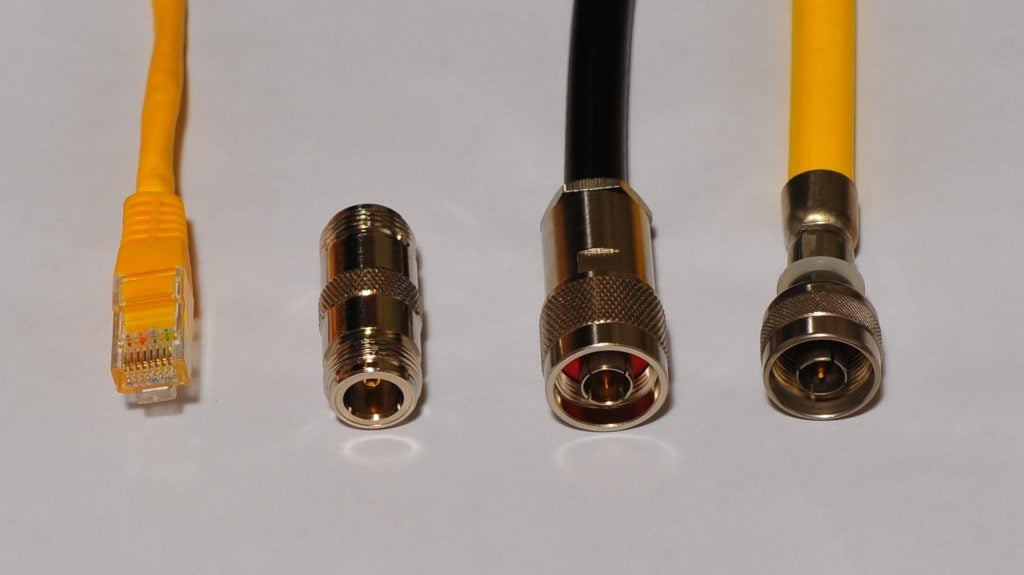
Thick Ethernet uses a relatively large coaxial cable, commonly identified by its yellow outer jacket in traditional installations.
The cable consists of several components:
- Inner conductor: Carries the electrical signal.
- Insulating dielectric: Separates the inner conductor from the outer shielding.
- Conductive shielding: Reduces electromagnetic interference and helps maintain signal integrity.
- Outer jacket: Protects the cable from physical damage.
The cable’s construction supports reliable signal transmission over longer distances than some other early copper Ethernet implementations.
Vampire Taps
A vampire tap connects a network transceiver to the main coaxial cable. Its name comes from the way the connector penetrates the cable’s outer layers to establish electrical contact with the internal conductor and shielding.
Vampire taps allow devices to connect at appropriate points along the cable without cutting it into separate sections.
AUI Cables
An Attachment Unit Interface (AUI) cable connects the external transceiver to a computer, server, or other network device.
The AUI interface separates the physical transmission hardware from the device’s Ethernet interface, allowing the transceiver to handle communication with the coaxial cable.
Thick Ethernet vs. Thin Ethernet
Thick Ethernet and Thin Ethernet are two early Ethernet technologies that use coaxial cables. Although they share similar operating principles, they differ in cable construction, maximum segment length, and installation requirements.
Thin Ethernet is commonly known as 10BASE2, while Thick Ethernet is known as 10BASE5.
| Feature | Thick Ethernet (10BASE5) | Thin Ethernet (10BASE2) |
|---|---|---|
| Cable type | Thick coaxial cable | Thin coaxial cable |
| Maximum data rate | 10 Mbps | 10 Mbps |
| Maximum segment length | 500 meters | 185 meters |
| Network topology | Bus | Bus |
| Device connection | Vampire taps and external transceivers | BNC T-connectors |
| Installation | More difficult | Relatively simple |
| Cable cost | Higher | Lower |
| Flexibility | Less flexible | More flexible |
Both technologies use a shared transmission medium and require proper termination at the ends of each bus segment.
The main advantage of Thick Ethernet is its longer maximum cable segment length. Thin Ethernet, however, is easier to install and generally less expensive.
Neither technology is commonly used in modern network deployments.
Advantages of Thick Ethernet
Although Thick Ethernet has largely been replaced, it offered several advantages when it was introduced.
- Long Cable Distance – A Thick Ethernet segment can extend up to 500 meters without an intermediate repeater. This made it useful for early LAN installations that needed to connect devices across relatively large areas.
- Reliable Signal Transmission – The thick coaxial cable provides effective shielding against external electromagnetic interference. Its construction supports signal transmission over long cable runs when installed correctly.
- Reduced Cable Segmentation Requirements – Because each segment can cover a relatively long distance, Thick Ethernet can connect devices across a larger area without requiring as many separate cable segments.
- Established Networking Standard – As part of the early Ethernet family, 10BASE5 helped establish foundational networking concepts, including Ethernet framing, MAC addressing, and shared-medium communication.
Disadvantages of Thick Ethernet
Despite its historical importance, Thick Ethernet has several limitations.
- High Installation Costs – Thick coaxial cable and its associated transceivers are relatively expensive compared with simpler cabling options. Installing vampire taps also requires specialized tools and careful procedures.
- Difficult Maintenance – Locating and repairing faults in a shared coaxial cable can be challenging. A cable break or termination problem may disrupt communication across an entire segment.
- Limited Bandwidth – Thick Ethernet supports a maximum data rate of 10 Mbps. This is insufficient for many modern applications, including high-resolution media streaming, large file transfers, and demanding server workloads.
- Limited Flexibility – The thick cable is less flexible than twisted-pair Ethernet cable, making it difficult to route through confined spaces or reorganize network connections.
- Shared Bandwidth and Collision Risk – Devices on a traditional Thick Ethernet segment share the same transmission medium. Simultaneous transmissions can cause collisions, reducing effective network performance.
Modern switched Ethernet networks largely avoid this problem by providing dedicated links between devices and switches.
Thick Ethernet vs. Modern Ethernet
Modern Ethernet technologies have largely replaced Thick Ethernet because they offer higher speeds, easier installation, and more flexible network designs.
For example, 100BASE-TX supports 100 Mbps over twisted-pair cabling, while Gigabit Ethernet supports 1 Gbps. Modern Ethernet standards also provide speeds of 10 Gbps, 25 Gbps, 40 Gbps, 100 Gbps, and beyond, depending on the implementation.
Unlike traditional Thick Ethernet, modern switched Ethernet networks typically use a star topology, with devices connected individually to network switches.
These developments have improved scalability, simplified troubleshooting, and increased available bandwidth.
Fiber-optic Ethernet is another alternative for applications that require long-distance connectivity, high bandwidth, or immunity to electromagnetic interference.
Is It Still Used Today?
Thick Ethernet is now largely obsolete and is rarely deployed in new networks.
Modern businesses typically use twisted-pair Ethernet, such as Cat 5e, Cat 6, or Cat 6A cabling, or fiber-optic connections to support higher data rates and simpler network management.
However, Thick Ethernet remains relevant in networking education, historical research, and the maintenance of legacy systems.
Understanding 10BASE5 can help networking professionals learn how early Ethernet networks operated and how modern Ethernet technologies evolved from shared coaxial systems to switched, high-speed networks.
Conclusion
Thick Ethernet, or 10BASE5, is an early Ethernet technology that uses thick coaxial cable to transmit data at up to 10 Mbps over cable segments as long as 500 meters. Its shared bus topology, external transceivers, and vampire taps distinguish it from modern Ethernet implementations.
Although Thick Ethernet is no longer a practical choice for most networking environments, it played a significant role in the development of LAN technology. Learning about its characteristics, advantages, and limitations helps explain the transition from early coaxial Ethernet to today’s high-speed copper and fiber-optic networks.