Transmit Opportunity (TXOP): How It Improves Wi‑Fi Performance
A transmit opportunity, commonly called TXOP, is a controlled window of time in which a Wi‑Fi device can send data over a shared wireless channel. Rather than competing for access before every individual frame, a device that wins a TXOP may send multiple frames within its allocated time period. TXOP is an important part of Wi‑Fi Quality of Service (QoS). It helps networks move time-sensitive traffic—such as voice calls, video meetings, and live streams—more efficiently while reducing unnecessary delays.
What Is a Transmit Opportunity?
In wireless networking, many devices share the same radio channel. Because only one device should transmit at a time, each device must wait for an opportunity to use the medium. A transmit opportunity gives one station temporary, contention-free access to the channel. During that period, it can send one or more frames associated with a particular traffic category.
In practical terms, TXOP reduces the repeated “wait, compete, send” cycle that can slow down wireless communication. Wi‑Fi’s Enhanced Distributed Channel Access (EDCA) uses TXOP alongside other parameters to give higher-priority traffic a better chance of being delivered promptly.
How TXOP Works in Wi‑Fi
Wi‑Fi devices use a method called contention-based access. Before transmitting, a device listens to confirm that the channel is available. If multiple devices try to use the channel, they wait for different randomized intervals to reduce collisions.
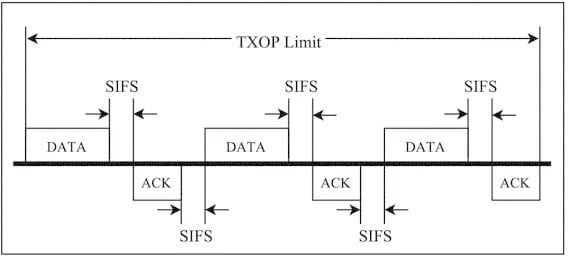
When a device gains access, a TXOP can allow it to continue transmitting for a limited duration. That device may send multiple data frames, often with acknowledgements and frame aggregation, before releasing the channel for other devices.
The process generally looks like this:
- A device identifies traffic waiting to be sent.
- It competes for channel access using its QoS settings.
- Once it gains access, the device begins its transmit opportunity.
- It sends eligible frames until the TXOP limit is reached or its queue is empty.
- Other devices then contend for the channel.
This approach improves efficiency because the network avoids extra contention periods between every individual transmission.
Why Transmit Opportunity Matters
A well-managed transmit opportunity can improve both user experience and network efficiency.
- Lower latency for real-time traffic – Voice and video traffic are sensitive to delay. A late packet can cause choppy audio, frozen video, or poor call quality. TXOP helps high-priority traffic move more predictably by allowing a device to send a burst of related frames once it has channel access.
- Higher wireless throughput – Each contention period adds overhead. With TXOP, a device can send several frames during a single access window. Less contention can mean more useful airtime is spent carrying application data.
- Better Quality of Service – Wi‑Fi QoS typically classifies traffic into access categories such as voice, video, best effort, and background. Higher-priority categories can receive different channel-access settings and TXOP durations. This helps a network favor critical traffic when many devices are active.
- More efficient frame aggregation – TXOP works especially well with frame aggregation. Instead of transmitting many small packets independently, a device can group frames and send them in a more efficient sequence. The result can be lower overhead and improved performance for compatible clients.
TXOP and Wi‑Fi Traffic Prioritization
Not every packet deserves the same priority. A cloud backup can tolerate a slight delay; a video conference often cannot.
TXOP supports traffic prioritization by helping Wi‑Fi devices manage airtime according to the type of data being sent. For example:
- Voice traffic benefits from fast delivery and minimal jitter.
- Video traffic may need sustained throughput and low delay.
- Best-effort traffic includes ordinary web browsing and email.
- Background traffic includes updates, backups, and other tasks that can wait.
The exact TXOP settings depend on the Wi‑Fi standard, access point configuration, client capability, and traffic class. A network administrator should avoid treating TXOP as a universal “speed boost”; it is a QoS tool that must balance urgency, fairness, and shared airtime.
Common Uses of Transmit Opportunity
Transmit opportunity is most useful in busy Wi‑Fi environments where multiple devices and traffic types compete for limited spectrum.
- Enterprise Wi‑Fi – Offices often combine video calls, cloud software, mobile devices, and guest access on the same wireless infrastructure. TXOP can help preserve call quality when the network is under load.
- Education and training – Classrooms and training centers may have many connected laptops, tablets, and streaming devices. Prioritizing instructional video or live sessions can improve the learning experience.
- Healthcare and industrial environments – Some wireless applications require predictable communication for monitoring, coordination, or operational data. QoS policies that include TXOP can help protect time-sensitive traffic.
- Public Wi‑Fi and high-density venues – Airports, hotels, stadiums, and conference centers often have hundreds of devices sharing a limited set of channels. Efficient channel use becomes essential, and TXOP can reduce avoidable transmission overhead.
TXOP Configuration Considerations
While transmit opportunity can improve performance, overly aggressive settings may create unfairness. If one device holds the channel for too long, other stations may wait longer than necessary.
Before changing TXOP-related settings, consider:
- The number of active clients
- The mix of voice, video, and background traffic
- Available channel width and radio capacity
- Interference from nearby networks
- Access point and client compatibility
- Existing Wi‑Fi Multimedia (WMM) or QoS policies
In most environments, vendor-recommended QoS profiles are a sensible starting point. Test changes in a controlled area, monitor latency and airtime use, then adjust only when results show a clear need.
Transmit Opportunity Beyond Wi‑Fi
Although TXOP is strongly associated with IEEE 802.11 Wi‑Fi QoS, the phrase transmit opportunity can also appear in other shared-media networking technologies. For example, in PLCA-based 10BASE‑T1S Ethernet, a node receives an assigned opportunity to begin transmission on the shared network segment.
The broad idea is the same: a shared network needs rules that determine when each participant may transmit.
Conclusion
A transmit opportunity is a key Wi‑Fi QoS mechanism that lets devices send multiple frames during a controlled period of channel access. By reducing repeated contention, TXOP can support lower latency, better throughput, and stronger performance for voice, video, and other important traffic. For network teams, the goal is not simply to extend transmission time. It is to use TXOP intelligently—giving critical traffic the responsiveness it needs while keeping the shared wireless network fair and reliable for everyone.