Virtual Carrier Sense in Wi-Fi: How the NAV Prevents Wireless Collisions
Wireless devices share the same radio channel, so they need a way to avoid transmitting over one another. In IEEE 802.11 Wi-Fi, that coordination relies on two related mechanisms: physical carrier sense and virtual carrier sense. Virtual carrier sense lets a Wi-Fi device reserve the channel for a known period by announcing how long an upcoming transmission exchange will take. Other devices record that reservation in a timer called the Network Allocation Vector (NAV) and wait before transmitting. This reduces collisions and helps Wi-Fi work more reliably in busy environments.
What Is Virtual Carrier Sense?
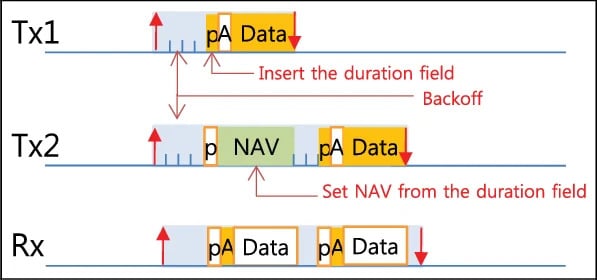
Virtual carrier sense is a Wi-Fi medium-access mechanism that tells nearby devices when the wireless channel is expected to be busy, even if they cannot directly hear every transmission in the exchange. Instead of relying only on detected radio energy, stations read the duration information included in certain 802.11 frames. They then update their NAV, which represents how long they should treat the medium as reserved.
Put simply:
Virtual carrier sense uses frame duration information to create a temporary “do not transmit” timer for other Wi-Fi devices.
While a device’s NAV is greater than zero, it defers transmission. When the timer reaches zero, the device may contend for the channel again under normal Wi-Fi rules.
How the Network Allocation Vector (NAV) Works
The NAV is a timer maintained by each Wi-Fi station. It is updated when the station receives a frame containing a duration value that indicates how long the sender expects to use the wireless medium.
A typical sequence looks like this:
- A sender announces an upcoming exchange.
- Nearby devices read the frame’s duration information.
- Those devices set or update their NAV timers.
- They remain silent while the NAV is active.
- Once the reservation period ends, devices resume normal channel contention.
The reservation may cover more than one frame. For example, it can protect the time required for an RTS, CTS, data frame, acknowledgment, and the short spacing periods between them.
This is especially valuable because Wi-Fi transmissions are not always a single, isolated packet. Reserving airtime helps ensure the full exchange has a chance to complete without interruption.
Virtual Carrier Sense vs. Physical Carrier Sense
Wi-Fi uses both physical and virtual carrier sense before transmitting.
| Feature | Physical carrier sense | Virtual carrier sense |
|---|---|---|
| What it detects | Radio energy or recognizable Wi-Fi signals | Reserved airtime announced in frames |
| Main mechanism | Clear Channel Assessment (CCA) | Network Allocation Vector (NAV) |
| Works when a device cannot hear the sender clearly? | Not reliably | Often, if it receives the reservation frame |
| Purpose | Detect an actively busy channel | Honor an expected future channel reservation |
Physical carrier sense answers: “Is the channel busy right now?”
Virtual carrier sense answers: “Has another station reserved this channel for the next few microseconds or milliseconds?”
Together, these mechanisms support Wi-Fi’s collision-avoidance approach, commonly known as CSMA/CA: Carrier Sense Multiple Access with Collision Avoidance.
RTS/CTS and Virtual Carrier Sense
Virtual carrier sense is closely associated with the RTS/CTS process:
- RTS (Request to Send): A station asks to reserve the channel.
- CTS (Clear to Send): The receiving station grants permission.
- NAV update: Stations that hear the RTS or CTS reserve the medium for the announced duration.
- Data and ACK: The sender transmits data, and the receiver responds with an acknowledgment.
RTS/CTS can reduce the impact of the hidden node problem. A hidden node occurs when two devices cannot hear each other but can both reach the same access point. Without coordination, they may transmit at the same time and cause a collision at the access point.
For example, Device A and Device C may be too far apart to detect one another. If Device A sends an RTS and the access point replies with a CTS, Device C can hear the CTS, set its NAV, and remain quiet while Device A sends its data.
Why Virtual Carrier Sense Matters
Virtual carrier sense improves wireless performance in several ways:
- Reduces preventable collisions: Devices can defer based on a known reservation, not only currently detected energy.
- Protects multi-frame exchanges: It reserves airtime for data and acknowledgment sequences.
- Helps with hidden nodes: RTS/CTS-based reservations can notify devices that cannot hear the original sender.
- Improves coordination in busy networks: Devices have clearer information about when they should wait.
It does not eliminate all Wi-Fi collisions. Two stations may still begin transmitting at nearly the same time, particularly when they both believe the channel is idle. However, virtual carrier sense is an important part of avoiding collisions before they happen.
When Is Virtual Carrier Sense Used?
Virtual carrier sense is used throughout IEEE 802.11 MAC operation, particularly when frames include duration information that reserves the medium for a follow-up exchange.
It is most noticeable when:
- RTS/CTS protection is enabled
- The network has hidden-node issues
- Many devices share the same access point or channel
- Larger frames make a collision more costly
- Wi-Fi equipment uses protection mechanisms for compatibility or reliability
Modern Wi-Fi networks often use RTS/CTS selectively rather than for every frame. Using it constantly creates additional overhead, so access points and clients balance protection against efficiency.
Limitations of Virtual Carrier Sense
Although useful, virtual carrier sense has limits. A device must receive and correctly decode a relevant frame to set its NAV. If it cannot hear the sender or receiver well enough, it may not know that the medium has been reserved. Additionally, excessive use of RTS/CTS can reduce throughput because control frames consume airtime.
Virtual carrier sense also cannot solve every source of interference. Non-Wi-Fi devices, neighboring networks, and poor radio conditions can still affect performance.
Key Takeaway
Virtual carrier sense is a core Wi-Fi coordination mechanism. By using the Network Allocation Vector to reserve airtime, it helps devices avoid interrupting ongoing exchanges, reduces collision risk, and supports more dependable wireless communication—especially in crowded or complex network environments.