What Is Port Address Translation?
What Is Port Address Translation?
Port Address Translation (PAT) is a networking technique that allows multiple devices on a private network to share a single public IP address. PAT works by translating both the IP address and the port number of outgoing traffic, enabling many devices to communicate over the internet simultaneously without requiring a unique public IP address for each device.
PAT is commonly considered a form of Network Address Translation (NAT), specifically known as NAT overload. It is widely used in home routers, enterprise networks, cloud infrastructures, and ISP environments.
Because IPv4 addresses are limited, PAT became one of the most important technologies for conserving public IP addresses while maintaining efficient internet communication.
Why Port Address Translation Is Important
Modern networks often contain dozens, hundreds, or even thousands of devices. Without PAT, every device would require its own public IP address to access the internet.
PAT solves several critical networking challenges:
- Conserves IPv4 addresses
- Reduces public IP address costs
- Improves network scalability
- Adds a layer of internal network privacy
- Enables multiple devices to connect simultaneously
- Simplifies network management
PAT is especially important because the world still heavily relies on IPv4 despite the gradual adoption of IPv6.
How Port Address Translation Works
PAT modifies both:
- Source IP addresses
- Source port numbers
When devices inside a private network send traffic to the internet, the router performing PAT replaces the private IP address with a public IP address and assigns a unique port number for each session.
Example of PAT Operation
Suppose three devices inside a network attempt to access a website:
| Device | Private IP | Original Port |
|---|---|---|
| Laptop | 192.168.1.10 | 5001 |
| Phone | 192.168.1.11 | 5001 |
| Tablet | 192.168.1.12 | 5001 |
The router translates them like this:
| Public IP | Translated Port |
|---|---|
| 203.0.113.5 | 10001 |
| 203.0.113.5 | 10002 |
| 203.0.113.5 | 10003 |
Although all devices share the same public IP address, the router differentiates sessions using unique port numbers.
When responses return from the internet, the router checks the translated port and forwards packets to the correct internal device.
PAT Translation Process Step-by-Step
1. Internal Device Sends Request
A device inside the local network initiates communication with an external server.
Example:
- Source IP: 192.168.1.10
- Source Port: 5001
- Destination IP: 142.250.190.78
- Destination Port: 443
2. Router Performs Translation
The PAT-enabled router changes:
- Private source IP → Public IP
- Original source port → Unique translated port
Translated packet:
- Source IP: 203.0.113.5
- Source Port: 10001
3. Router Stores Translation Entry
The router creates a translation table entry:
| Internal Address | Internal Port | Public Address | Public Port |
|---|---|---|---|
| 192.168.1.10 | 5001 | 203.0.113.5 | 10001 |
4. External Server Responds
The server replies to:
- Destination IP: 203.0.113.5
- Destination Port: 10001
5. Router Reverses Translation
The router checks its PAT table and forwards traffic back to:
- 192.168.1.10:5001
This entire process occurs in milliseconds.
PAT vs NAT
PAT and NAT are closely related, but they are not identical.
| Feature | NAT | PAT |
|---|---|---|
| Address Translation | Yes | Yes |
| Port Translation | No | Yes |
| Multiple Devices Sharing One IP | Limited | Yes |
| IPv4 Conservation | Moderate | Excellent |
| Common Usage | Enterprise Mapping | Home & Enterprise Internet Access |
PAT is essentially an advanced version of NAT optimized for large-scale internet sharing.
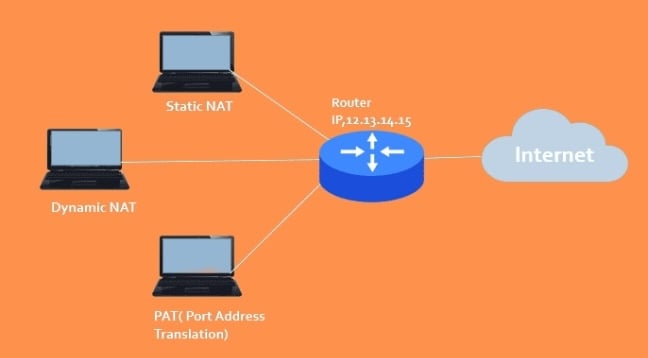
Types of NAT Related to PAT
Static NAT
Static NAT creates a permanent one-to-one mapping between private and public IP addresses.
Characteristics:
- Fixed mapping
- Common for servers
- Easier inbound access
Dynamic NAT
Dynamic NAT maps private addresses to a pool of public addresses dynamically.
Characteristics:
- Temporary mappings
- Requires multiple public IPs
- Less efficient than PAT
PAT (NAT Overload)
PAT allows many devices to use a single public IP address through port translation.
Characteristics:
- Most efficient
- Most common
- Uses TCP/UDP ports for session tracking
Advantages of Port Address Translation
- Conserves IPv4 Addresses – PAT dramatically reduces the number of public IP addresses required for internet access. Without PAT, organizations would need a public IP for every connected device.
- Improves Scalability – Networks can support large numbers of users and devices without expanding public IP allocations.
- Adds Basic Security – Internal IP addresses remain hidden from external networks, reducing direct exposure. However, PAT alone should not replace firewalls or advanced security systems.
- Reduces Costs – Organizations save money by purchasing fewer public IP addresses from internet service providers.
- Simplifies Network Design – PAT makes network deployment easier for homes, offices, schools, and enterprises.
Disadvantages of Port Address Translation
Can Complicate Troubleshooting
Since many devices share one public IP, identifying specific traffic sources can become difficult.
May Affect Certain Applications
Applications requiring direct inbound connections may encounter issues with PAT.
Examples include:
- Online gaming
- VoIP services
- Peer-to-peer applications
Port Exhaustion Risk
A router has a limited number of available ports. Extremely high traffic environments may exhaust available translations.
Limited End-to-End Connectivity
PAT changes packet headers, which can interfere with protocols that embed IP information inside payloads.
Common PAT Use Cases
Home Networks
Most residential routers use PAT to allow:
- Smartphones
- Smart TVs
- Laptops
- Gaming consoles
to share a single internet connection.
Enterprise Networks
Businesses use PAT to support:
- Employee workstations
- Wireless devices
- Printers
- Servers
while minimizing public IP consumption.
Cloud and Data Centers
Cloud providers often implement PAT in:
- Virtual private clouds
- Container environments
- Shared hosting systems
Internet Service Providers
ISPs use Carrier-Grade NAT (CGNAT), which heavily relies on PAT to support large customer bases.
PAT Translation Table Explained
A PAT translation table tracks active sessions.
Example Table:
| Protocol | Inside Local | Inside Global | Outside Address |
|---|---|---|---|
| TCP | 192.168.1.10:5001 | 203.0.113.5:10001 | 142.250.190.78:443 |
| TCP | 192.168.1.11:5001 | 203.0.113.5:10002 | 151.101.1.69:443 |
The table allows the router to correctly route returning traffic.
PAT and IPv6
IPv6 provides a nearly unlimited address space, reducing the need for PAT.
However, PAT still remains common because:
- IPv4 remains dominant
- Many organizations use dual-stack networks
- Legacy systems depend on NAT/PAT architectures
Over time, IPv6 adoption may reduce PAT usage, but PAT continues to play a major role in modern networking.
PAT Security Considerations
Although PAT provides some obscurity, it is not a full security solution.
Security Best Practices:
- Use firewalls alongside PAT
- Implement intrusion detection systems
- Enable secure remote access
- Monitor translation tables
- Apply access control lists (ACLs)
PAT should be part of a layered cybersecurity strategy.
Future of Port Address Translation
PAT remains essential because IPv4 still dominates global internet infrastructure.
However, future trends include:
- Increased IPv6 adoption
- Growth of cloud-native networking
- Software-defined networking (SDN)
- Advanced security architectures
Despite these changes, PAT will continue to be relevant for many years.
Conclusion
Port Address Translation (PAT) is one of the foundational technologies that enables efficient internet connectivity in modern networks. By allowing multiple devices to share a single public IP address, PAT conserves IPv4 resources, reduces costs, and supports scalable networking environments.
From home routers to enterprise systems and cloud infrastructures, PAT continues to play a critical role in network communication. Understanding how PAT works helps network administrators optimize performance, improve security, and troubleshoot connectivity issues more effectively.
As networking technologies evolve, PAT remains a key component of today’s internet infrastructure and an essential concept for IT professionals and students alike.