Connectionless Service in Computer Networks: Definition, How It Works, Types, and Examples
A connectionless service is a type of network communication in which data is transmitted from a source device to a destination device without establishing a dedicated connection or session beforehand. Each data packet is sent independently and contains the information required to reach its destination. Unlike connection-oriented services, connectionless communication does not require a connection setup process before transmitting data. This makes it faster and more flexible, particularly for applications that need efficient data transmission with minimal overhead. Connectionless services are widely used in computer networking, especially in Internet Protocol (IP) and User Datagram Protocol (UDP). Understanding how they work, their characteristics, advantages, and limitations is essential for network administrators, developers, and IT professionals.
What Is Connectionless Service?
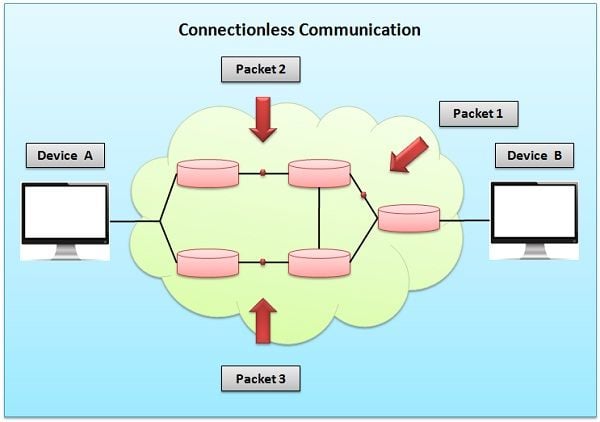
A connectionless service is a communication method in which network devices exchange data without establishing a logical connection between them before transmission. In this approach, the sender divides information into individual packets and transmits them through the network. Each packet is handled independently and may follow a different route to reach the destination. The receiving device processes incoming packets without relying on a previously established communication session. Depending on the protocol, packets may arrive out of order, be duplicated, or fail to reach their destination. Connectionless services generally operate on a best-effort delivery model. This means the network attempts to deliver packets but does not inherently guarantee successful delivery, packet ordering, or error recovery.
Key characteristics of connectionless service include:
-
No connection establishment: Communication begins without a connection setup or handshake.
-
Independent packets: Each packet is transmitted and processed independently.
-
No guaranteed delivery: Packets may be lost during transmission.
-
Flexible routing: Different packets can travel through different network paths.
-
Low overhead: No connection management information is required to maintain a dedicated session.
-
Stateless communication: The network layer does not need to maintain connection-specific state for each communication flow.
How Does It Work?
Connectionless communication follows a relatively straightforward process. Instead of establishing a connection before sending data, the sender transmits packets directly toward the destination.
The process typically involves the following steps:
1. Data Segmentation
The sending application generates data that needs to be transmitted over the network. The data is divided into smaller units called packets or datagrams, depending on the protocol.
Each packet contains a header with information such as the source address, destination address, and other fields required for transmission.
2. Packet Transmission
The sender transmits packets independently without requesting permission from the destination device or establishing a dedicated connection.
For example, when using the Internet Protocol (IP), a device can send an IP packet to another device without first negotiating a connection.
3. Independent Routing
Routers examine the destination address in each packet and determine the appropriate next hop based on their routing tables.
Because packets are handled independently, they may travel through different network paths depending on routing conditions.
4. Packet Reception
When packets reach the destination device, the network stack processes them according to the relevant protocol.
Packets may arrive in their original order, out of order, or with some packets missing.
5. Data Processing
The destination application receives the available data. If reliable delivery or packet reordering is required, these functions must be provided by a higher-layer protocol or the application itself.
Examples of Connectionless Services
Several networking protocols and technologies use connectionless communication. The following are some common examples.
1. Internet Protocol (IP)
Network layer
The Internet Protocol is one of the most widely used examples of a connectionless service.
IP delivers packets from source devices to destination devices across interconnected networks without establishing a dedicated connection beforehand.
Both IPv4 and IPv6 provide connectionless, best-effort packet delivery.
IP does not guarantee that packets will reach their destinations, arrive in order, or avoid duplication. These responsibilities may be handled by higher-layer protocols.
2. User Datagram Protocol (UDP)
Transport layer
The User Datagram Protocol (UDP) is a connectionless transport-layer protocol that allows applications to exchange datagrams without establishing a connection.
UDP has a smaller protocol header and lower communication overhead than TCP. It is particularly useful for applications that prioritize speed and low latency over guaranteed delivery.
Common UDP applications include:
-
Online gaming
-
Voice over IP (VoIP)
-
Live video streaming
-
DNS queries
-
DHCP communication
-
Real-time communication applications
3. Internet Control Message Protocol (ICMP)
Network layer support protocol
The Internet Control Message Protocol (ICMP) is used to communicate network errors and diagnostic information.
For example, the ping command uses ICMP Echo Request and Echo Reply messages to test connectivity between network devices.
ICMP messages are transmitted without establishing a dedicated connection between the source and destination.
4. Ethernet
Data link layer
Traditional Ethernet communication uses connectionless frame delivery. Devices can transmit Ethernet frames over a local network without establishing a dedicated connection with the destination device.
Ethernet frames contain source and destination MAC addresses, allowing switches and network interfaces to process and forward them.
However, Ethernet itself does not guarantee successful frame delivery or retransmission at the link layer.
Connectionless Service vs. Connection-Oriented Service
Connectionless and connection-oriented services are two fundamental communication approaches in computer networking. The primary difference is whether a logical connection must be established before data transmission.
A connection-oriented service establishes a communication relationship between two endpoints before exchanging application data. It typically provides mechanisms for reliable delivery, sequencing, and flow control.
TCP is a common example of a connection-oriented transport protocol, while UDP is a connectionless transport protocol.
The following table highlights their main differences.
| Feature | Connectionless Service | Connection-Oriented Service |
|---|---|---|
| Connection setup | Not required | Required |
| Data transmission | Independent packets | Data sent over an established connection |
| Delivery guarantee | Not inherently guaranteed | Often provides reliable delivery |
| Packet ordering | Not guaranteed | Usually maintained |
| Error recovery | Not inherently provided | Typically supported |
| Overhead | Generally lower | Generally higher |
| Communication speed | Lower setup overhead | Requires connection establishment |
| Network state | No per-connection state required at the network service level | Connection state is maintained |
| Examples | IP, UDP | TCP |
Connectionless vs. Connection-Oriented: Practical Example
Consider two users communicating over the Internet.
With a connectionless service, one user can send multiple packets to another user without establishing a dedicated connection first. Each packet is independently routed through the network.
With a connection-oriented service, the two endpoints first establish a connection. They then exchange data through that connection, with mechanisms for acknowledging received data and retransmitting lost segments when necessary.
Both approaches are useful, but they serve different networking requirements.
Advantages of Connectionless Service
Connectionless communication offers several benefits that make it suitable for modern networking environments.
1. Low Communication Overhead
Connectionless services do not require connection establishment, maintenance, or termination. This reduces the amount of control information exchanged between devices.
For protocols such as UDP, the smaller header also helps reduce transmission overhead.
2. Faster Initial Data Transmission
Since there is no connection setup process, applications can begin transmitting data immediately.
This is particularly useful for short-lived communications, such as DNS queries and small data exchanges.
3. Efficient Network Resource Utilization
Network devices do not need to maintain connection-specific state for every communication flow at the connectionless network service level.
This can simplify network operation and support large numbers of independent packet transmissions.
4. Flexible Routing
Each packet can be routed independently based on current network conditions and routing information.
If network topology or routing information changes, subsequent packets may use alternative paths.
5. Suitable for Real-Time Applications
Connectionless protocols such as UDP are useful for real-time applications where minimizing latency is more important than retransmitting every lost packet.
For example, in online gaming and voice communication, receiving newer data quickly may be more valuable than waiting for delayed retransmissions.
Disadvantages of Connectionless Service
Despite its benefits, connectionless communication also has several limitations.
1. No Inherent Delivery Guarantee
Connectionless services generally do not guarantee that every packet will reach its destination.
Packets may be dropped because of network congestion, transmission errors, routing problems, or device failures.
2. No Guaranteed Packet Ordering
Since packets are transmitted independently, they may follow different network paths and arrive in a different order from which they were sent.
Applications that require ordered data must implement additional mechanisms.
3. Limited Error Recovery
Connectionless services do not inherently provide retransmission mechanisms for lost packets.
If an application requires reliable delivery, it must rely on a higher-layer protocol or implement its own recovery process.
4. Potential Packet Duplication
Network conditions or application-level retransmission mechanisms can result in duplicate packets.
Applications must account for this possibility when duplicate processing could cause problems.
5. More Responsibility for Applications
Applications using connectionless protocols may need to implement their own mechanisms for reliability, sequencing, congestion control, and data integrity when these features are necessary.
Common Applications of Connectionless Service
Connectionless services are used in many networking scenarios where low latency, simplicity, and efficient communication are important.
Some common applications include:
-
DNS (Domain Name System): DNS commonly uses UDP to send queries and receive responses, although TCP and other transports are also used in specific situations.
-
Online gaming: UDP enables fast communication of player movements, game states, and real-time events.
-
Video and audio streaming: Connectionless transport can reduce latency when transmitting real-time media.
-
VoIP: Voice communication applications often use UDP-based RTP to deliver real-time audio packets.
-
Network diagnostics: ICMP supports diagnostic tools such as ping and traceroute.
-
DHCP: DHCP commonly uses UDP to exchange network configuration messages between clients and servers.
-
Multicasting: Connectionless communication is useful for delivering data from one sender to multiple receivers.
Connectionless Service in the OSI Model
Connectionless communication can be implemented at different layers of the Open Systems Interconnection (OSI) model.
Two important examples are the network layer and transport layer.
Network Layer
At the network layer, IP provides connectionless packet delivery.
Each IP packet contains addressing information that allows routers to forward it independently toward its destination.
The network layer does not establish a dedicated end-to-end connection before transmitting IP packets.
Transport Layer
At the transport layer, UDP provides connectionless communication between applications.
UDP uses port numbers to identify source and destination applications. It allows applications to exchange datagrams without performing a connection establishment handshake.
Although both IP and UDP are connectionless, they operate at different layers and serve different purposes.
When Should You Use Connectionless Service?
Connectionless communication is a good choice when an application prioritizes low latency, low overhead, and flexible packet transmission.
Consider using connectionless protocols in the following situations:
-
When transmitting small amounts of data that do not justify connection setup.
-
When developing real-time applications such as online games or video conferencing.
-
When occasional packet loss is acceptable.
-
When applications can handle packet loss and reordering themselves.
-
When sending multicast or broadcast traffic.
-
When minimizing communication overhead is important.
However, if an application requires reliable delivery, guaranteed ordering, and built-in retransmission, a connection-oriented protocol such as TCP may be more appropriate.
Conclusion
Connectionless service is an important communication method in computer networking that enables devices to exchange data without establishing a dedicated connection beforehand. By transmitting independent packets, it reduces communication overhead, supports flexible routing, and enables low-latency data exchange. Protocols such as IP, UDP, and ICMP demonstrate how connectionless communication works across different networking layers. Although it does not inherently guarantee packet delivery or ordering, it remains essential for applications such as online gaming, DNS, VoIP, and real-time streaming.
Understanding the differences between connectionless and connection-oriented services helps network engineers and developers select the appropriate communication method based on application requirements, performance expectations, and reliability needs.