Connection-Oriented Service: How It Works, Benefits, and Examples
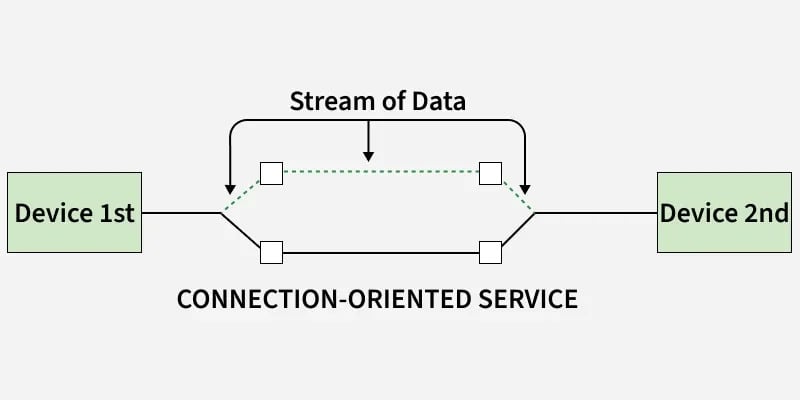
A connection-oriented service is a method of data communication in which two devices establish a logical connection before sending information. The connection remains active while data is exchanged and is closed when communication is complete. This approach is widely used when accuracy, ordering, and dependable delivery matter. A familiar example is the Transmission Control Protocol (TCP), which supports services such as web browsing, email, and file transfers.
What Is a Connection-Oriented Service?
In a connection-oriented service, the sender and receiver first agree to communicate. This setup process creates a managed path—or logical session—between the two endpoints.
Communication generally follows three stages:
- Connection establishment – The devices initiate and confirm the connection.
- Data transfer – Data is sent, tracked, and, when required, retransmitted.
- Connection termination – The devices close the session after the exchange finishes.
Because the service keeps track of the connection, it can help ensure that data reaches the destination correctly and in the intended order.
Key Features of Connection-Oriented Communication
A connection-oriented service commonly provides the following features:
- Connection setup: Devices establish a session before exchanging data.
- Reliable delivery: Lost data can be detected and sent again.
- Ordered delivery: Data is reassembled in the same sequence in which it was sent.
- Error detection: The service checks for corrupted or missing data.
- Flow control: The sender adjusts its transmission rate so the receiver is not overwhelmed.
- Session termination: The connection is intentionally closed when it is no longer needed.
The exact features depend on the protocol and network layer involved. For example, TCP provides reliable, ordered delivery at the transport layer.
How Does It Work?
Consider a user downloading a document through a TCP-based application. First, the user’s device and the server establish a connection. In TCP, this usually happens through a process known as a three-way handshake. The devices synchronize communication settings and confirm that both sides are ready. Next, the document is divided into smaller pieces of data called segments. Each segment is numbered, allowing the receiving device to place the content back into the correct order. If a segment is missing, the receiver can signal the sender to retransmit it. Finally, after the complete document arrives, the devices terminate the connection.
This managed process adds overhead, but it makes communication more dependable.
Connection-Oriented Service vs. Connectionless Service
The main difference is whether a session is established before data is transmitted.
| Feature | Connection-Oriented Service | Connectionless Service |
|---|---|---|
| Setup required | Yes | No |
| Delivery guarantee | Often provided | Not usually provided |
| Data ordering | Usually preserved | May arrive out of order |
| Error recovery | Commonly supported | Usually handled by the application, if needed |
| Speed and overhead | More overhead | Lower overhead |
| Common example | TCP | UDP |
A connectionless service sends packets independently, without first creating a dedicated logical session. This can be useful when speed matters more than perfect delivery, such as live streaming, online gaming, or real-time voice communication.
Advantages of Connection-Oriented Services
Connection-oriented communication is valuable for applications that cannot tolerate missing, duplicated, or out-of-order data.
- Reliable Data Delivery: The protocol can acknowledge received data and retransmit information that did not arrive successfully. This is essential for tasks such as downloading files, processing payments, or synchronizing databases.
- Correct Data Order: When a large message is broken into smaller pieces, those pieces may travel through a network differently. A connection-oriented service can restore them to their original order before delivering them to the application.
- Better Flow Management: A fast sender can overload a slower receiver. Flow-control mechanisms help regulate transmission so both sides can communicate efficiently.
- Clear Communication Lifecycle: Opening and closing a connection provides a structured communication process. Applications can use this structure to manage resources, authenticate sessions, and detect when a peer becomes unavailable.
Disadvantages of Connection-Oriented Services
Despite their reliability, connection-oriented services are not ideal for every use case.
- Extra delay: Establishing a connection takes time before data transfer begins.
- More network overhead: Acknowledgments, sequence numbers, and control messages consume bandwidth.
- Resource usage: Devices must maintain connection state for active sessions.
- Potential performance tradeoff: Repeated retransmissions may be undesirable for real-time media, where an old packet can be less useful than the next one.
For these reasons, system designers choose connection-oriented or connectionless communication based on the application’s priorities.
Some Examples
TCP
TCP is the best-known connection-oriented transport protocol. It provides reliable, ordered, error-checked delivery of data between applications.
Common TCP-based uses include:
- Web traffic using HTTP/1.1 and HTTP/2
- Email protocols such as SMTP, IMAP, and POP3
- File transfers
- Remote administration tools
- Database connections
SCTP
Stream Control Transmission Protocol (SCTP) is another connection-oriented transport protocol. It supports features such as multi-streaming and multi-homing, making it useful in specialized telecommunications and signaling applications.
Virtual-Circuit Networks
Some network-layer technologies also use connection-oriented concepts. They may establish a virtual circuit before forwarding data, giving traffic a defined logical path through the network.
When Should You Use a Connection-Oriented Service?
Choose a connection-oriented service when the application needs:
- Complete and accurate data transfer
- Predictable ordering of messages
- Recovery from loss or corruption
- Controlled communication between known endpoints
- A persistent session for transactions or stateful applications
It is especially suitable for file transfers, web applications, banking systems, enterprise software, and database operations.
Conclusion
A connection-oriented service establishes and manages communication between two endpoints before data transfer begins. Its reliability, sequencing, flow control, and error recovery make it a strong choice for applications where complete and accurate delivery matters. While connectionless services are often better for low-latency, real-time traffic, connection-oriented communication remains fundamental to dependable internet and enterprise networking.