Complementary Code Keying (CCK): A Guide to 802.11b Wi‑Fi Modulation
Complementary Code Keying (CCK) is a wireless modulation technique best known for enabling the higher data rates of IEEE 802.11b Wi‑Fi. Introduced during the early growth of wireless LANs, CCK helped 2.4 GHz networks move beyond the original 1 Mbps and 2 Mbps speeds to reach 5.5 Mbps and 11 Mbps. While modern Wi‑Fi uses more advanced techniques, CCK remains an important part of networking history. It explains how early Wi‑Fi devices delivered faster wireless connections while preserving compatibility with existing 802.11 equipment.
What Is Complementary Code Keying?
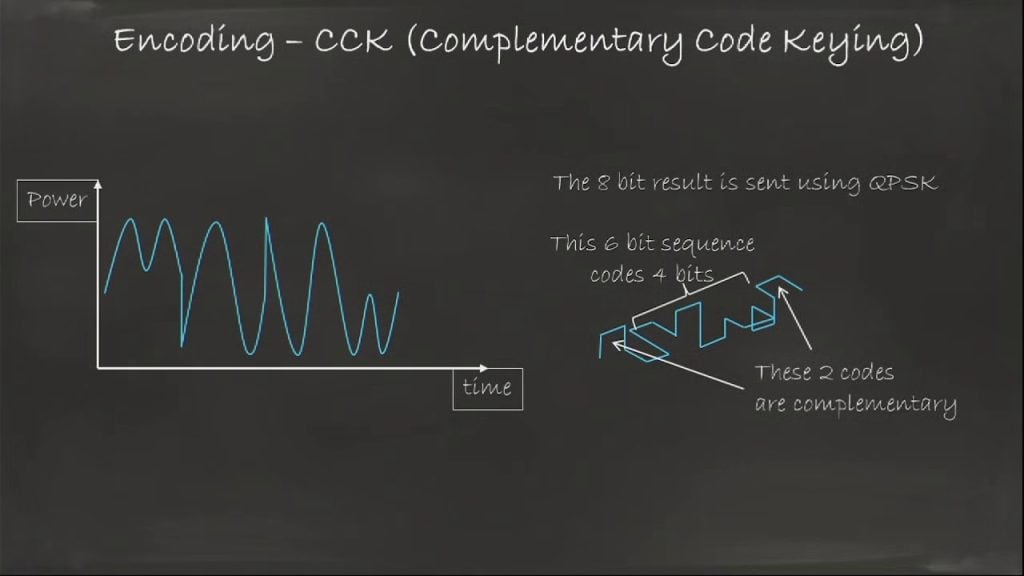
Complementary Code Keying is a coding and modulation method that represents data with specially selected sequences of signal “chips.” In 802.11b, each CCK symbol contains eight complex chips transmitted at an 11 Mchip/s rate.
Instead of assigning a single bit pattern to every chip independently, CCK uses a structured codeword. The receiver recognizes the selected sequence and translates it back into the original data. This approach lets a wireless device transmit more information per symbol than the earlier Barker-code method used by the original IEEE 802.11 physical layer.
CCK is used specifically for the 5.5 Mbps and 11 Mbps modes of 802.11b.
How CCK Works
At a high level, Complementary Code Keying converts incoming bits into one of several predefined eight-chip codewords. Each chip has a phase associated with quadrature phase-shift keying (QPSK), and the full sequence carries the data.
The process works as follows:
- A transmitter groups the data into symbols.
- It maps the bits to phase values and a valid eight-chip CCK codeword.
- It sends the eight chips over the 2.4 GHz wireless channel.
- The receiver correlates the received signal with expected CCK sequences.
- It selects the most likely codeword and recovers the transmitted bits.
At 5.5 Mbps, a CCK symbol represents four data bits. At 11 Mbps, it represents eight data bits. Because the chip rate remains 11 Mchip/s and each symbol contains eight chips, the symbol rate is 1.375 million symbols per second.
| 802.11b rate | Modulation/coding approach | Bits per CCK symbol |
|---|---|---|
| 1 Mbps | DSSS with DBPSK | N/A |
| 2 Mbps | DSSS with DQPSK | N/A |
| 5.5 Mbps | CCK | 4 |
| 11 Mbps | CCK | 8 |
Why CCK Was Important for 802.11b
Before 802.11b, early 802.11 WLANs used an 11-chip Barker sequence for direct-sequence spread spectrum (DSSS) transmissions. That approach supported 1 Mbps and 2 Mbps data rates, but it could not efficiently provide the faster speeds the market wanted.
CCK provided a practical upgrade path. It used the same 2.4 GHz band and fit within the high-rate direct-sequence framework, allowing 802.11b equipment to maintain interoperability with lower-rate 802.11 devices. The result was a maximum nominal data rate of 11 Mbps—a major improvement for early home and office wireless networks.
Complementary Code Keying vs. Barker Coding
CCK and Barker coding both support spread-spectrum wireless communication, but they serve different performance levels.
Barker coding uses a fixed 11-chip sequence. Its predictable structure supports robust low-rate transmissions, but it limits how much information can be carried in each symbol.
CCK uses eight-chip complementary codewords and phase choices to encode more bits per symbol. This greater coding flexibility is what allows 802.11b to offer 5.5 Mbps and 11 Mbps modes.
In simple terms, Barker coding prioritizes basic, lower-speed communication, while CCK increases the amount of data sent during the same general transmission interval.
Advantages of Complementary Code Keying
CCK was well suited to the Wi‑Fi market of its time because it offered several meaningful benefits:
- Higher throughput: It enabled the 5.5 Mbps and 11 Mbps rates associated with 802.11b.
- Backward compatibility: It worked alongside the original 1 Mbps and 2 Mbps 802.11 modes.
- Efficient use of symbols: CCK encoded four or eight bits within one eight-chip symbol.
- Practical receiver design: Receivers could use correlation to identify valid CCK codewords in the received signal.
Limitations of CCK
CCK was innovative for early Wi‑Fi, but it has important limitations by modern standards.
First, 802.11b operates in the crowded 2.4 GHz band, where interference from neighboring Wi‑Fi networks, Bluetooth devices, microwave ovens, and other equipment can affect performance. Second, the maximum 11 Mbps physical-layer rate is far below the speeds available from later Wi‑Fi standards.
As Wi‑Fi evolved, technologies such as OFDM, MIMO, wider channels, and higher-order modulation became the preferred ways to increase capacity and reliability. CCK is therefore mainly encountered today in legacy compatibility modes rather than in high-performance wireless networking.
Is CCK Still Used Today?
CCK is largely a legacy technology. Modern Wi‑Fi networks normally use newer 802.11 standards and modulation methods, but some devices may retain 802.11b compatibility for older clients. In those cases, CCK can still be used when a connection falls back to 5.5 Mbps or 11 Mbps operation.
For most current network deployments, CCK is relevant as a foundational technology rather than a configuration choice.
Conclusion
Complementary Code Keying was a key step in the development of Wi‑Fi. By encoding more data into structured eight-chip codewords, CCK enabled 802.11b to deliver 5.5 Mbps and 11 Mbps connections while remaining compatible with earlier wireless devices. It is no longer a leading-edge Wi‑Fi technology, but understanding CCK provides useful context for how wireless networking evolved from basic low-rate links into the high-speed systems used today.