Phase Shift Keying (PSK): Definition, Types, Working Principle, and Applications
What Is Phase Shift Keying (PSK)?
Phase Shift Keying (PSK) is a digital modulation technique used to transmit digital data by changing the phase of a carrier signal. It is widely used in wireless communication, satellite systems, digital broadcasting, and modern data transmission technologies. In PSK, the carrier signal maintains a constant frequency and amplitude while its phase changes according to the digital information being transmitted. Each phase value represents one or more bits of data, depending on the PSK scheme.
Phase shift keying is an important technique in digital communications because it offers good noise resistance, efficient bandwidth utilization, and reliable data transmission.
How Does PSK Work?
Phase shift keying works by mapping digital data to specific phase angles of a carrier wave. A transmitter converts binary data into symbols, assigns a phase to each symbol, and sends the resulting modulated signal through a communication channel.
At the receiving end, a demodulator analyzes the phase of the received signal and determines which symbol was transmitted. The recovered symbols are then converted back into binary data.
The basic process involves the following steps:
- Data input: The transmitter receives a stream of binary bits.
- Symbol mapping: The bits are grouped and assigned to predefined phase values.
- Phase modulation: The carrier signal’s phase changes according to the selected symbol.
- Signal transmission: The modulated signal travels through a wired or wireless communication channel.
- Demodulation: The receiver estimates the phase of the incoming signal.
- Data recovery: The detected symbols are converted back into the original binary sequence.
For example, Binary Phase Shift Keying (BPSK) uses two different phase states, typically 0° and 180°, to represent binary 0 and 1. The receiver distinguishes between these two states to recover the transmitted data.
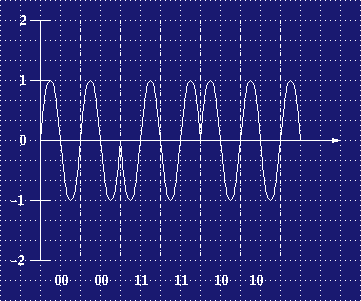
Types of Phase Shift Keying
Several PSK schemes are used in digital communication systems. They differ in the number of phase states, the number of bits transmitted per symbol, and their sensitivity to noise.
1. Binary Phase Shift Keying (BPSK)
Binary Phase Shift Keying is the simplest form of PSK. It uses two phase states separated by 180 degrees to represent binary data.
Each symbol carries one bit of information.
For example:
- Binary 0: 0° phase
- Binary 1: 180° phase
The exact phase assignments depend on the system’s modulation convention.
BPSK provides strong noise resistance and a relatively low error rate under comparable signal conditions. However, it transmits fewer bits per symbol than higher-order PSK schemes.
Applications: Satellite communication, telemetry, deep-space communication, and robust wireless data links.
2. Quadrature Phase Shift Keying (QPSK)
Quadrature Phase Shift Keying uses four distinct phase states to represent four possible symbols. Each symbol carries two bits of information.
A common implementation uses phase states separated by 90 degrees, although the precise phase mapping varies by system.
For example, the four symbols can represent the bit pairs 00, 01, 10, and 11.
Because QPSK transmits two bits per symbol, it can achieve twice the bit rate of BPSK at the same symbol rate. Alternatively, it can transmit the same bit rate using half the symbol rate.
QPSK is widely used in cellular networks, satellite links, and digital communication systems.
3. Differential Phase Shift Keying (DPSK)
Differential Phase Shift Keying encodes information in the phase difference between consecutive symbols rather than relying solely on an absolute carrier phase.
The receiver compares the phase of the current symbol with that of the previous symbol to determine the transmitted data.
DPSK can reduce the need for precise carrier-phase synchronization. However, differential detection generally has a performance penalty compared with ideal coherent detection under equivalent conditions.
Applications: Certain wireless communication systems, optical communication schemes, and systems where simpler phase recovery is desirable.
4. Differential Quadrature Phase Shift Keying (DQPSK)
Differential Quadrature Phase Shift Keying combines differential encoding with four possible phase changes. Each symbol can represent two bits, with the information carried by the change in phase between successive symbols.
DQPSK can simplify some receiver designs because it does not require the same form of absolute phase reference as coherent QPSK detection.
It is useful in communication systems that prioritize practical receiver implementation and reliable data recovery.
5. 8-Phase Shift Keying (8-PSK)
8-PSK uses eight distinct phase states to represent eight possible symbols. Each symbol carries three bits of information because (2^3 = 8).
This approach increases spectral efficiency compared with BPSK and QPSK at the same symbol rate.
However, the phase states are closer together, making 8-PSK more sensitive to noise and phase errors. It generally requires a better signal-to-noise ratio to achieve the same error performance as lower-order schemes.
Applications: Some satellite communication systems and digital radio technologies.
6. Higher-Order PSK
Higher-order PSK schemes use more than eight phase states to encode additional bits per symbol. For example, 16-PSK uses 16 phase states and carries four bits per symbol.
Although higher-order PSK can improve spectral efficiency, the smaller angular separation between phase states makes accurate detection more difficult in noisy channels.
As a result, higher-order PSK is selected when bandwidth efficiency is important, and the communication channel provides sufficient signal quality.
Phase Shift Keying vs. Other Digital Modulation Techniques
Phase shift keying is one of several digital modulation methods. Other common techniques include Amplitude Shift Keying (ASK), Frequency Shift Keying (FSK), and Quadrature Amplitude Modulation (QAM).
| Feature | PSK | ASK | FSK | QAM |
|---|---|---|---|---|
| Modulated property | Phase | Amplitude | Frequency | Amplitude and phase |
| Noise resistance | Generally good | Sensitive to amplitude noise | Often robust, depending on design | Depends on constellation and signal quality |
| Spectral efficiency | Moderate to high | Often lower | Often lower for comparable designs | High |
| Receiver complexity | Moderate | Low to moderate | Low to moderate | Moderate to high |
| Typical applications | Wireless and satellite links | Optical and simple digital links | Radio and low-power links | Broadband and high-data-rate systems |
Actual performance depends on the modulation order, channel conditions, coding, filtering, and receiver design. No single modulation technique is best for every application.
Advantages of Phase Shift Keying
PSK offers several advantages that make it useful in modern communication systems.
- Good Noise Performance – PSK can provide reliable data transmission in noisy environments. BPSK, in particular, offers strong error performance for a given energy per bit in an additive white Gaussian noise channel with coherent detection.
- Efficient Use of Bandwidth – Higher-order PSK schemes transmit more bits per symbol without necessarily increasing the symbol rate. This can improve bandwidth efficiency.
- Constant Envelope – Ideal PSK maintains a constant signal amplitude. This can make it suitable for systems that use efficient nonlinear power amplifiers, although practical implementations and filtering may introduce amplitude variations.
- Wide Range of Applications – PSK supports applications ranging from simple, robust telemetry links to more advanced wireless and satellite communication systems.
- Flexible Modulation Options – Communication systems can select BPSK, QPSK, or higher-order PSK based on bandwidth requirements, signal quality, and implementation complexity.
Disadvantages of Phase Shift Keying
Despite its advantages, PSK has several limitations.
- Phase Synchronization Requirements – Coherent PSK receivers must estimate the carrier phase accurately. Phase synchronization errors can lead to incorrect symbol detection.
- Increasing Complexity at Higher Orders – As the number of phase states increases, the receiver must distinguish between more closely spaced symbols. This makes accurate detection more challenging.
- Sensitivity to Phase Noise – Oscillator instability, channel effects, and phase noise can alter the received phase and increase the probability of bit errors.
- Potential Error Propagation in Differential Systems – Differential schemes determine information from phase changes between symbols. An incorrect symbol decision can affect the interpretation of neighboring symbols, depending on the encoding and detection method.
Applications of Phase Shift Keying
PSK is used in a wide variety of digital communication technologies.
- Satellite communication: BPSK and QPSK are used in satellite telemetry, data links, and broadcasting systems.
- Cellular networks: QPSK and related phase-based modulation schemes are used in cellular radio interfaces, including LTE and 5G New Radio, depending on the channel and transmission configuration.
- Wi-Fi: Wireless LAN standards use modulation schemes that include BPSK and QPSK for particular data rates and operating conditions.
- Digital broadcasting: PSK-based modulation is used in several digital radio and satellite broadcasting systems.
- Optical communication: Differential PSK and related phase modulation formats can transmit data through optical fiber.
- Telemetry and remote sensing: PSK supports the transmission of measurement data and control information from remote devices.
- Radio communication: PSK is suitable for digital radio links that require reliable communication and efficient bandwidth usage.
The modulation scheme selected for a specific application depends on the required data rate, available bandwidth, signal-to-noise ratio, and system design.
Difference Between BPSK and QPSK
BPSK and QPSK are two widely used PSK schemes, but they differ in the number of symbols and the amount of data transmitted per symbol.
| Feature | BPSK | QPSK |
|---|---|---|
| Number of phase states | 2 | 4 |
| Bits per symbol | 1 | 2 |
| Phase separation | 180° | 90° between adjacent states |
| Spectral efficiency | Lower | Higher |
| Receiver complexity | Relatively simple | Somewhat more complex |
| Typical use | Robust, low-rate links | Higher-rate wireless and satellite links |
At the same symbol rate, QPSK carries twice as many bits as BPSK. With ideal coherent detection and Gray coding, QPSK can achieve the same theoretical BER as BPSK at the same (E_b/N_0) in an additive white Gaussian noise channel.
This makes QPSK a useful choice when higher data rates are needed without proportionally increasing the symbol rate.
Conclusion
Phase Shift Keying (PSK) is a fundamental digital modulation technique that encodes information by changing the phase of a carrier signal. Its combination of noise performance, bandwidth efficiency, and flexible modulation schemes makes it valuable in wireless networks, satellite communication, digital broadcasting, and other data transmission systems. BPSK provides robust communication with one bit per symbol, while QPSK and higher-order PSK schemes improve spectral efficiency by transmitting more bits per symbol. Choosing the appropriate PSK scheme requires balancing data rate, bandwidth, noise tolerance, synchronization requirements, and implementation complexity.
Understanding phase shift keying is essential for learning digital communications and designing efficient, reliable data transmission systems.