Radio Wave Transmission: How It Works, Types, and Uses
Radio wave transmission is the process of sending information through electromagnetic waves. It makes wireless communication possible, powering everything from AM/FM broadcasts and mobile phones to Wi-Fi, GPS, satellite links, and emergency radio systems. Unlike wired communication, radio transmission carries signals through the air, space, or other environments without a physical cable between the transmitter and receiver. Understanding how it works helps explain why signal strength, range, speed, and reliability can vary between devices and locations.
What Is Radio Wave Transmission?
Radio waves are a form of electromagnetic radiation. They travel at the speed of light and are commonly used to carry audio, video, digital data, and control signals over distance.
A basic radio wave transmission system has three main parts:
- Transmitter: Creates and sends a radio signal.
- Antenna: Converts electrical energy into radio waves and radiates them.
- Receiver: Captures the radio waves and converts them back into usable information.
For example, a radio station converts sound into an electrical signal, adds that signal to a radio-frequency carrier wave, and broadcasts it through an antenna. A radio receiver then selects the correct station, removes the carrier wave, and plays the original audio.
How Does It Work?
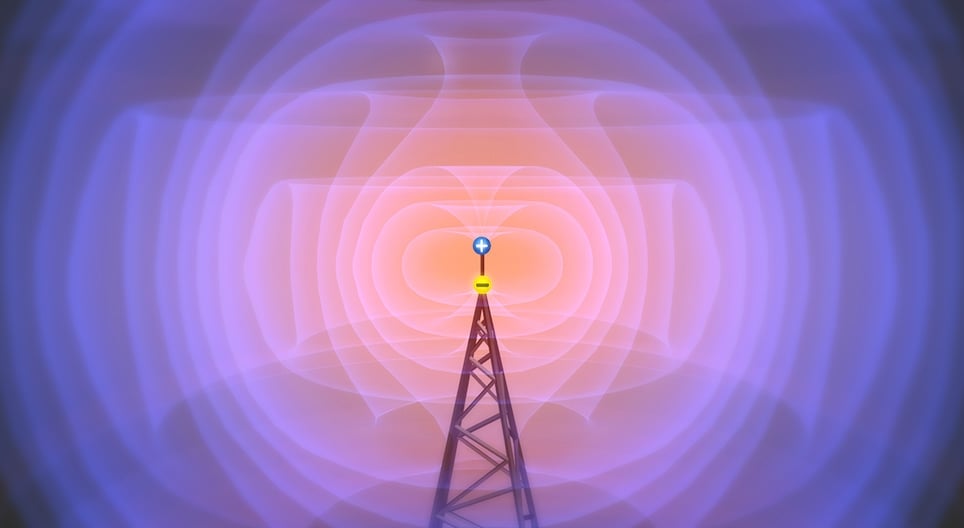
Radio wave transmission begins when a transmitter produces an alternating electrical current at a chosen frequency. When this current reaches an antenna, it creates electromagnetic waves that travel outward.
To carry meaningful information, the signal is usually modified through a process called modulation. The receiver detects the transmitted wave, identifies the intended signal, and demodulates it to recover the original voice, music, image, or data.
The process can be summarized as:
- Information is created, such as voice or digital data.
- The information modulates a carrier wave.
- An antenna transmits the radio wave.
- The wave travels through space or the atmosphere.
- A receiving antenna captures the signal.
- The receiver demodulates and processes the information.
Frequency and Wavelength in Radio Transmission
Frequency is one of the most important factors in radio wave transmission. It measures how many wave cycles occur each second and is expressed in hertz (Hz).
Higher-frequency signals have shorter wavelengths, while lower-frequency signals have longer wavelengths. This affects how signals behave in the real world.
Lower-frequency radio waves can often travel farther and bend around obstacles more effectively. Higher-frequency waves can support more data capacity but are more likely to be weakened by walls, rain, terrain, and other obstructions.
Common frequency ranges include:
- AM radio: Long-distance broadcasting, especially at night.
- FM radio: Higher-quality local audio broadcasting.
- VHF and UHF: Television, aviation, public safety, and two-way radio.
- Microwave bands: Cellular networks, Wi-Fi, radar, and satellite communication.
- Millimeter-wave bands: High-capacity 5G and specialized communications.
Types of Radio Wave Propagation
Radio signals do not all travel the same way. Their path depends on frequency, antenna height, terrain, weather, and atmospheric conditions.
- Ground-Wave Propagation – Ground waves travel along the Earth’s surface. They are commonly associated with lower-frequency signals and can cover substantial distances, especially over conductive ground or water.
- Skywave Propagation – Skywave transmission occurs when radio waves are reflected or refracted by the ionosphere and returned toward Earth. This allows some shortwave broadcasts and amateur radio signals to travel far beyond the horizon.
- Line-of-Sight Propagation – Higher-frequency signals, including many television, cellular, microwave, and Wi-Fi signals, generally travel in a line-of-sight path. Buildings, hills, trees, and the Earth’s curvature can limit their range.
- Satellite Transmission – Satellite communication sends radio waves from a ground station to a satellite and then back to another location on Earth. It supports television distribution, navigation, remote internet access, weather monitoring, and global communications.
Modulation Methods Used in Radio Wave Transmission
Modulation changes a carrier wave so it can carry information. Different modulation methods serve different communication needs.
- Amplitude Modulation (AM) – AM varies the strength, or amplitude, of a carrier wave. It is widely used in traditional AM broadcasting and can cover long distances, but it is more vulnerable to electrical noise.
- Frequency Modulation (FM) – FM varies the frequency of a carrier wave. It typically delivers better audio quality and greater resistance to interference than AM, making it common in music broadcasting.
- Digital Modulation – Modern wireless systems use digital modulation techniques to transmit data efficiently. Technologies such as Wi-Fi, 4G, 5G, Bluetooth, and satellite links use advanced digital methods to increase speed, reliability, and capacity.
Factors That Affect Radio Signal Strength
Several environmental and technical factors influence the quality of radio wave transmission.
- Distance – Signal power decreases as the distance between the transmitter and receiver increases. More distant receivers may need stronger transmitters, larger antennas, repeaters, or better signal processing.
- Obstacles – Concrete walls, metal structures, hills, dense vegetation, and buildings can reflect, absorb, or block radio waves. This is why a phone or Wi-Fi signal may weaken indoors.
- Interference – Interference happens when unwanted signals affect a receiver. It may come from other transmitters, electrical equipment, poorly shielded devices, or overlapping wireless networks.
- Weather and Atmosphere – Rain, fog, and atmospheric conditions can affect certain frequency bands. High-frequency microwave and satellite links are particularly susceptible to rain attenuation.
- Antenna Design and Placement – An antenna’s height, direction, polarization, gain, and placement have a major impact on radio performance. Raising an antenna and keeping it clear of large obstructions can often improve coverage.
Everyday Applications of Radio Wave Transmission
Radio wave transmission supports much of modern life. Common applications include:
- AM, FM, and digital radio broadcasting
- Mobile phone networks
- Wi-Fi and Bluetooth connections
- Television broadcasting
- GPS and other satellite navigation systems
- Air traffic control and aviation communication
- Emergency services and disaster response
- Radar systems for weather, aviation, and defense
- Remote controls, sensors, and Internet of Things devices
- Spacecraft and satellite communication
How to Improve Radio Wave Transmission
Improving a wireless link usually involves balancing coverage, capacity, cost, and regulatory requirements. Common approaches include selecting an appropriate frequency, improving antenna placement, reducing nearby interference, using directional antennas, and installing repeaters or signal boosters where permitted.
For digital networks, error correction, adaptive modulation, channel planning, and multiple-antenna technologies can help maintain reliable communication under changing conditions. It is also important to follow local spectrum regulations. Many radio frequencies require licensing or must operate within specified power limits to prevent harmful interference.
Conclusion
Radio wave transmission is the foundation of wireless communication. By using antennas, carrier waves, modulation, and carefully selected frequencies, it enables devices and systems can exchange information without cables.
From local Wi-Fi networks to global satellite services, radio transmission remains essential to communication, navigation, broadcasting, safety, and connected technology. As wireless systems continue to evolve, efficient and reliable radio wave transmission will remain central to how people and devices stay connected.