Route Poisoning in Networking: Definition, How It Works, and Benefits
What Is Route Poisoning?
Route poisoning is a networking technique used in distance-vector routing protocols to prevent routing loops. When a router detects that a route has become invalid or unreachable, it marks the route with an infinite metric (commonly 16 in the Routing Information Protocol, or RIP) and advertises this update to neighboring routers. This process ensures that other routers remove the faulty route from their routing tables, maintaining efficient and stable network operations.
In simple terms, route poisoning acts like a warning signal in a network: once a route is broken, routers immediately tell others not to use it.
How Does It Work?
The process of route poisoning typically follows these steps:
- Failure Detection – A router identifies that a network path has failed or become unreachable.
- Marking the Route – The router assigns an infinite metric to the route (in RIP, a hop count of 16), signaling that the destination is no longer reachable.
- Broadcasting the Poisoned Route – The router sends the poisoned route update to all its neighboring routers.
- Neighbor Updates – Neighboring routers remove the failed route from their routing tables and propagate the poisoned route to their own neighbors.
- Loop Prevention with Hold-Down Timers – To avoid receiving incorrect updates, routers may use hold-down timers, which delay acceptance of new routes until stability is confirmed.
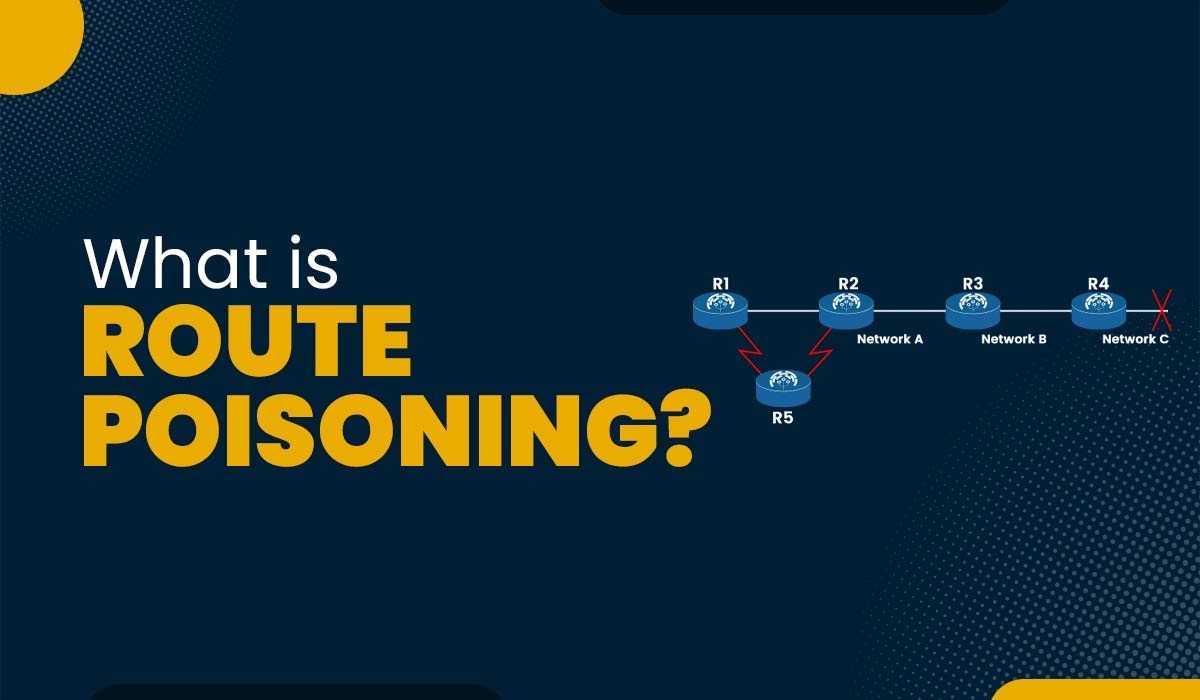
Example of Route Poisoning in RIP
Imagine Router A loses connectivity to Network X:
- Router A sets the metric for Network X to 16 (infinite).
- Router A broadcasts this update to Router B and Router C.
- Routers B and C remove Network X from their routing tables and share the update with their neighbors.
- This prevents routing loops and ensures no traffic is sent toward the unreachable Network X.
Benefits of Route Poisoning
- Prevents Routing Loops: Stops data packets from endlessly circulating in the network.
- Ensures Faster Convergence: Helps networks quickly adapt to topology changes.
- Improves Stability: Reduces the chances of incorrect routing information spreading.
- Works with Split Horizon and Hold-Down Timers: Provides a layered defense against routing errors.
Route Poisoning vs. Other Loop Prevention Techniques
| Technique | Description | Key Purpose |
|---|---|---|
| Route Poisoning | Marks a failed route as unreachable with an infinite metric | Stops use of invalid routes |
| Split Horizon | Prevents a router from advertising a route back to the router it learned from | Prevents two-router loops |
| Hold-Down Timers | Delays acceptance of potentially incorrect updates | Improves stability after failures |
Together, these methods ensure reliable distance-vector routing.
Conclusion
Route poisoning is a critical mechanism in distance-vector routing protocols like RIP. By assigning an infinite metric to unreachable routes, it prevents routing loops, speeds up network convergence, and ensures stable communication. When combined with split-horizon and hold-down timers, route poisoning plays a key role in keeping modern networks efficient and resilient.
If you’re managing a network using RIP or another distance-vector protocol, understanding and properly configuring route poisoning can significantly improve your network’s reliability and performance.