Token Bus: Definition, Working, Advantages, and Disadvantages
What Is Token Bus?
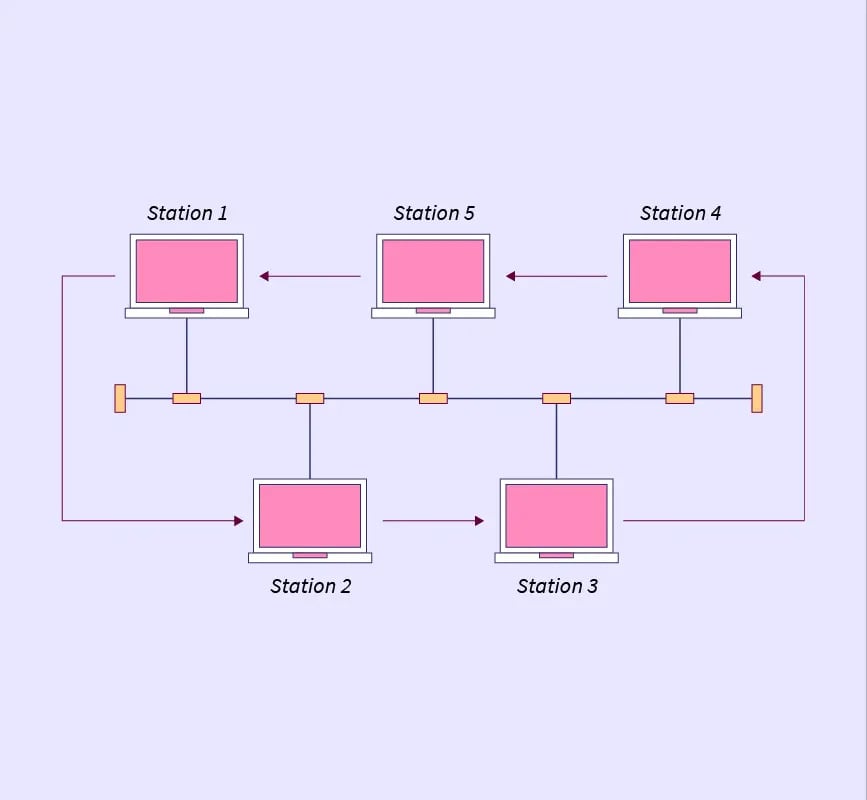
Token bus is a network access method in which computers and other devices share a common bus network while using a logical ring to control access to the transmission medium. Each device can transmit data only when it receives a special control message called a token. Token bus combines the physical structure of a bus topology with the logical structure of a ring topology. Unlike traditional bus networks that may use contention-based access, token bus provides an organized mechanism for determining which device can transmit data at a given time.
Token bus was standardized as IEEE 802.4 and was primarily designed for industrial automation, manufacturing environments, and other applications that require predictable communication delays.
How Does Token Bus Work?
Token bus uses a token-passing mechanism to coordinate communication between devices. The token circulates among participating stations in a predetermined logical order, allowing each station an opportunity to transmit data.
The token bus process works as follows:
-
Network initialization: Devices establish a logical ring order even though they are physically connected to a shared bus cable.
-
Token transmission: One station receives the token and gains permission to transmit data.
-
Data transmission: The station sends its data frames over the shared communication medium. It must follow the protocol’s transmission-time limits.
-
Token transfer: After completing its transmission, the station passes the token to the next station in the logical ring.
-
Continuous operation: The process repeats, allowing other stations to transmit when their turns arrive.
If a station has no data to send, it can pass the token to the next station without transmitting a data frame. This helps prevent idle stations from unnecessarily delaying communication.
Token bus also includes procedures for handling problems such as lost tokens, duplicate tokens, and changes in network membership.
Token Bus Topology
Token bus has two distinct network structures:
-
Physical topology: Devices connect to a common bus cable.
-
Logical topology: Devices form a ring that determines the order in which the token is passed.
For example, devices may be connected physically in the order A, B, C, and D along a shared cable. However, the logical token-passing order is determined by the network protocol rather than simply by the physical cable layout.
This arrangement allows token bus to use a shared transmission medium while providing controlled access to the network.
Key Features of Token Bus
Token bus offers several features that distinguish it from other network access methods.
- Token-Passing Mechanism – The token grants permission to transmit data. Only the station holding the token can initiate normal data transmission, helping prevent collisions caused by multiple stations transmitting simultaneously.
- Deterministic Access – Token bus provides a predictable order of network access. Under stable network conditions and configured transmission limits, devices can estimate when they will next receive permission to transmit.
- Physical Bus and Logical Ring – The network uses a physical bus topology but organizes communication through a logical ring. This makes token bus different from token ring, which typically uses a ring-based physical or logical arrangement implemented with ring-oriented connectivity.
- Priority Support – IEEE 802.4 supports multiple traffic priorities, allowing time-sensitive or higher-priority data to receive preferential treatment according to the protocol’s access rules.
- Industrial Network Support – Token bus was designed with industrial communication requirements in mind, including orderly access to a shared medium and predictable transmission behavior.
Some Advantages
Token bus has several advantages in environments where controlled network access is important.
-
Collision avoidance: Token passing prevents ordinary stations from independently transmitting at the same time.
-
Predictable access: Each station receives an opportunity to transmit according to the logical ring and protocol rules.
-
Efficient bandwidth coordination: Stations do not need to compete continuously for access through random contention.
-
Priority-based communication: Different traffic priorities can support applications with different timing requirements.
-
Suitable for industrial environments: Its controlled access method makes it useful for explaining and designing deterministic communication systems.
These advantages are especially relevant when multiple devices share a communication medium and uncontrolled contention could interfere with time-sensitive operations.
Some Disadvantages
Despite its advantages, token bus also has limitations.
-
Protocol complexity: Establishing and maintaining the logical ring requires additional control mechanisms.
-
Token management overhead: The network must manage token circulation and recover from token-related errors.
-
Potential delays: A station may need to wait for the token to circulate before it can transmit.
-
Network maintenance: Adding or removing stations can require changes to the logical ring.
-
Limited modern adoption: Token bus is largely a legacy technology and is less common in contemporary Ethernet-based networks.
Although the protocol can provide predictable access, actual performance depends on network configuration, traffic load, transmission limits, and error-recovery behavior.
Token Bus vs. Token Ring
Token bus and token ring both use token passing to coordinate network access, but they differ in their network organization.
| Feature | Token Bus | Token Ring |
|---|---|---|
| IEEE standard | IEEE 802.4 | IEEE 802.5 |
| Physical topology | Bus | Traditionally ring-oriented |
| Logical topology | Ring | Ring |
| Access method | Token passing | Token passing |
| Collision control | Controlled access through the token | Controlled access through the token |
| Historical applications | Industrial automation and manufacturing | Local area networks in enterprise environments |
The main difference is that token bus uses a shared physical bus while maintaining a logical ring. Token ring organizes stations into a ring-based communication arrangement.
Both approaches were developed to provide orderly access to shared network resources, but neither is as widely deployed today as modern Ethernet technologies.
Token Bus vs. Ethernet
Token bus and Ethernet use different approaches to controlling access to a network.
Traditional shared-medium Ethernet originally used CSMA/CD (Carrier Sense Multiple Access with Collision Detection). Devices checked whether the medium was busy and handled collisions when they occurred.
Token bus, in contrast, uses token passing to determine which station can transmit.
Modern switched Ethernet networks generally use full-duplex links, which allow devices to transmit and receive simultaneously without the traditional shared-medium collision behavior. As a result, modern Ethernet does not normally need token passing to coordinate access.
| Feature | Token Bus | Modern Switched Ethernet |
|---|---|---|
| Access control | Token passing | Dedicated switched links |
| Physical organization | Shared bus | Star-like connection to switches |
| Collisions | Prevented by controlled token access | Not expected on full-duplex links |
| Predictability | Protocol-controlled transmission opportunities | Depends on network design and traffic management |
| Current usage | Primarily historical or specialized legacy systems | Widely used in modern networks |
Applications of Token Bus
Token bus was developed primarily for industrial and automation applications where network communication needed to be organized and predictable.
- Industrial Automation – Factories use communication networks to exchange information among controllers, sensors, actuators, and other equipment. Token bus was designed to support orderly data exchange in these environments.
- Manufacturing Systems – Manufacturing environments can involve multiple machines sharing communication resources. Token bus provides a controlled access mechanism that can help coordinate communication among participating devices.
- Process Control – Industrial process-control systems may require regular communication between monitoring equipment and controllers. Token bus’s scheduled access characteristics made it relevant to historical systems with deterministic communication requirements.
- Industrial Networking Education – Token bus remains useful for learning about network topologies, token-passing protocols, medium-access control, and the development of industrial communication standards.
These applications primarily describe the protocol’s historical role; contemporary installations commonly use newer industrial Ethernet and fieldbus technologies.
Is Token Bus Still Used Today?
Token bus is no longer a mainstream networking technology. Ethernet-based industrial networks and other modern communication systems have largely replaced it in new deployments. However, understanding token bus remains valuable for networking students, engineers studying legacy industrial systems, and professionals comparing different medium-access control methods. Its approach to predictable access also illustrates an important networking principle: controlling when devices transmit can reduce contention and make communication timing easier to manage.
Conclusion
Token bus is a network access protocol standardized as IEEE 802.4 that combines a physical bus topology with a logical ring topology. It uses token passing to regulate which device can transmit data, helping prevent collisions and provide predictable access to a shared communication medium. Although token bus played an important role in the development of industrial networking, it has largely been superseded by modern Ethernet-based technologies. Its concepts remain relevant for understanding network topologies, deterministic communication, token-passing protocols, and the evolution of computer networks.