What Is a Distance Vector Routing Protocol?
Distance Vector Routing Protocol is one of the foundational routing methods used in computer networks. It enables routers to determine the best path for forwarding data packets by exchanging routing information with neighboring routers. Although modern enterprise networks often use more advanced routing protocols, distance vector routing remains an essential concept for understanding network routing and internetwork communication. In this comprehensive guide, you’ll learn what a distance vector routing protocol is, how it works, its advantages and disadvantages, and real-world examples.
What Is a Distance Vector Routing Protocol?
A distance vector routing protocol is a routing method where routers share information about the distance and direction (vector) to network destinations. Each router maintains a routing table containing:
- Destination networks
- Distance (metric) to each destination
- Next-hop router for reaching the destination
The protocol periodically exchanges routing updates with neighboring routers, allowing the network to adapt to topology changes.
Key Components
Distance
- Represents the cost of reaching a destination.
- Usually measured in hop count, bandwidth, delay, or other metrics.
Vector
- Indicates the direction or next-hop router to reach the destination.
Together, distance and vector help routers determine the most efficient route through a network.
How Distance Vector Routing Works
Distance vector routing follows the Bellman-Ford algorithm, which calculates the shortest path to a destination based on information received from neighboring routers.
Step-by-Step Process
- Each router knows the networks directly connected to it.
- Routers periodically send their routing tables to neighboring routers.
- Neighboring routers compare received routes with existing routes.
- If a better path is found, the routing table is updated.
- The updated information is propagated throughout the network.
Example
Consider three routers:
Network A --- Router 1 --- Router 2 --- Router 3 --- Network BInitially:
| Router | Known Networks |
|---|---|
| Router 1 | Network A |
| Router 2 | Router 1 |
| Router 3 | Network B |
As routing updates are exchanged:
- Router 2 learns about Network A.
- Router 3 learns about Network A through Router 2.
- Router 1 learns about Network B through Router 2 and Router 3.
Eventually, all routers have complete routing information.
Routing Metrics in Distance Vector Protocols
Distance vector protocols use metrics to determine the best route.
Common metrics include:
| Metric | Description |
|---|---|
| Hop Count | Number of routers between the source and the destination |
| Delay | Time required to traverse the route |
| Bandwidth | Available network capacity |
| Reliability | Stability of the route |
| Load | Current traffic utilization |
The route with the lowest metric value is typically selected.
Characteristics of Distance Vector Routing Protocols
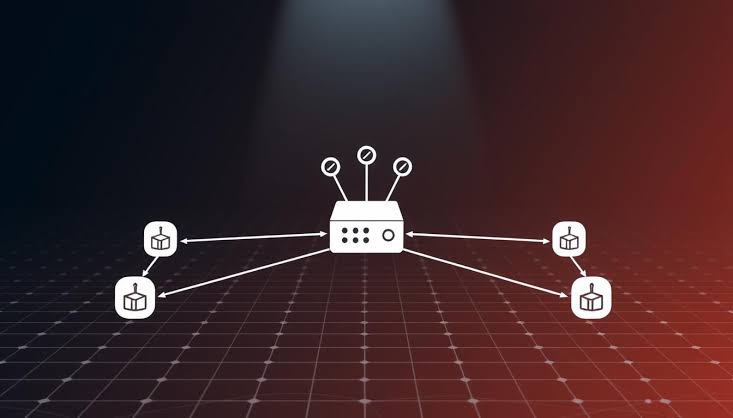
Distance vector protocols share several common characteristics:
- Periodic Updates – Routers regularly exchange routing tables, often every 30 seconds.
- Neighbor-Based Communication – Updates are sent only to directly connected neighbors rather than all routers in the network.
- Simplicity – These protocols are relatively easy to configure and manage.
- Limited Network Visibility – Routers do not maintain a complete map of the network topology.
Some Examples
1. Routing Information Protocol (RIP)
The Routing Information Protocol is the most well-known distance vector routing protocol.
Features
- Uses hop count as a metric
- Maximum hop count of 15
- Updates every 30 seconds
- Easy to configure
Advantages
- Simple implementation
- Low resource requirements
Limitations
- Poor scalability
- Slow convergence
- Limited network size
2. Interior Gateway Routing Protocol (IGRP)
Interior Gateway Routing Protocol was developed by Cisco Systems.
Features
- Composite metric system
- Supports larger networks than RIP
- Improved routing efficiency
Although largely obsolete, IGRP influenced many modern routing technologies.
3. Enhanced IGRP (EIGRP)
Enhanced Interior Gateway Routing Protocol is often classified as an advanced distance vector or hybrid routing protocol.
Features
- Fast convergence
- Reduced bandwidth usage
- Loop-free routing mechanisms
- Scalable design
EIGRP combines distance vector simplicity with link-state efficiency.
Advantages of Distance Vector Routing Protocols
- Easy Configuration – Distance vector protocols require minimal setup compared to more advanced routing methods.
- Lower Resource Usage – They consume less CPU and memory than link-state protocols.
- Suitable for Small Networks – Ideal for simple environments with limited routing complexity.
- Simple Operation – Network administrators can easily understand and troubleshoot routing behavior.
Disadvantages of Distance Vector Routing Protocols
- Slow Convergence – Network changes may take time to propagate throughout the network.
- Routing Loops – Incorrect routing information can create loops that waste bandwidth.
- Limited Scalability – Performance decreases as the network size grows.
- Periodic Update Overhead – Regular routing updates consume network bandwidth.
- Incomplete Network Knowledge – Routers only know information received from neighbors rather than the entire topology.
Common Problems in Distance Vector Routing
Count-to-Infinity Problem
A routing loop can cause routers to continually increase the metric value for an unreachable destination.
Example:
Router A → Router B → Router CIf Router C fails, Router A and B may repeatedly advertise outdated routes, causing metrics to increase indefinitely.
Routing Loops
Loops occur when routers incorrectly believe a destination can be reached through one another.
Effects include:
- Packet loss
- Increased latency
- Bandwidth waste
Loop Prevention Techniques
Distance vector protocols use several mechanisms to reduce routing issues.
- Split Horizon – Prevents a router from advertising a route back through the interface from which it was learned.
- Route Poisoning – Marks failed routes with an infinite metric value.
- Poison Reverse – Advertises failed routes back to the source with an infinite metric.
- Hold-Down Timers – Temporarily suppress updates that may contain incorrect routing information.
- Triggered Updates – Immediately send updates when a topology change occurs.
Distance Vector vs Link-State Routing
| Feature | Distance Vector | Link-State |
|---|---|---|
| Network View | Neighbor-based | Full topology |
| Convergence Speed | Slower | Faster |
| Resource Usage | Lower | Higher |
| Scalability | Limited | Excellent |
| Complexity | Simple | More complex |
| Examples | RIP, IGRP | OSPF, IS-IS |
Distance vector routing is generally preferred for smaller networks, while link-state protocols are better suited for large enterprise and service provider environments.
Real-World Applications
Distance vector routing protocols are commonly used in:
- Small business networks
- Educational labs
- Branch office deployments
- Legacy network environments
- Entry-level networking training
Despite the popularity of modern protocols, distance vector routing remains an important educational and practical networking technology.
Best Practices for Using Distance Vector Routing
To maximize network stability:
- Use route summarization where possible.
- Enable split horizon and route poisoning.
- Monitor routing tables regularly.
- Avoid large-scale deployments with basic distance vector protocols.
- Consider EIGRP or link-state alternatives for growing networks.
- Document network topology changes carefully.
Future of Distance Vector Routing
While traditional protocols like RIP have largely been replaced in enterprise environments, the principles behind distance vector routing continue to influence modern networking technologies. Understanding distance vector protocols helps network engineers build a solid foundation in routing concepts and troubleshoot diverse network infrastructures.
Conclusion
A Distance Vector Routing Protocol enables routers to determine the best paths through a network by exchanging routing information with neighboring devices. Built upon the Bellman-Ford algorithm, these protocols prioritize simplicity and low resource consumption while providing effective routing for small and medium-sized networks.
Although they face challenges such as slow convergence, routing loops, and limited scalability, mechanisms like split horizon, route poisoning, and hold-down timers help improve reliability. Understanding distance vector routing remains essential for networking professionals, as it forms the basis for many modern routing concepts and protocols.