What Is a Limited Contention Protocol?
What Is a Limited Contention Protocol?
A limited contention protocol is a medium access control (MAC) protocol used in computer networks to regulate how multiple devices share a common communication channel. It combines the advantages of contention-based protocols and controlled-access protocols to improve network efficiency under different traffic conditions.
In a shared network, multiple devices may try to transmit data at the same time, causing collisions and wasting bandwidth. Contention-based protocols, such as ALOHA and CSMA, allow devices to compete for access to the channel. Although these protocols can work efficiently when network traffic is light, their performance often decreases as the number of competing devices increases.
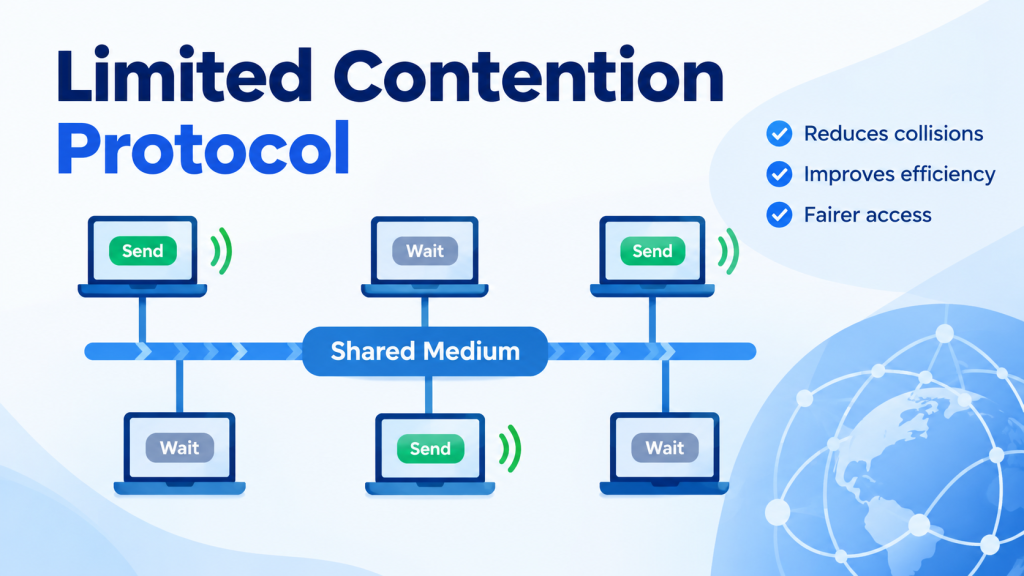
Limited contention protocols address this problem by dividing devices into groups or using other mechanisms to limit the number of devices competing for channel access at a given time. This approach helps reduce collisions while maintaining relatively low access delays.
The concept is particularly associated with adaptive MAC protocols, which aim to combine the low-load efficiency of contention-based access with the high-load stability of controlled access.
How Does It Work?
A limited contention protocol manages access to a shared communication medium by controlling which devices are permitted to compete for transmission opportunities.
Although the exact mechanism depends on the protocol design, the general process involves the following steps:
-
Network initialization: Devices connect to a shared communication channel and become eligible to transmit data.
-
Access organization: The protocol divides devices into groups or establishes rules that restrict which devices can compete for the channel.
-
Channel contention: Eligible devices attempt to transmit data according to the protocol’s access rules.
-
Collision management: By limiting the number of competing devices, the protocol reduces the likelihood of simultaneous transmissions and collisions.
-
Adaptive access: Some implementations adjust access rules or group sizes according to network traffic conditions.
-
Data transmission: A device that successfully obtains access transmits its frame over the communication channel.
For example, imagine a network with 100 devices sharing one communication medium. If all 100 devices compete simultaneously, the probability of collisions may become high. A limited contention approach could restrict competition to a smaller subset of devices during a particular access opportunity.
This reduces the number of potential competitors and can improve channel utilization, especially under heavy traffic.
Limited Contention vs. Contention-Based and Controlled-Access Protocols
Limited contention protocols occupy a middle ground between unrestricted contention and fully controlled channel access.
| Feature | Contention-based protocols | Limited contention protocols | Controlled-access protocols |
|---|---|---|---|
| Channel access | Devices compete freely | Competition is restricted | Access is explicitly coordinated |
| Collision probability | Can be high under heavy load | Reduced by limiting competition | Usually very low |
| Light-load performance | Often efficient | Can be efficient | May incur coordination overhead |
| Heavy-load performance | Can degrade significantly | Can remain more stable | Generally predictable |
| Implementation | Often relatively simple | Depends on the control mechanism | May require scheduling or coordination |
| Examples | ALOHA, CSMA | Adaptive group-based access schemes | Polling, token passing, reservation |
The precise performance of each approach depends on its implementation, network topology, traffic distribution, and coordination overhead.
Types and Approaches to Limited Contention Protocols
Limited contention is better understood as a family of MAC design approaches rather than one universal protocol with a single standard implementation.
1. Adaptive Group-Based Contention
In adaptive group-based contention, devices are organized into groups, and only selected groups are permitted to compete for channel access during a particular phase.
The system can adjust the group size based on the number of active devices or the observed traffic load. When traffic is light, it may allow more devices to contend. When traffic increases, it can reduce the number of simultaneous competitors.
This approach aims to balance channel utilization and collision reduction.
2. Tree-Based Contention Resolution
Tree-based contention resolution is a method for identifying which devices can successfully access a shared channel when several devices attempt transmission simultaneously.
When a collision occurs, the protocol divides the competing devices into smaller subsets. These subsets then attempt transmission in separate contention opportunities until the competition is resolved.
This process limits the number of devices competing in subsequent rounds and can provide more predictable behavior than repeated unrestricted contention.
Tree-based algorithms are commonly discussed in the context of adaptive MAC protocols and random-access networks.
3. Reservation-Assisted Contention
Reservation-assisted approaches combine contention with scheduled transmission opportunities.
Devices initially compete for the right to reserve channel resources. Once a reservation is granted, the selected device can transmit during its allocated period without competing with every other device.
This method can reduce collisions during data transmission and improve predictability when the channel carries sustained traffic.
However, reservation requests and scheduling introduce additional overhead, so the approach may not always be optimal for networks with very little traffic.
Advantages of Limited Contention Protocols
Limited contention protocols offer several potential benefits for shared communication networks.
- Reduced Collisions – Restricting the number of devices that can compete simultaneously reduces opportunities for overlapping transmissions. This can decrease retransmissions and improve effective throughput.
- Better Channel Utilization – Collisions consume bandwidth without delivering useful data. By reducing collisions, limited contention approaches can increase the proportion of channel capacity used for successful transmissions.
- Improved Performance Under Heavy Traffic – Unrestricted contention can become inefficient when many devices are active. Limiting competition helps prevent excessive contention and can make performance more stable as traffic increases.
- Balance Between Efficiency and Coordination – Unlike fully scheduled access methods, some limited contention approaches retain distributed access mechanisms. This can reduce the need for continuous centralized scheduling while still controlling contention.
- Potentially More Predictable Access Delays – Depending on the algorithm, limiting the number of competitors can make access delays more manageable. Tree-based resolution and reservation-assisted approaches can be especially useful when predictable channel access is important.
Some Disadvantages
Despite their benefits, limited contention protocols also have limitations.
- Additional Protocol Complexity – Grouping devices, resolving collisions, tracking reservations, or adapting access rules requires additional control logic. This can make implementation more complicated than a basic random-access protocol.
- Control Overhead – Some mechanisms require control frames, reservation messages, or coordination periods. These activities consume channel capacity that could otherwise carry useful data.
- Potential Access Delays – A device may need to wait until its group is eligible to contend or until a reservation opportunity becomes available. This can increase latency compared with immediate random access under light traffic.
- Dependence on Traffic Conditions – An access strategy optimized for heavy traffic may perform poorly when only a few devices are active. Effective adaptive designs must account for changing network conditions.
- Implementation-Specific Performance – Limited contention is not a guarantee of better performance in every situation. Results depend on the contention algorithm, number of devices, packet size, channel conditions, and traffic patterns.
Applications of Limited Contention Protocols
Limited contention techniques are relevant to communication environments in which multiple devices share a channel and unrestricted competition can become inefficient.
-
Wireless sensor networks: Numerous sensor nodes may need to transmit measurements over a shared wireless medium. Controlling contention can reduce collisions and conserve energy.
-
Industrial communication systems: Machines and sensors may exchange data over shared communication resources. Managed access can help improve reliability and predictability.
-
Internet of Things (IoT): Networks containing many connected devices can experience bursts of simultaneous transmissions. Contention control can help manage these bursts.
-
Satellite communication: Shared communication resources and long propagation delays make efficient channel access important. Reservation and contention-resolution mechanisms can help organize transmissions.
-
Shared wireless networks: Adaptive access mechanisms can improve channel efficiency when the number of active devices changes over time.
The suitability of a particular approach depends on the actual MAC protocol and its support in the target network technology. Not every modern wireless standard uses a protocol explicitly named a limited contention protocol.
Limited Contention Protocol vs. CSMA/CD
Limited contention protocols and Carrier Sense Multiple Access with Collision Detection (CSMA/CD) both address competition for a shared communication medium, but they use different strategies.
CSMA/CD requires a device to listen to the channel before transmitting and detect collisions while transmitting. If a collision occurs, the device stops transmission and attempts again after a backoff interval.
A limited contention approach instead seeks to control or reduce the number of devices competing at the same time, potentially using groups, staged contention, or reservations.
| Feature | Limited contention protocol | CSMA/CD |
|---|---|---|
| Primary strategy | Restricts or organizes contention | Detects collisions and uses backoff |
| Collision handling | May prevent or resolve contention through controlled access | Detects collisions after transmission begins |
| Coordination | Depends on the design | Distributed channel sensing and backoff |
| Typical context | Adaptive MAC schemes and shared-channel access | Traditional shared, half-duplex Ethernet |
CSMA/CD is primarily associated with legacy shared Ethernet. Modern switched full-duplex Ethernet does not use CSMA/CD for normal operation.
Limited Contention Protocol vs. Polling and Token Passing
Polling and token passing are controlled-access mechanisms that regulate which device can transmit.
With polling, a controller asks devices in turn whether they have data to send. With token passing, a device must possess a special control frame called a token before transmitting.
Limited contention protocols differ because they still allow competition for access, but restrict or organize that competition rather than necessarily assigning every transmission opportunity through a controller or token.
Polling and token passing can offer orderly access, while limited contention approaches can reduce coordination overhead in some network conditions. The most suitable method depends on the required throughput, latency, complexity, and reliability.
Conclusion
A limited contention protocol is a medium access control approach that reduces unrestricted competition for a shared communication channel. By limiting the number of devices that contend at a given time, it can reduce collisions, improve channel utilization, and provide more stable performance under heavy network traffic. Techniques such as adaptive group-based contention, tree-based contention resolution, and reservation-assisted access illustrate how network designers can control contention while retaining some of the flexibility of random access.
However, these approaches may introduce additional control overhead, implementation complexity, and access delays. Choosing an appropriate method requires evaluating network size, traffic load, latency requirements, and the behavior of the underlying communication medium. Understanding limited contention is useful for studying MAC protocols, shared-channel communication, and the trade-offs between random access and controlled access in computer networks.