What is Backup Deduplication?
What is Backup Deduplication?
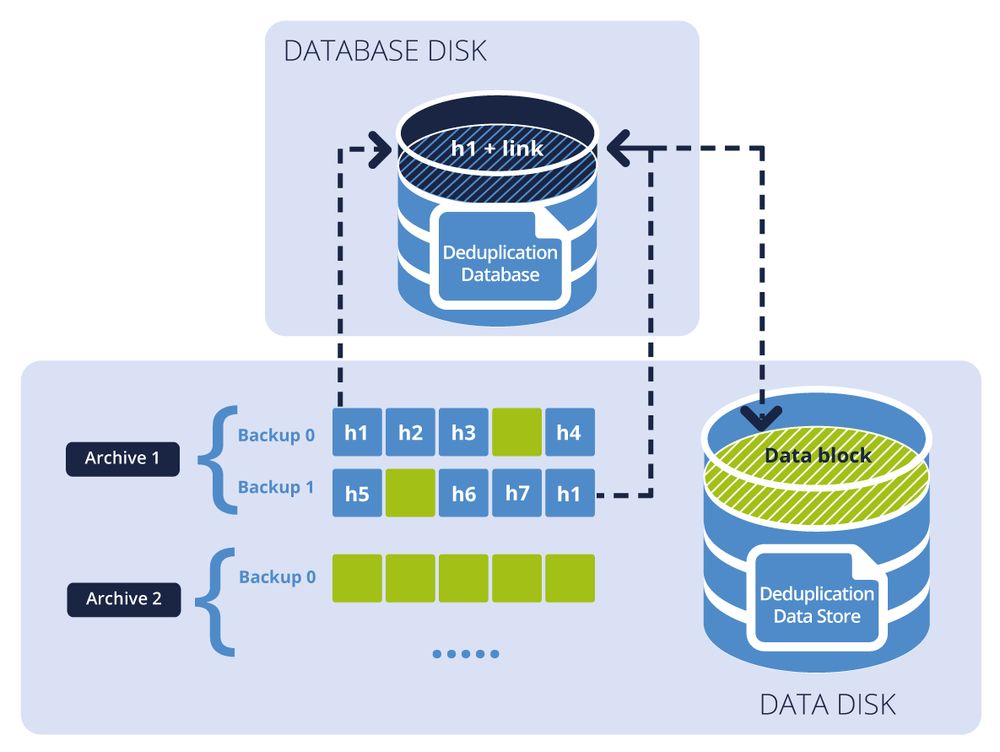
Backup deduplication (or data deduplication) is a technique that eliminates redundant copies of data during the backup process. Instead of storing multiple identical files or data blocks, the system stores only one unique instance and replaces duplicates with references.
Simple Example:
If 100 users have the same 10 MB file:
- Without deduplication → 1,000 MB stored
- With deduplication → Only 10 MB stored + references
How Backup Deduplication Works
Deduplication operates by identifying duplicate data segments and storing only unique ones. The process typically includes:
- Data Segmentation – Files are broken into smaller chunks (blocks or segments).
- Hashing – Each segment is assigned a unique hash value (fingerprint).
- Comparison – The system compares hashes to detect duplicates.
- Storage Optimization – Duplicate segments are replaced with pointers to the original data.
Types of Backup Deduplication
1. File-Level Deduplication
- Eliminates duplicate files
- Simple but less efficient for large datasets
2. Block-Level Deduplication
- Breaks files into blocks and removes duplicate blocks
- Much more efficient than file-level
3. Byte-Level Deduplication
- Works at the smallest granularity
- Highest efficiency but more CPU-intensive
Source vs Target Deduplication
Source-Side Deduplication
- Occurs before data is transferred
- Reduces bandwidth usage
- Ideal for remote backups
Target-Side Deduplication
- Happens at the backup storage destination
- Easier to deploy
- Requires more network bandwidth
Benefits of Backup Deduplication
- Reduced Storage Costs – By storing only unique data, organizations can significantly lower storage requirements.
- Faster Backups – Less data means quicker backup operations.
- Optimized Bandwidth Usage – Especially beneficial for cloud or remote backups.
- Improved Scalability – Allows businesses to scale backup infrastructure efficiently.
- Enhanced Disaster Recovery – Faster backups lead to quicker recovery times.
Deduplication vs Compression
| Feature | Deduplication | Compression |
|---|---|---|
| Purpose | Remove duplicate data | Reduce data size |
| Efficiency | High for repetitive data | Moderate |
| Process | Eliminates redundancy | Encodes data |
| Best Use Case | Backups, archives | File transfer, storage |
Best practice: Use both together for maximum efficiency.
Common Use Cases
- Enterprise Backup Systems – Large organizations use deduplication to manage petabytes of data.
- Cloud Backup Solutions – Reduce storage and transfer costs in cloud environments.
- Virtual Machine Backups – VMs often share similar OS files—perfect for deduplication.
- Email Servers – Many duplicate attachments can be eliminated.
Challenges of Backup Deduplication
While powerful, deduplication comes with some trade-offs:
- High CPU usage during hashing and comparison
- Complex implementation in large environments
- Longer restoration times in some cases due to reconstruction
- Initial setup cost for advanced systems
Best Practices for Implementing Backup Deduplication
- Choose the Right Deduplication Type – Block-level deduplication is usually the best balance of performance and efficiency.
- Combine with Compression – Maximize storage savings by using both techniques together.
- Monitor Performance – Keep an eye on CPU, memory, and storage performance.
- Use Incremental Backups – Pair deduplication with incremental or differential backups for optimal results.
- Test Restore Processes – Ensure data can be restored quickly and reliably.
Backup Deduplication in Modern IT Environments
With the rise of:
- Cloud computing
- Big data
- Remote work
Deduplication has become essential for maintaining efficient and cost-effective backup systems. It plays a crucial role in modern strategies like:
- Backup as a Service (BaaS)
- Disaster Recovery as a Service (DRaaS)
- Hybrid cloud storage
Conclusion
Backup deduplication is a powerful technology that helps organizations reduce storage costs, improve backup speed, and optimize data management. By eliminating redundant data, businesses can build more scalable and efficient backup systems.
Whether you’re running a small business or managing enterprise infrastructure, implementing deduplication can significantly enhance your backup strategy.