Demultiplexing: Understanding How Data Reaches the Right Application
In modern computer networks, multiple applications often communicate simultaneously over the same network connection. Whether you’re browsing websites, streaming videos, sending emails, or participating in video conferences, data packets constantly travel across networks. One of the key processes that ensures this data reaches the correct destination is demultiplexing. Demultiplexing is a fundamental networking concept that allows a receiving device to direct incoming data to the appropriate application or service. Without demultiplexing, computers would struggle to distinguish between data intended for different programs, resulting in communication failures and inefficient network operations. This article explores demultiplexing, how it works, its importance, types, advantages, challenges, and real-world applications.
What Is Demultiplexing?
Demultiplexing is the process of separating incoming data streams and delivering them to the correct application, process, or service on a receiving device.
In computer networking, demultiplexing primarily occurs at the Transport Layer (Layer 4) of the OSI model. When a host receives packets from the network, the transport layer examines specific identifiers – such as port numbers – to determine which application should receive the data.
Simply put, demultiplexing acts like a mail sorter that directs incoming letters to the correct recipient based on the address.
Simple Example:
Imagine a computer running:
- A web browser
- An email client
- A video conferencing application
All these applications receive data through the same network interface. Demultiplexing ensures that:
- Web traffic goes to the browser
- Email traffic goes to the mail application
- Video packets go to the conferencing software
How Demultiplexing Works
Demultiplexing occurs when incoming packets arrive at a host.
Step 1: Packet Reception
The network interface card (NIC) receives incoming packets from the network.
Step 2: Transport Layer Analysis
The transport layer protocol examines packet headers, including:
- Source port number
- Destination port number
- Source IP address
- Destination IP address
- Protocol type (TCP or UDP)
Step 3: Socket Identification
The operating system identifies the appropriate socket associated with the application waiting for the data.
Step 4: Data Delivery
The packet payload is delivered to the correct application process. This entire operation occurs within milliseconds and is transparent to users.
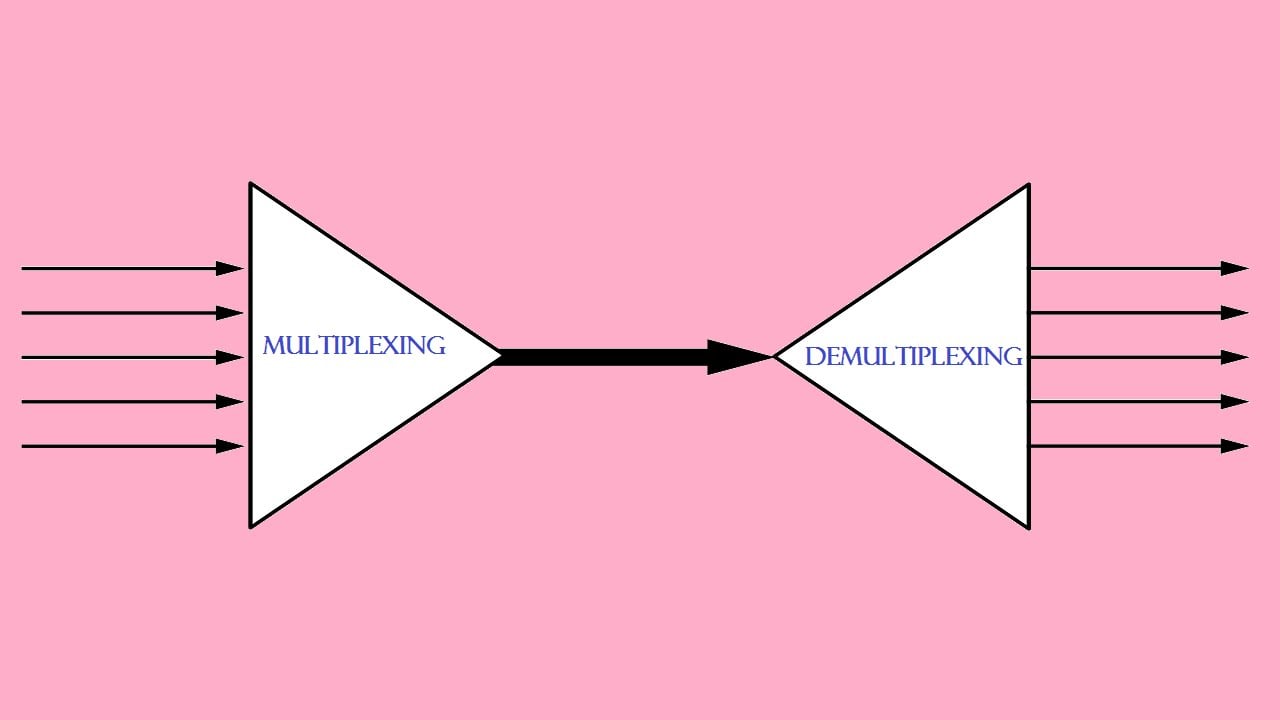
Relationship Between Multiplexing and Demultiplexing
Multiplexing and demultiplexing work together.
| Process | Function |
|---|---|
| Multiplexing | Combines data from multiple applications into a single transmission stream |
| Demultiplexing | Separates incoming data and delivers it to the correct application |
Example
A user’s computer:
- Sends browser traffic.
- Sends email data.
- Sends chat messages.
The transport layer multiplexes these streams into outgoing packets.
On the receiving side, demultiplexing separates the streams and forwards them to the appropriate applications.
Demultiplexing in TCP
TCP Demultiplexing
The Transmission Control Protocol (TCP) uses multiple fields to identify connections:
- Source IP address
- Destination IP address
- Source port
- Destination port
These four values create a unique connection identifier.
TCP can maintain multiple simultaneous connections because each connection has a unique socket pair.
Example
A web server may handle thousands of users simultaneously:
| Client IP | Source Port | Destination Port |
|---|---|---|
| 192.168.1.10 | 50123 | 80 |
| 192.168.1.11 | 50124 | 80 |
| 192.168.1.12 | 50125 | 80 |
Demultiplexing allows the server to distinguish between these connections and deliver responses to the correct clients.
Demultiplexing in UDP
UDP Demultiplexing
The User Datagram Protocol (UDP) uses a simpler mechanism.
Incoming packets are typically directed based on:
- Destination port number
Since UDP is connectionless, there is no need to maintain extensive connection information.
Example
A DNS server listens on:
- Port 53
Any incoming UDP packet addressed to port 53 is delivered to the DNS service.
Socket-Based Demultiplexing
A socket serves as the endpoint for communication between applications and the transport layer.
Socket Components
A socket may include:
- IP address
- Port number
- Protocol type
The operating system maintains a socket table that maps incoming packets to the correct application.
Example
| Application | Port |
|---|---|
| HTTP Server | 80 |
| HTTPS Server | 443 |
| DNS Server | 53 |
| SMTP Server | 25 |
Demultiplexing uses these port assignments to route incoming traffic correctly.
Importance of Demultiplexing
Demultiplexing is essential for modern networking because it:
- Supports Multiple Applications – A single device can run numerous network applications simultaneously.
- Improves Resource Utilization – Multiple services can share one network interface efficiently.
- Enables Client-Server Communication – Servers can communicate with many clients at the same time.
- Facilitates Scalability – Large-scale systems depend on demultiplexing to manage thousands of concurrent connections.
- Maintains Reliable Data Delivery – Packets consistently reach the intended applications.
Some Real-World Examples
- Web Browsing – A web browser receives: HTML content, Images, JavaScript files, Streaming data,… Demultiplexing ensures packets are assigned to the correct browser session.
- Email Services – Mail servers process incoming messages and route them to the appropriate user mailboxes.
- Video Streaming – Streaming platforms handle large numbers of data streams simultaneously while directing packets to active viewing sessions.
- Online Gaming – Game servers receive updates from thousands of players and use demultiplexing to identify the correct game session.
- VoIP Communications – Voice-over-IP applications use demultiplexing to separate audio, video, and signaling traffic.
Some Advantages
- Efficient Traffic Management – Allows multiple communication streams to coexist on one host.
- Enhanced Network Performance – Reduces processing overhead by directing packets efficiently.
- Better Scalability – Supports a large number of concurrent network connections.
- Application Isolation – Prevents data from being delivered to the wrong application.
- Reliable Service Delivery – Improves communication accuracy and stability.
Some Challenges
Despite its advantages, demultiplexing faces several challenges:
- High Connection Volumes – Servers handling millions of connections require efficient socket management.
- Security Risks – Attackers may exploit open ports or flood services with traffic.
- Resource Consumption – Maintaining large connection tables consumes memory and processing power.
- Complex Network Architectures – Cloud and distributed systems require advanced demultiplexing techniques.
Demultiplexing in Modern Networking
As networking technologies evolve, demultiplexing remains a critical function.
- Cloud Computing – Cloud platforms manage massive numbers of virtualized connections and services.
- Microservices Architecture – Traffic must be directed to the correct service instance among many running applications.
- Software-Defined Networking (SDN) – Controllers use advanced packet handling and routing mechanisms that rely on demultiplexing concepts.
- Internet of Things (IoT) – Millions of connected devices generate data that must be properly separated and processed.
- 5G Networks – High-speed mobile networks depend on efficient traffic distribution and service identification.
Best Practices for Effective Demultiplexing
Organizations can improve network efficiency by:
- Using standardized port assignments.
- Monitoring socket utilization.
- Implementing secure transport protocols.
- Optimizing server resources.
- Deploying load balancers.
- Applying traffic filtering and firewall rules.
- Regularly updating networking software.
Future of Demultiplexing
Emerging technologies continue to influence how demultiplexing is implemented.
Key trends include:
- AI-assisted traffic classification
- Intelligent network orchestration
- Edge computing optimization
- Automated service discovery
- Advanced cloud-native networking
- Enhanced security integration
As networks become increasingly complex, demultiplexing mechanisms will evolve to provide faster and more intelligent traffic management.
Conclusion
Demultiplexing is a core networking process that ensures incoming data reaches the correct application or service. By examining transport-layer information such as port numbers and connection identifiers, demultiplexing enables multiple applications to communicate simultaneously over a shared network infrastructure.
From web browsing and email delivery to cloud computing and 5G networks, demultiplexing plays a crucial role in maintaining efficient, scalable, and reliable communications. Understanding how demultiplexing works helps network administrators, IT professionals, and technology enthusiasts better appreciate the mechanisms that power modern digital connectivity.