Quadrature Amplitude Modulation (QAM): How It Works, Types, and Trade-Offs
Quadrature amplitude modulation (QAM) is a digital modulation technique that sends more information through a communication channel by changing both a carrier wave’s amplitude and phase. It is a foundational idea in modern broadband systems, helping technologies such as cable networks, Wi-Fi, cellular links, microwave backhaul, and optical communications move large amounts of data efficiently. The basic promise is straightforward: rather than sending one bit at a time, QAM groups bits into symbols. A single 256-QAM symbol, for example, can represent eight bits. The trade-off is equally important: as QAM packs more bits into each symbol, the possible signal states move closer together, making the transmission more vulnerable to noise, interference, and distortion.
What Is Quadrature Amplitude Modulation?
QAM combines two carriers of the same frequency that are shifted 90 degrees apart. One is the in-phase (I) component, and the other is the quadrature (Q) component. Because these two waveforms are orthogonal, a receiver can separate them and recover the information carried by each.
In digital QAM, the transmitter selects a defined pair of I and Q amplitude values for every symbol period. When the two components are combined, the resulting carrier has a specific amplitude and phase. Each permitted combination represents a binary bit pattern.
A compact model for the transmitted signal is:
s(t) = I(t) cos(2πfct) − Q(t) sin(2πfct)
Here, fc is the carrier frequency, while I(t) and Q(t) choose the signal state. You do not need to calculate this equation to understand QAM; it simply shows why changing the I and Q values changes the final waveform.
How a QAM Constellation Diagram Works
A constellation diagram is the clearest way to visualize Quadrature Amplitude Modulation. It plots every valid symbol as a point on a two-dimensional graph:
- The horizontal axis is the I value.
- The vertical axis is the Q value.
- Each point corresponds to a unique group of bits.
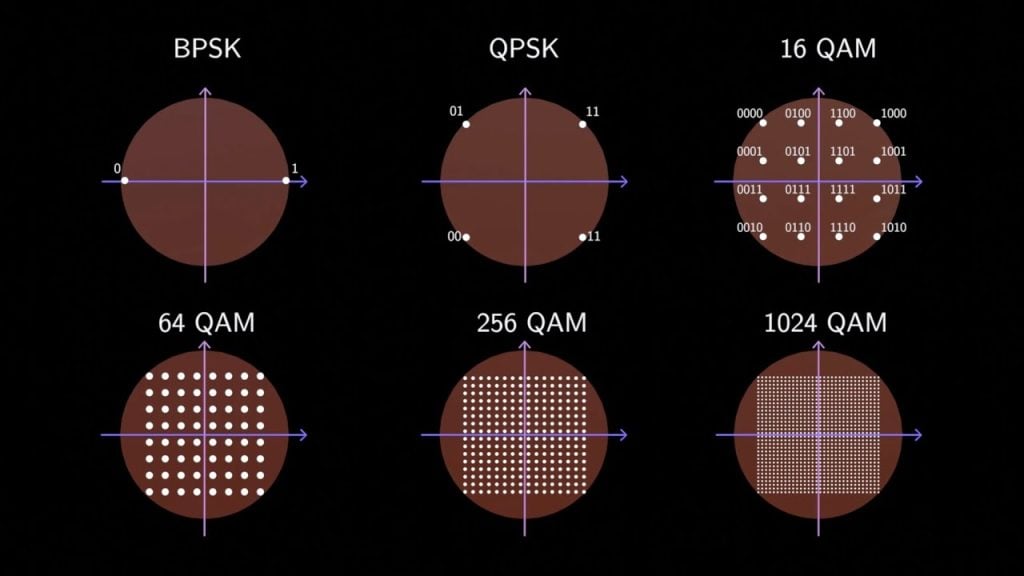
For 16-QAM, there are 16 possible points, commonly arranged in a 4-by-4 grid. Since 16 equals 2⁴, each symbol carries four bits. A receiver samples the incoming signal, identifies the nearest valid point, and converts that point back into its associated bits.
In a real signal, received points do not land perfectly on their ideal locations. Noise produces a cloud around each point. If that cloud crosses a decision boundary and lands closer to a neighboring point, the receiver makes a symbol error. This visual relationship explains the central QAM trade-off: denser constellations increase capacity but reduce the margin for error.
Common Quadrature Amplitude Modulation Types and Bits per Symbol
The number before “QAM” is the modulation order—the count of permitted constellation points. For an M-QAM scheme, bits per symbol equal log₂(M).
| QAM type | Constellation points | Bits per symbol | Practical takeaway |
|---|---|---|---|
| 4-QAM (equivalent constellation to QPSK) | 4 | 2 | Robust, lower data density |
| 16-QAM | 16 | 4 | A widely used balance of speed and resilience |
| 64-QAM | 64 | 6 | Higher throughput; needs better signal quality |
| 256-QAM | 256 | 8 | High capacity; more sensitive to impairments |
| 1024-QAM | 1,024 | 10 | Very dense; suitable only when the link has a strong margin |
The modulation order alone does not determine the user data rate. Symbol rate, channel bandwidth, pulse shaping, forward error correction, protocol overhead, and channel conditions all matter. Still, bits per symbol is why higher-order QAM is so valuable when spectrum is scarce.
QAM Modulation Step by Step
- Group incoming bits. The transmitter takes a serial data stream and groups bits according to the modulation order. For 64-QAM, each group contains six bits.
- Map bits to a symbol. A mapping table assigns each bit group to one point in the constellation. Systems often use Gray coding, which assigns neighboring points labels that differ by only one bit, helping limit the damage from a nearest-neighbor error.
- Create the I and Q components. The chosen point supplies an I amplitude and a Q amplitude.
- Modulate and combine the carriers. The transmitter scales the two 90-degree-shifted carriers and sums them into one RF, electrical, or optical signal.
- Receive and decide. The receiver synchronizes to the signal, estimates I and Q, corrects channel effects where possible, then assigns the measured point to its nearest valid constellation state.
- Convert symbols back to bits. The receiver reverses the mapping and passes recovered bits to the next layer.
Why Higher-Order QAM Delivers Faster Data Rates
Bandwidth is finite. Increasing the symbol rate usually requires more bandwidth, while increasing QAM order allows a system to carry more bits during each symbol interval. That improves spectral efficiency, commonly expressed in bits per second per hertz.
For example, at the same symbol rate, an ideal 256-QAM signal transports four times as many raw bits per symbol as 16-QAM: eight versus four. That does not mean its real-world throughput is always four times higher, because a 256-QAM link may need stronger coding, retransmissions, or a fallback mode when conditions worsen.
This is why adaptive modulation is common. When a channel is clean, a network can choose a dense constellation. When the signal-to-noise ratio (SNR) falls, it can step down to 64-QAM, 16-QAM, or a more robust scheme to keep the connection usable.
Advantages of Quadrature Amplitude Modulation
- High spectral efficiency: QAM can send several bits in one symbol without requiring a proportional increase in bandwidth.
- Flexible link design: A system can select or adapt its modulation order based on signal quality and performance goals.
- Broad adoption: QAM fits naturally into many wired, wireless, radio, and optical communication designs.
- Clear measurement model: Constellation diagrams make it practical to diagnose noise, phase error, imbalance, and nonlinear behavior.
Limitations and Engineering Challenges
QAM’s main challenge is its sensitivity to channel and hardware imperfections. High-order QAM requires more distance accuracy between received points and their intended locations.
Common causes of degraded QAM performance include:
- Noise and interference, which spread constellation points and raise the bit-error rate (BER).
- Phase noise and frequency offset, which rotate or blur the constellation.
- I/Q imbalance and DC offset, which skew or shift the point pattern.
- Nonlinear amplifiers, which distort amplitude-dependent signals. QAM does not have a constant envelope, so power amplifiers generally need adequate linearity and output back-off.
- Multipath fading, which can change amplitude and phase across a wireless channel.
Engineers often track error vector magnitude (EVM) alongside BER. EVM measures the difference between a received symbol and its ideal constellation location. Lower EVM generally indicates a cleaner signal and more room to run a higher modulation order.
Where is Quadrature Amplitude Modulation Used?
QAM appears wherever designers need high throughput from limited spectrum or channel bandwidth. Notable uses include:
- Cable television and broadband: 64-QAM and 256-QAM have long been used for digital cable transmission.
- Wi-Fi and cellular systems: Modern standards use QAM among several configurable modulation and coding choices, selecting modes based on radio conditions.
- Digital subscriber lines and cable modems: Multicarrier systems use QAM on individual subcarriers to make efficient use of available spectrum.
- Microwave and satellite links: Higher-order modulation can boost capacity when the link budget and amplifier linearity support it.
- Coherent optical transport: Advanced QAM formats help increase data capacity over fiber.
QAM vs. PSK: What Is the Difference?
Phase-shift keying (PSK) identifies symbols primarily by carrier phase. Conventional QAM uses a two-dimensional constellation in which amplitude levels as well as the resultant phase vary. In practical terms, QAM can provide more symbol states for a given bandwidth, but the varying amplitude makes it more demanding on the channel and RF hardware.
There is some overlap in terminology. A 4-QAM constellation is geometrically equivalent to QPSK: four equally spaced points with constant magnitude. As the modulation order rises, square QAM constellations use multiple amplitude levels and show the usual QAM capacity-versus-robustness trade-off.
How to Choose the Right QAM Order
Choose the highest order that the complete link can support reliably – not the highest number on a specification sheet. Consider:
- Available SNR and expected fading or interference
- Required BER, latency, and retransmission tolerance
- Channel bandwidth and target throughput
- Power-amplifier linearity and peak-to-average power constraints
- Error-correction coding and adaptive-modulation behavior
- Regulatory or standard-specific requirements
A 1024-QAM mode can be excellent in a short, clean, well-engineered link. In a noisy or fading channel, 16-QAM may deliver better usable throughput because it avoids errors and retransmissions.
Conclusion
Quadrature amplitude modulation makes high-capacity digital communication possible by representing multiple bits with each carefully chosen I/Q symbol. Its effectiveness comes from a deliberate trade-off: larger constellations improve spectral efficiency, while tighter point spacing demands better signal quality, synchronization, and hardware linearity. The most successful QAM implementations adapt the modulation order to real channel conditions, balancing speed with reliability.