TCP Connection Management: How Reliable Network Connections Work
TCP connection management is the process of establishing, maintaining, and closing reliable communication between two devices on a network. It is a core function of the Transmission Control Protocol (TCP), which powers many everyday internet services, including web browsing, email, file transfers, and remote access. Unlike connectionless protocols such as UDP, TCP is designed to make sure data arrives accurately, in the correct order, and without unnecessary duplication. To achieve that reliability, TCP manages the full lifecycle of a connection—from the first request to the final close.
What Is TCP Connection Management?
TCP connection management refers to the mechanisms TCP uses to create and control a session between a client and a server. A TCP connection allows both endpoints to exchange data safely while monitoring delivery, network capacity, and connection status.
The TCP connection lifecycle generally includes three stages:
- Connection establishment
- Data transfer and connection maintenance
- Connection termination
During these stages, TCP uses sequence numbers, acknowledgments, timers, and control flags to keep communication dependable even when packets are delayed, lost, or received out of order.
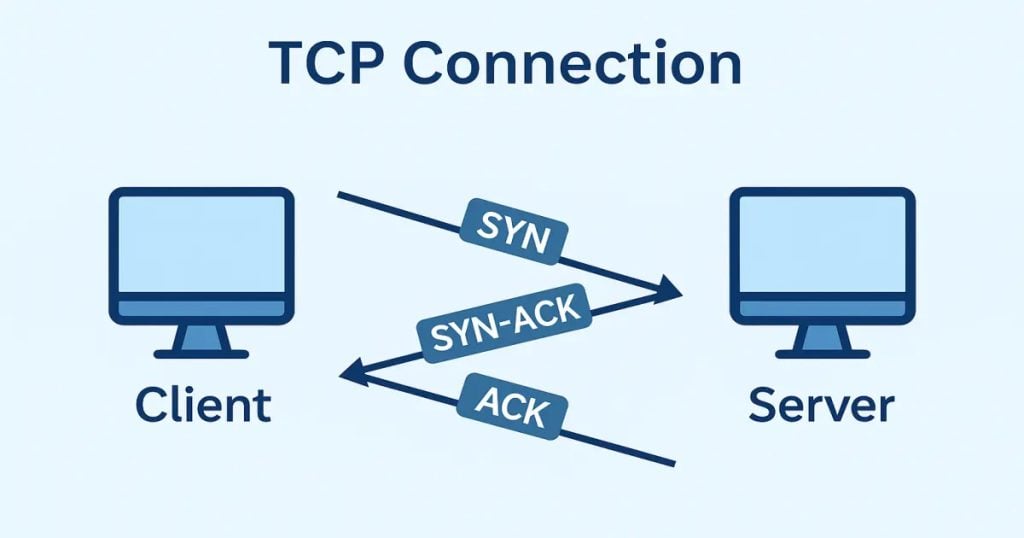
How TCP Establishes a Connection: The Three-Way Handshake
Before applications can exchange data, TCP must establish a connection. This happens through the TCP three-way handshake.
The handshake confirms that both devices are reachable, ready to communicate, and synchronized on initial sequence numbers.
Step 1: SYN
The client begins by sending a packet with the SYN, or synchronize, flag enabled. This packet tells the server that the client wants to open a TCP connection.
The client also provides an initial sequence number, which TCP uses to track bytes sent during the session.
Step 2: SYN-ACK
If the server is available and willing to accept the connection, it responds with a SYN-ACK packet.
This response does two things:
- Acknowledges the client’s SYN request
- Sends the server’s own initial sequence number
At this point, the server knows the client can be reached, but it still needs confirmation that the client received its response.
Step 3: ACK
The client sends an ACK, or acknowledgment, packet back to the server. Once this final acknowledgment arrives, the TCP connection is established. Both sides can now send and receive application data.
This three-way process helps prevent old or delayed packets from being mistaken for a new connection. It also ensures both devices agree on the starting state of the session.
Managing Data Transfer in TCP
After a connection is established, TCP connection management focuses on reliable and efficient data delivery.
TCP breaks application data into smaller segments, sends those segments across the network, and reassembles them at the destination. Each segment contains a sequence number, allowing the receiving device to identify missing data or restore the correct order.
Acknowledgments and Retransmissions
When a device receives TCP data, it sends an acknowledgment to confirm successful delivery. If the sender does not receive an acknowledgment within a defined period, it assumes the segment may have been lost and retransmits it.
This retransmission process is one reason TCP is reliable, but it can also increase latency on unstable networks.
Sequence Numbers
TCP sequence numbers identify the position of data within a stream. They help the receiving device detect:
- Missing segments
- Duplicate segments
- Out-of-order delivery
For example, if segments arrive in the order 1, 3, and 2, TCP can reorder them before passing the complete data stream to the application.
TCP Flow Control
Flow control prevents a fast sender from overwhelming a slower receiver.
TCP uses a receive window, often called the advertised window, to tell the sender how much data the receiver can accept before it needs processing time. If the receiver’s buffer begins to fill, it can reduce the window size. The sender then slows down until the receiver is ready for more data.
Without flow control, a receiving device could drop packets simply because it cannot process data quickly enough.
TCP Congestion Control
Congestion control protects the wider network rather than just the receiving endpoint.
When TCP detects signs of packet loss or increased delay, it treats them as possible network congestion. It then reduces the rate at which it sends data. As conditions improve, TCP gradually increases the sending rate again.
Common TCP congestion-control concepts include:
- Slow start: TCP begins cautiously and increases its sending rate quickly while conditions are healthy.
- Congestion avoidance: TCP increases transmission more gradually after reaching a threshold.
- Fast retransmit: TCP retransmits a likely missing packet before a timeout expires when duplicate acknowledgments indicate packet loss.
- Fast recovery: TCP reduces its sending rate after loss without restarting the entire connection process.
These mechanisms help TCP balance speed and reliability across shared networks.
How TCP Closes a Connection
TCP connection termination is usually a four-step process because each direction of communication closes independently.
- Step 1: FIN – One endpoint sends a FIN, or finish, packet to indicate it has no more data to send.
- Step 2: ACK – The other endpoint acknowledges the FIN. The first half of the connection is now closed, but the second endpoint may still send remaining data.
- Step 3: FIN – When the second endpoint is ready to close its side, it sends its own FIN packet.
- Step 4: ACK – The original endpoint sends a final acknowledgment. The connection is then fully closed.
After closing, the endpoint that sends the final ACK may enter a temporary TIME_WAIT state. This allows delayed packets to expire and ensures that the final acknowledgment can be resent if necessary.
Common TCP Connection States
TCP uses defined states to track where a connection is in its lifecycle. Important TCP states include:
- LISTEN: A server is waiting for incoming connection requests.
- SYN_SENT: A client has sent a SYN and is awaiting a response.
- SYN_RECEIVED: A server has received a SYN and sent a SYN-ACK.
- ESTABLISHED: Both endpoints can exchange data.
- FIN_WAIT: One endpoint has requested to close the connection.
- CLOSE_WAIT: An endpoint has received a close request and is waiting for its application to finish.
- TIME_WAIT: The connection is closed, but TCP is waiting briefly for delayed packets.
Understanding these states is useful when diagnosing application outages, connection leaks, or firewall issues.
Common TCP Connection Management Problems
Several issues can disrupt TCP connections or reduce performance.
- Connection Timeouts – A timeout occurs when one side does not receive an expected response. Common causes include network outages, firewall rules, overloaded servers, or incorrect routing.
- Connection Resets – A TCP reset, shown as RST, immediately terminates a connection. It may occur when an application is not listening on a requested port, a firewall actively rejects traffic, or a server closes an invalid session.
- Half-Open Connections – A half-open connection happens when one endpoint believes the connection is active while the other endpoint has failed or disconnected. TCP keepalive settings and application-level health checks can help detect these situations.
- Too Many Open Connections – Servers have limits on concurrent TCP connections, available file descriptors, and memory buffers. Poorly managed applications can leave connections open, causing resource exhaustion and degraded service.
Best Practices for TCP Connection Management
Effective TCP connection management improves reliability, performance, and application stability.
- Set sensible connection and idle timeouts.
- Reuse connections when appropriate through connection pooling.
- Monitor retransmissions, packet loss, latency, and TCP state counts.
- Configure firewalls and load balancers to allow expected connection lifetimes.
- Use TCP keepalives or application health checks for long-lived connections.
- Investigate excessive TIME_WAIT, CLOSE_WAIT, or reset events.
- Tune operating-system TCP settings carefully and test changes before production deployment.
Conclusion
TCP connection management is what makes reliable network communication possible. From the three-way handshake to flow control, congestion control, acknowledgments, and graceful termination, TCP continuously manages the state and quality of each connection.
For network administrators, developers, and security teams, understanding TCP connection management makes it easier to troubleshoot slow applications, reduce connection failures, and build more resilient services. Whether you are running a website, API, database, or enterprise network, strong TCP connection management is essential to dependable digital communication.