What Is Hamming Distance In Computer Network?
Hamming distance is a fundamental concept in computer science, information theory, telecommunications, cryptography, and data science. It measures the number of positions where two strings of equal length differ. This simple but powerful metric is widely used in error detection, error correction, machine learning, DNA sequencing, and digital communications. Understanding hamming distance helps network engineers, developers, cybersecurity professionals, and data scientists improve data reliability and optimize algorithms.
What Is Hamming Distance?
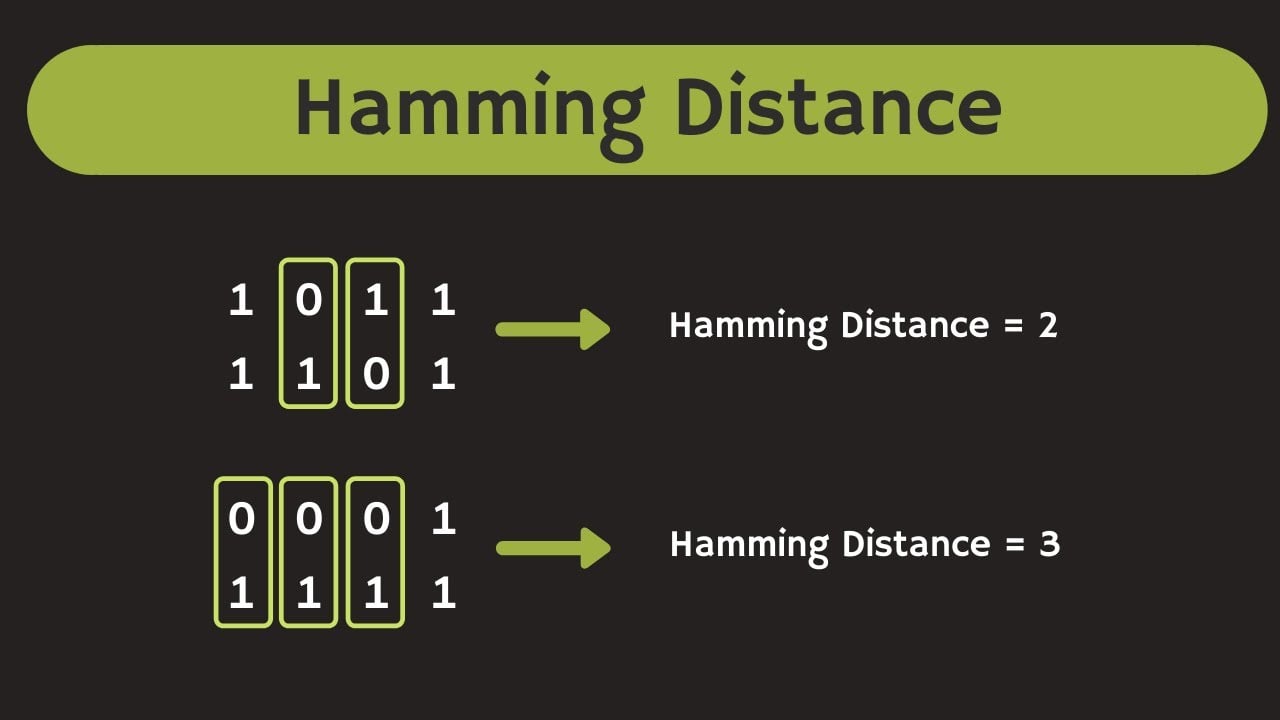
Hamming distance is the number of bit positions in which two binary strings differ.
It was introduced by mathematician Richard Hamming, who developed error-correcting codes for reliable data transmission.
For example:
- String A:
1011101 - String B:
1001001
The differing positions are:
- Position 3
- Position 5
Therefore, the hamming distance is 2.
How Does It Work?
The algorithm compares two strings character by character.
Step-by-Step Process
- Take two equal-length strings
- Compare each position
- Count the number of mismatches
- The total mismatches equal the Hamming distance
Hamming Distance in Binary Systems
Binary systems are the most common use case for hamming distance because digital devices operate using bits.
In networking and communication systems, Hamming distance helps:
- Detect transmission errors
- Correct corrupted data
- Improve communication reliability
- Design efficient coding systems
The greater the hamming distance between valid codewords, the better the error detection capability.
Hamming Distance and Error Detection
One of the most important applications is in Hamming codes and error-correcting systems.
Error Detection
If transmitted data changes during communication, the received codeword differs from the original. The system calculates the Hamming distance to determine whether an error occurred.
Error Correction
A coding system with minimum hamming distance:
d = 2can detect 1-bit errorsd = 3can correct 1-bit errors- Higher distances allow stronger correction capabilities
Applications of Hamming Distance
1. Data Transmission
Communication systems use the Hamming distance to ensure reliable transfer of information across noisy channels.
Examples include:
- Ethernet networks
- Wireless communication
- Satellite transmission
2. Error-Correcting Codes
Hamming distance is essential for:
- Hamming codes
- Reed–Solomon codes
- BCH codes
- Forward error correction systems
3. Computer Science
In programming and algorithms, hamming distance helps with:
- String comparison
- Similarity analysis
- Data validation
- Pattern recognition
4. Cryptography
Security systems use the Hamming distance to analyze:
- Encryption strength
- Bit-level differences
- Avalanche effect in hash functions
A secure cryptographic hash should produce significantly different outputs even for minor input changes.
5. Machine Learning
Machine learning systems use hamming distance for:
- Clustering categorical data
- Recommendation systems
- Feature comparison
- Similarity measurement
It is especially useful with binary feature vectors.
6. Bioinformatics
DNA and protein sequence analysis often uses the Hamming distance to compare genetic sequences.
Researchers use it for:
- Mutation analysis
- Sequence alignment
- Evolutionary studies
Some Advantages
- Simple to Implement – The algorithm is computationally lightweight and easy to code.
- Fast Performance – Binary XOR operations are extremely fast in hardware and software.
- Useful for Error Detection – It provides an effective way to identify transmission corruption.
- Widely Applicable – Hamming distance is useful across networking, cybersecurity, AI, and bioinformatics.
Some Limitations
- Equal-Length Requirement – The two strings must have identical lengths.
- Limited Semantic Meaning – For text analysis, hamming distance may not reflect actual semantic similarity.
- Not Ideal for Numerical Distance – Metrics like Euclidean distance are better for continuous numerical data.
Hamming Distance vs Other Distance Metrics
Hamming Distance vs Levenshtein Distance
| Feature | Hamming Distance | Levenshtein Distance |
|---|---|---|
| String Length | Must be equal | Can differ |
| Operations | Substitution only | Insertions, deletions, substitutions |
| Complexity | Lower | Higher |
| Common Use | Binary comparison | Text editing |
Hamming Distance vs Euclidean Distance
| Feature | Hamming Distance | Euclidean Distance |
|---|---|---|
| Data Type | Categorical/Binary | Numerical |
| Output | Integer | Real number |
| Common Fields | Coding theory | Geometry & ML |
Best Practices When Using Hamming Distance
- Use Equal-Length Data – Always ensure strings or vectors have identical lengths.
- Combine with Error-Correcting Codes – For reliable communication systems, combine the hamming distance with ECC algorithms.
- Optimize with Bitwise Operations – Use XOR and bit-count instructions for maximum efficiency.
- Choose the Right Metric – Use hamming distance only when appropriate for categorical or binary comparisons.
Conclusion
Hamming distance is one of the most important concepts in digital communication and computer science. Despite its simplicity, it plays a major role in:
- Error detection
- Error correction
- Data reliability
- Cryptography
- Machine learning
- Bioinformatics
Because it is fast, efficient, and easy to implement, hamming distance remains a core technique in modern computing systems. Whether you are building network protocols, analyzing datasets, or developing secure communication systems, understanding hamming distance is essential for improving accuracy and reliability.