What Is TCP Connection Release?
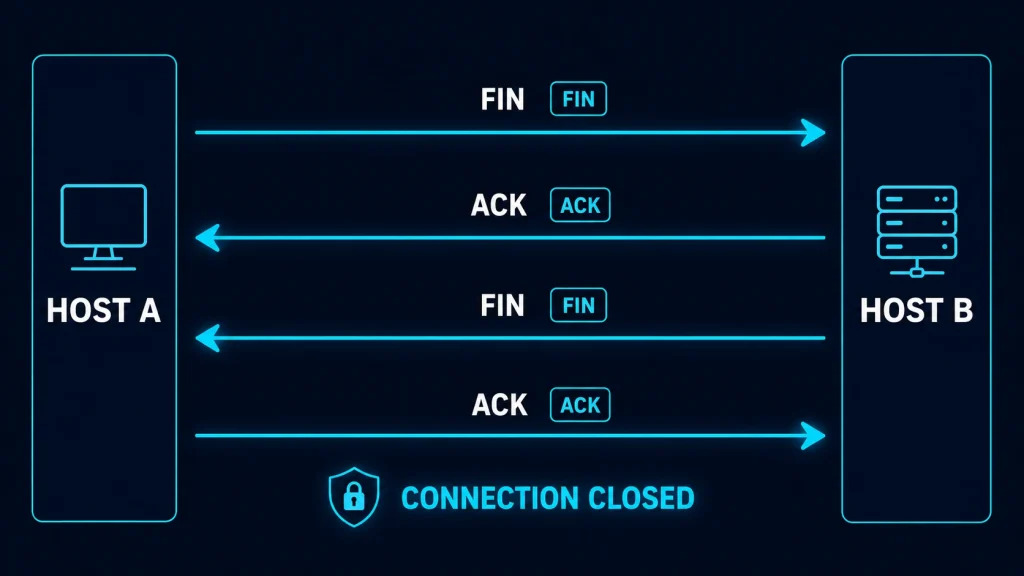
TCP connection release is the process TCP uses to close an established connection reliably. Unlike connection setup, which usually uses a three-way handshake, a normal TCP connection termination typically needs four messages: FIN, ACK, FIN, and ACK. This orderly process matters because TCP supports two-way communication. Each endpoint must independently signal that it has finished sending data, while the other endpoint confirms receipt. Understanding this process helps developers troubleshoot socket issues, interpret packet captures, and design network applications that shut down cleanly.
What Is TCP Connection Release?
TCP connection release, also called TCP connection termination, is the controlled closing of a TCP session between two hosts. It happens after an application has finished sending and receiving data—or when one side intentionally ends its sending stream. TCP is full-duplex, meaning both endpoints can send data at the same time. Therefore, closing one direction does not automatically close the other. A host can tell its peer, “I will not send any more data,” while still receiving any remaining data from that peer.
The TCP FIN flag communicates this intent: no more data will be sent by that endpoint. The protocol specification defines FIN as “no more data from sender.”
The TCP Four-Way Handshake
A typical TCP connection release follows these four steps:
| Step | Sender | Message | Meaning |
|---|---|---|---|
| 1 | Client | FIN | The client has finished sending data. |
| 2 | Server | ACK | The server acknowledges the client’s FIN. |
| 3 | Server | FIN | The server has also finished sending data. |
| 4 | Client | ACK | The client acknowledges the server’s FIN. |
Here is the same exchange in a simple flow:
Client                                  Server
  |                                       |
  | -------- FIN -----------------------> |  1. Client closes its sending side
  | <------- ACK ------------------------ |  2. Server acknowledges
  |                                       |
  | <------- FIN ------------------------ |  3. Server closes its sending side
  | -------- ACK -----------------------> |  4. Client acknowledges
  |                                       |
Once the final acknowledgment is received, the server can close the connection. The client generally enters the TIME_WAIT state before it fully releases the socket.
Why Does TCP Use Four Messages?
TCP connection release usually requires four packets because a FIN only closes one direction of the connection.
For example, a client might send a FIN after it finishes uploading a file. The server can acknowledge that FIN but may still need to send a response, confirmation, or buffered data. Only after it completes that work does the server send its own FIN.
This is known as a half-closed connection:
- The client cannot send additional data after its FIN.
- The client can still receive data from the server.
- The server can continue sending until it sends its own FIN.
TCP Connection Termination States
TCP tracks connection release through a state machine. The most common states include:
- FIN_WAIT_1: The active closer has sent FIN and is waiting for an ACK or FIN.
- FIN_WAIT_2: Its FIN was acknowledged; it is waiting for the peer’s FIN.
- CLOSE_WAIT: The peer received FIN and is waiting for its application to close the sending side.
- LAST_ACK: The peer has sent FIN and is waiting for the final ACK.
- TIME_WAIT: The active closer has acknowledged the peer’s FIN and waits briefly before closing.
- CLOSED: The connection no longer exists.
A connection stuck in CLOSE_WAIT usually signals an application issue: the remote side closed correctly, but the local application failed to close its socket.
What Is TIME_WAIT in TCP?
TIME_WAIT is a temporary state that normally appears on the side that performs the active close. It serves two important purposes:
- It allows retransmission of the final ACK if the peer did not receive it.
- It helps prevent delayed packets from an old connection from being mistaken for packets in a new connection with the same endpoint addresses and ports.
The traditional TCP model uses a wait period of twice the maximum segment lifetime (2×MSL), although the exact duration is implementation-dependent.
TIME_WAIT is expected behavior, not automatically an error. However, an application that opens and closes very large numbers of short-lived TCP connections may accumulate many TIME_WAIT sockets and require connection-management tuning.
FIN vs. RST: Graceful vs. Abrupt Release
TCP can end a connection with either FIN or RST, but they serve very different purposes.
FIN: Graceful TCP Connection Release
A FIN performs an orderly shutdown. It lets in-flight data be delivered and gives both sides an opportunity to close their sending streams cleanly.
Use a graceful FIN-based close when the application has completed its work normally.
RST: Immediate Connection Reset
An RST packet resets the connection immediately. It can discard unread data and typically indicates that the connection cannot continue, such as when an application rejects a connection or a host receives traffic for a nonexistent socket.
Use RST only when an immediate abort is necessary. It is not a substitute for normal TCP connection termination.
Common TCP Connection Release Problems
Several issues can interfere with a clean TCP shutdown:
- Missing final ACK: Packet loss can cause retransmission and delay closure.
- Sockets stuck in CLOSE_WAIT: An application has not closed a connection after receiving a FIN.
- Too many TIME_WAIT sockets: High churn from short-lived connections can exhaust available client ports.
- Premature RST packets: A reset can terminate a session before all application data is processed.
- Firewall or load-balancer timeouts: Network devices may remove idle connection state before either endpoint closes normally.
Tools such as Wireshark, netstat, ss, and application logs can help identify which side initiated the close and where the shutdown sequence stopped.
Key Takeaways
TCP connection release is designed for reliability. A normal close uses a four-way handshake—FIN, ACK, FIN, ACK—because each endpoint must independently close its sending side. The process supports half-closed connections, allows outstanding data to be delivered, and uses TIME_WAIT to protect against lost acknowledgments and delayed packets. For most applications, the best practice is straightforward: finish application work, close sockets gracefully, and investigate abnormal states such as CLOSE_WAIT or excessive RST packets.