Rake Receiver in Wireless Communication: How It Works, Benefits, and Applications
A Rake receiver is a specialized radio receiver used in wireless communication systems to improve signal reception in environments affected by multipath propagation. By collecting and combining multiple delayed versions of the same transmitted signal, a rake receiver significantly enhances signal quality, reduces errors, and increases overall system performance. Rake receivers have been widely used in Code Division Multiple Access (CDMA) networks and continue to influence modern wireless communication technologies. Understanding how a rake receiver works is essential for network engineers, telecommunications professionals, and students studying digital communications.
What Is a Rake Receiver?
A rake receiver is a signal processing technique designed to exploit multipath propagation rather than treat it as interference. In wireless environments, transmitted signals often reach the receiver through multiple paths due to reflection, diffraction, and scattering from buildings, mountains, and other obstacles. Instead of ignoring these multiple signal copies, a rake receiver captures them separately and combines them constructively to improve reception quality. The name “rake” comes from the resemblance of the receiver structure to a garden rake, where each “finger” collects a different signal path.
Key Characteristics of a Rake Receiver
- Utilizes multipath diversity
- Improves signal-to-noise ratio (SNR)
- Reduces fading effects
- Enhances communication reliability
- Commonly used in CDMA systems
Why Is a Rake Receiver Needed?
Wireless signals rarely travel directly from transmitter to receiver. Multiple reflected versions arrive at different times, causing:
- Signal fading
- Inter-symbol interference (ISI)
- Reduced communication quality
- Increased bit error rates
A rake receiver addresses these issues by:
- Detecting individual signal components
- Aligning delayed versions
- Combining them to maximize the received energy
This process converts multipath effects into a performance advantage.
How Does It Work?
The operation of a rake receiver can be divided into several stages.
- Multipath Detection – The receiver identifies different delayed signal components arriving through separate propagation paths.
- Correlation Process – Each detected path is correlated with a locally generated replica of the spreading code.
- Finger Assignment – Separate processing units called fingers are assigned to track individual signal paths.
- Delay Compensation – Each finger compensates for the delay associated with its assigned path.
- Signal Combining – The outputs of all fingers are combined using diversity combining techniques.
- Data Recovery – The combined signal is demodulated to recover the transmitted information.
Basic Architecture of a Rake Receiver
A typical rake receiver consists of:
Searcher Unit
- Detects available multipath components
- Measures signal strength and delay
Finger Processors
- Track specific signal paths
- Correlate incoming signals
Channel Estimator
- Estimates channel characteristics
- Determines path amplitudes and phases
Combiner
- Merges outputs from all fingers
- Produces a stronger composite signal
Decision Device
- Recovers original data bits
- Performs decoding and error correction
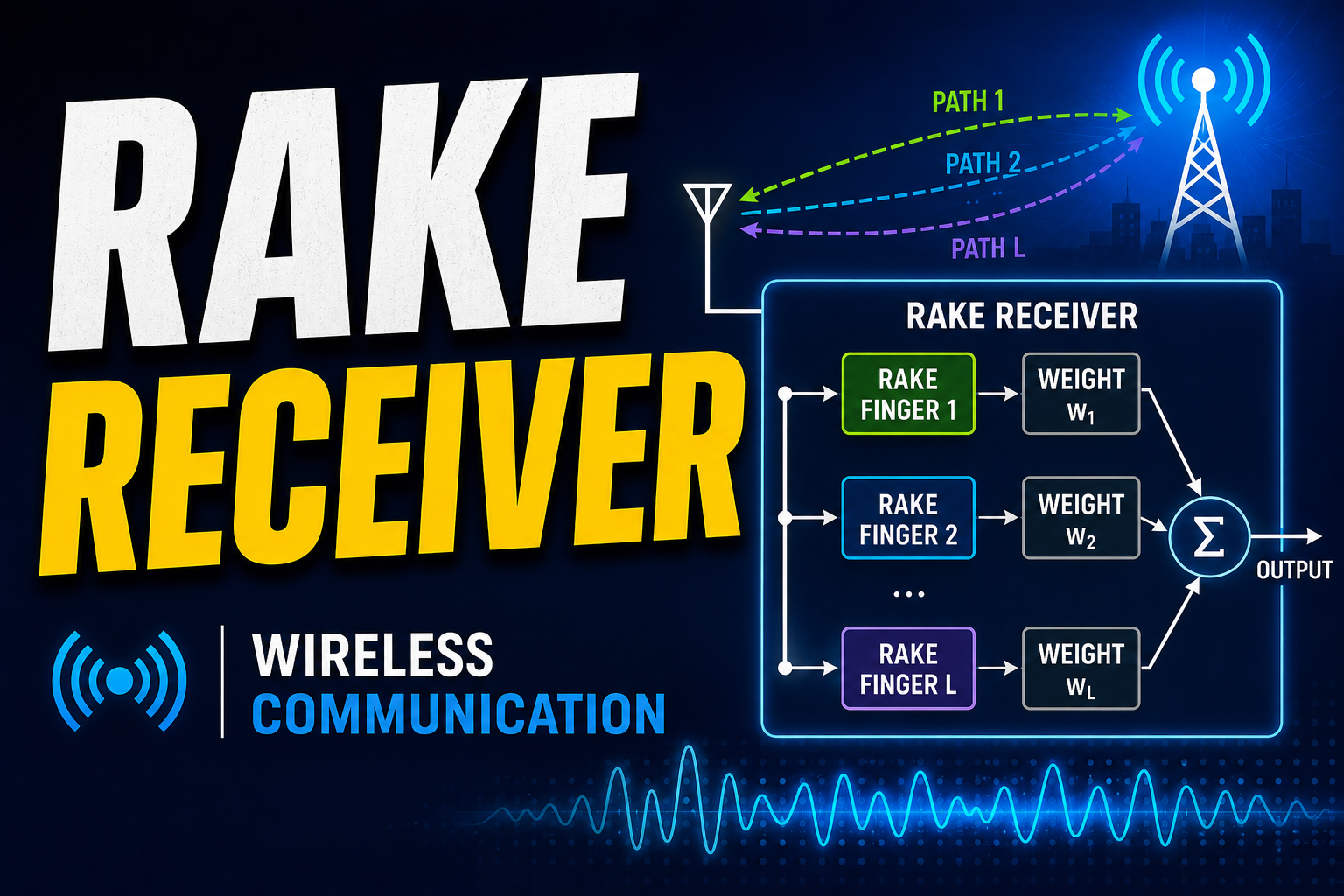
Components of a Rake Receiver
| Component | Function |
|---|---|
| Antenna | Receives wireless signals |
| Searcher | Finds multipath components |
| Correlators | Match spreading codes |
| Fingers | Process individual paths |
| Combiner | Adds path contributions |
| Decoder | Recovers transmitted data |
Types of Rake Receivers
All-Rake Receiver (A-Rake)
Processes every resolvable multipath component.
Advantages:
- Maximum diversity gain
- Highest performance
Disadvantages:
- High complexity
- Increased power consumption
Selective Rake Receiver (S-Rake)
Selects only the strongest signal paths.
Advantages:
- Reduced complexity
- Lower processing requirements
Disadvantages:
- May ignore useful signal energy
Partial Rake Receiver (P-Rake)
Uses the first arriving signal paths regardless of strength.
Advantages:
- Simple implementation
- Lower cost
Disadvantages:
- Less optimal performance
Adaptive Rake Receiver
Dynamically adjusts finger allocation according to channel conditions.
Advantages:
- Better efficiency
- Improved performance in changing environments
Disadvantages:
- More complex algorithms
Some Advantages
- Improved Signal Quality – Combines multiple signal copies to increase received power.
- Multipath Diversity Gain – Utilizes natural propagation diversity.
- Reduced Fading Effects – Mitigates deep signal fades caused by channel conditions.
- Lower Bit Error Rate – Improves communication reliability.
- Better Coverage – Enhances performance in urban and indoor environments.
- Efficient CDMA Operation – Supports the spread-spectrum nature of CDMA systems.
Some Disadvantages
- Increased Complexity – Multiple correlators and processing units are required.
- Higher Power Consumption – Additional processing consumes more energy.
- Synchronization Challenges – Accurate timing alignment is essential.
- Limited Effectiveness – Performance decreases when multipath components are not sufficiently separated in time.
- Hardware Cost – More sophisticated receiver architecture increases implementation costs.
Rake Receiver in CDMA Systems
Rake receivers became particularly important in CDMA-based cellular networks because CDMA signals use spreading codes that allow delayed signal copies to be separated and processed independently.
Applications include:
- IS-95 CDMA networks
- CDMA2000 systems
- Wideband CDMA (WCDMA)
- Third-generation (3G) mobile communications
In these systems, rake receivers significantly improve capacity and reliability.
Applications of Rake Receivers
- Mobile Cellular Networks – Used extensively in CDMA and 3G systems.
- Satellite Communications – Helps combat signal reflections and atmospheric effects.
- Indoor Wireless Networks – Improves reception in buildings with significant multipath propagation.
- Military Communication Systems – Enhances reliability in challenging environments.
- Wireless Sensor Networks – Supports robust communication in obstructed areas.
- Broadband Wireless Systems – Improves signal reception in dense urban deployments.
Rake Receiver vs Equalizer
| Feature | Rake Receiver | Equalizer |
|---|---|---|
| Purpose | Exploit multipath | Remove ISI |
| Primary Use | CDMA systems | Various digital systems |
| Diversity Gain | Yes | No |
| Complexity | Moderate to high | Moderate |
| Multipath Utilization | Beneficial | Treated as a distortion |
While equalizers attempt to cancel multipath effects, rake receivers leverage them to improve performance.
Rake Receiver and Modern Wireless Networks
Although modern technologies such as OFDM dominate 4G and 5G networks, the principles behind rake receivers remain relevant.
Modern systems use advanced techniques, including:
- MIMO (Multiple Input Multiple Output)
- Beamforming
- Diversity combining
- Channel estimation
These technologies continue the fundamental concept of exploiting multiple signal paths to improve communication performance.
Future of Rake Receiver Technology
As wireless systems evolve, traditional rake receivers are becoming less common in commercial cellular networks. However, their underlying concepts continue to influence:
- Advanced receiver design
- Diversity reception techniques
- Multi-antenna systems
- Software-defined radio (SDR)
- Next-generation wireless research
Researchers are also exploring AI-assisted signal processing methods that build upon diversity combining concepts introduced by rake receivers.
Best Practices for Implementing a Rake Receiver
To maximize performance:
- Use accurate channel estimation.
- Implement effective synchronization mechanisms.
- Optimize finger allocation algorithms.
- Employ the maximal ratio combining where possible.
- Continuously monitor changing channel conditions.
- Minimize processing delays.
- Select appropriate spreading codes.
Conclusion
A rake receiver is a powerful wireless communication technology that transforms multipath propagation from a challenge into an advantage. By detecting, tracking, and combining multiple delayed signal copies, it improves signal quality, reduces fading, and enhances communication reliability. Widely used in CDMA and 3G networks, rake receivers played a crucial role in the development of modern mobile communication systems. While newer technologies such as OFDM and MIMO have become dominant, the core principles of diversity reception and signal combining pioneered by rake receivers continue to shape today’s wireless communication landscape.
For engineers and networking professionals, understanding rake receiver technology provides valuable insight into the evolution of wireless signal processing and the foundations of modern communication systems.