L2TP Protocol: A Complete Guide to Layer 2 Tunneling Protocol
The L2TP protocol (Layer 2 Tunneling Protocol) is a widely used tunneling technology designed to support virtual private networks (VPNs). It enables secure communication by encapsulating data traffic across public networks like the Internet. Although not inherently encrypted, L2TP is often paired with IPsec to provide strong security.
What is the L2TP Protocol?
Layer 2 Tunneling Protocol (L2TP) is a tunneling protocol developed by combining features of two earlier protocols: PPTP (by Microsoft) and L2F (by Cisco).
L2TP operates at the data link layer (Layer 2) of the OSI model and is used to create tunnels for transmitting data securely between two endpoints.
Important: L2TP itself does not provide encryption or confidentiality—this is why it is almost always implemented as L2TP/IPsec.
How L2TP Works
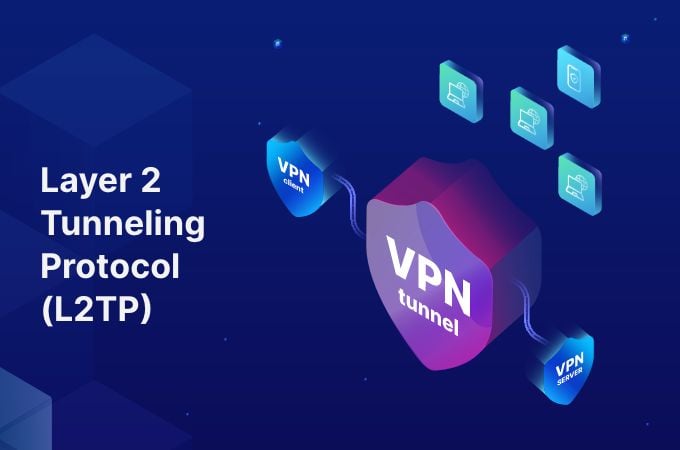
L2TP creates a secure tunnel between a client and a server using a two-layer encapsulation process:
- PPP Encapsulation – Data is first encapsulated using the PPP, which enables authentication and link establishment.
- L2TP Tunneling – The PPP frame is then encapsulated inside L2TP packets.
- IPsec Encryption (Optional but Common) – To ensure confidentiality and integrity, L2TP is paired with IPsec, which encrypts the data.
- Transmission Over an IP Network – The encrypted data is sent over the internet to the VPN server.
Key Features of the L2TP Protocol
- Tunneling Support – L2TP allows secure tunneling of data across untrusted networks.
- Compatibility – It is supported by most modern operating systems, including Windows, macOS, Linux, Android, and iOS.
- Multi-Protocol Support – L2TP can encapsulate various network protocols, making it flexible for different use cases.
- Works with IPsec – When combined with IPsec, it provides strong encryption and authentication.
Advantages of the L2TP Protocol
- Widely Supported: Built into many platforms and devices
- Secure (with IPsec): Provides encryption, authentication, and integrity
- Reliable Tunneling: Handles data encapsulation efficiently
- ISP Transparency: Works across NAT networks
Disadvantages of L2TP Protocol
- No Native Encryption: Requires IPsec for security
- Slower Performance: Double encapsulation can reduce speed
- Blocked by Firewalls: Uses UDP ports (500, 1701, 4500), which may be restricted
- More Complex Setup: Compared to simpler VPN protocols
L2TP vs Other VPN Protocols
L2TP vs PPTP
- L2TP is more secure (when paired with IPsec)
- PPTP is faster but considered outdated and insecure
L2TP vs OpenVPN
- OpenVPN offers better security and flexibility
- L2TP is easier to configure on built-in OS clients
L2TP vs WireGuard
- WireGuard is faster and more modern
- L2TP is more widely supported on legacy systems
Common Use Cases of L2TP
- Remote Access VPNs: Secure connections for employees working remotely
- Site-to-Site VPNs: Linking multiple office locations
- ISP Tunneling Services: Encapsulation of customer traffic
- Bypassing Geo-Restrictions: Accessing restricted content securely
Is L2TP Still Relevant Today?
While newer protocols like WireGuard and OpenVPN are gaining popularity, L2TP remains relevant due to its broad compatibility and ease of deployment. However, for modern security requirements, many organizations prefer newer alternatives that offer better performance and simpler configurations.
Best Practices for Using L2TP
- Always use L2TP with IPsec, never standalone
- Use strong authentication methods (certificates or pre-shared keys)
- Ensure firewall ports (UDP 500, 1701, 4500) are properly configured
- Regularly update VPN configurations and credentials
Conclusion
The L2TP protocol is a reliable and widely supported tunneling solution that plays a key role in VPN technology. Although it lacks native encryption, pairing it with IPsec makes it a secure option for many use cases. If you need compatibility and stability across devices, L2TP/IPsec is still a solid choice. However, for cutting-edge performance and security, exploring newer protocols like WireGuard may be worthwhile.