Baud Rate: Definition, Importance, and How It Affects Data Communication
In digital communication systems, baud rate is a fundamental concept that determines how quickly signals are transmitted across a communication channel. Whether you’re working with computer networks, serial communication interfaces, modems, industrial automation systems, or embedded devices, understanding baud rate is essential for ensuring reliable and efficient data transmission. This article explains what baud rate is, how it differs from bit rate, its applications, advantages, limitations, and best practices for selecting the appropriate baud rate for communication systems.
What Is Baud Rate?
Baud rate refers to the number of signal changes, symbols, or signaling events transmitted per second over a communication channel. It is measured in baud, named after French engineer Émile Baudot, a pioneer in telecommunications.
In simple terms:
Baud rate = Number of signal units transmitted per second
For example:
- 300 baud = 300 signal changes per second
- 9600 baud = 9,600 signal changes per second
- 115200 baud = 115,200 signal changes per second
Baud rate is commonly used in serial communication standards such as UART, RS-232, RS-485, and modem communications.
How Baud Rate Works
Data is transmitted through electrical, optical, or radio signals. Each signal change represents a symbol that may carry one or more bits of information.
When a transmitter sends data:
- Data is converted into symbols.
- Symbols are transmitted over the communication medium.
- The receiver interprets the symbols and reconstructs the original data.
The baud rate determines how many symbols are sent each second.
Example
If a communication system transmits:
- 1 bit per symbol at 9600 baud
Then:
- Bit rate = 9600 bits per second (bps)
If a system uses:
- 4 bits per symbol at 9600 baud
Then:
- Bit rate = 38,400 bps
This distinction highlights why baud rate and bit rate are not always the same.
Baud Rate vs Bit Rate
Many people mistakenly use baud rate and bit rate interchangeably. However, they represent different measurements.
| Feature | Baud Rate | Bit Rate |
|---|---|---|
| Definition | Number of symbols transmitted per second | Number of bits transmitted per second |
| Unit | Baud | Bits per second (bps) |
| Measures | Signal changes | Data quantity |
| Relationship | Depends on the modulation scheme | Depends on the baud rate and bits per symbol |
Formula
Bit rate can be calculated as:
Bit Rate=Baud Rate×Bits Per Symbol\text{Bit Rate} = \text{Baud Rate} \times \text{Bits Per Symbol}
In advanced modulation schemes, one symbol can represent multiple bits, causing the bit rate to exceed the baud rate.
Common Baud Rates
Several standard baud rates are widely used in communication systems.
| Baud Rate | Typical Usage |
|---|---|
| 300 | Legacy modems |
| 1200 | Basic serial devices |
| 2400 | Embedded systems |
| 4800 | Industrial communications |
| 9600 | Default serial communication |
| 19200 | Sensor networks |
| 38400 | Embedded applications |
| 57600 | High-speed serial links |
| 115200 | Microcontrollers and debugging |
| 230400+ | High-performance communication |
Among these, 9600 baud remains one of the most commonly used settings due to its balance between speed and reliability.
Baud Rate in Serial Communication
Baud rate is especially important in serial communication protocols.
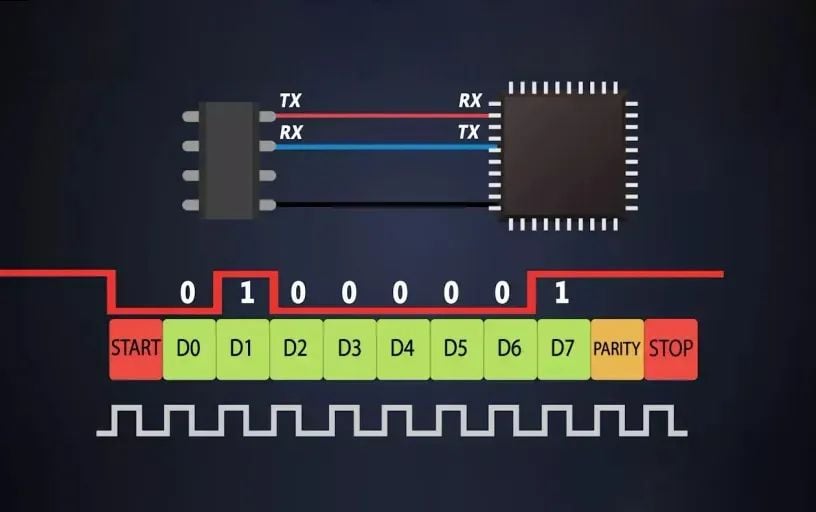
UART Communication
In UART systems:
- Both sender and receiver must use the same baud rate.
- Mismatched baud rates lead to communication errors.
- Typical UART baud rates include 9600, 19200, 57600, and 115200.
RS-232
RS-232 communication is commonly used:
- 9600 baud
- 19200 baud
- 38400 baud
for connecting computers, industrial equipment, and networking devices.
RS-485
Industrial automation networks often rely on RS-485, where baud rates vary depending on:
- Cable length
- Noise conditions
- Network topology
Why Does It Matter?
Choosing the correct baud rate directly impacts communication performance.
Faster Data Transfer
Higher baud rates enable:
- Increased throughput
- Faster device responses
- Reduced communication delays
System Compatibility
Devices must support identical baud rates to communicate successfully.
Signal Reliability
Higher baud rates may introduce:
- Signal degradation
- Noise sensitivity
- Increased error rates
A balance between speed and reliability is essential.
Factors Affecting Baud Rate Selection
Several factors influence the optimal baud rate.
Communication Distance
Longer cables often require lower baud rates to maintain signal integrity.
Noise Environment
Electromagnetic interference can affect high-speed transmissions.
Hardware Capability
Microcontrollers, modems, and communication interfaces have maximum supported baud rates.
Application Requirements
Different applications have varying speed requirements:
- Sensor monitoring may require only 9600 baud.
- Real-time control systems may require 115200 baud or higher.
Advantages of Higher Baud Rates
Using a higher baud rate offers several benefits.
- Improved Performance – Data reaches its destination more quickly.
- Reduced Latency – Systems respond faster to commands and events.
- Better User Experience – Applications such as device debugging and data logging become more efficient.
- Increased Throughput – More information can be transferred in the same period.
Limitations of High Baud Rates
Despite their benefits, higher baud rates present challenges.
- Greater Error Potential – Fast transmissions are more susceptible to noise and synchronization problems.
- Reduced Transmission Distance – Signal quality decreases as speed increases.
- Hardware Constraints – Older devices may not support modern high-speed configurations.
- Increased Processing Requirements – Receivers must handle incoming data more rapidly.
Baud Rate Synchronization
Successful communication requires synchronization between devices.
Typical communication settings include:
- Baud rate
- Data bits
- Stop bits
- Parity settings
For example:
9600, 8, N, 1
means:
- 9600 baud
- 8 data bits
- No parity
- 1 stop bit
Any mismatch can cause corrupted data or a communication failure.
Baud Rate in Modern Applications
Baud rate remains important across numerous technologies.
Embedded Systems
Microcontrollers use baud rate settings for:
- Debugging
- Sensor communication
- Device control
Industrial Automation
Programmable Logic Controllers (PLCs) rely on specific baud rates for machine communication.
Telecommunications
Modems and communication gateways utilize baud rates to manage data transmission.
Internet of Things (IoT)
IoT devices frequently exchange data through UART and serial interfaces using standardized baud rates.
Best Practices for Baud Rate Configuration
To optimize communication performance:
- Match Device Settings – Ensure transmitter and receiver use identical parameters.
- Test Before Deployment – Verify communication reliability under real operating conditions.
- Consider Cable Length – Lower baud rates often improve stability over longer distances.
- Use Shielded Cables – Reduce electromagnetic interference and signal degradation.
- Balance Speed and Reliability – Choose the lowest baud rate that satisfies performance requirements.
Conclusion
Baud rate is a critical parameter in digital communication that defines how many signal symbols are transmitted each second. From UART and RS-232 connections to industrial automation and IoT systems, the baud rate directly affects communication speed, reliability, and overall system performance. Understanding the relationship between baud rate and bit rate, selecting appropriate communication settings, and balancing speed with signal integrity can help organizations and engineers build more efficient and dependable communication networks. As modern devices continue to exchange growing volumes of data, proper baud rate configuration remains a key aspect of successful digital communication.