Cut-Through Switching: How It Works, Benefits, and Trade-Offs
Cut-through switching is a network switching method designed to reduce latency. Instead of waiting for an Ethernet frame to arrive in full, the switch begins forwarding it as soon as it has read enough header information to determine the destination port. That seemingly small change can matter in environments where microseconds count: high-performance computing, financial trading, low-latency data centers, and fast storage networks.
What Is Cut-Through Switching?
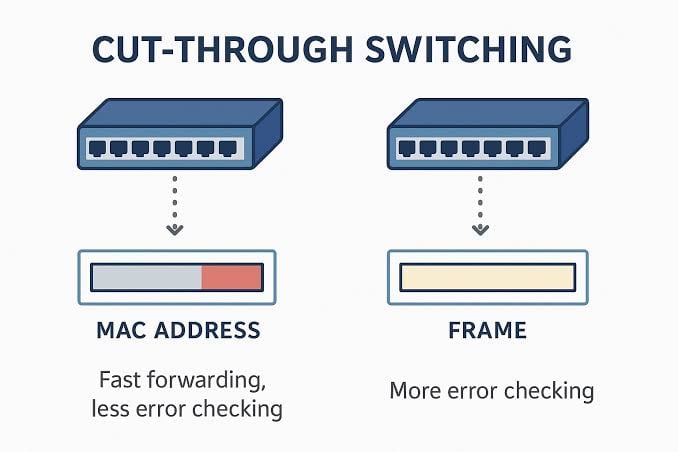
In cut-through switching, a switch examines the incoming frame’s destination information—typically the destination MAC address—performs its forwarding lookup, and starts transmitting the frame out of the appropriate port before the rest of the frame has been received.
By contrast, store-and-forward switching receives the entire frame first, checks its Frame Check Sequence (FCS) for errors, then sends it onward.
Cisco describes cut-through mode as forwarding a frame once destination details are available, while store-and-forward waits for the full frame and CRC validation.
The process is simple:
- A frame enters the switch.
- The switch reads the header fields required to make a forwarding decision.
- It looks up the destination in its forwarding table.
- It begins sending the frame through the selected egress port immediately.
- The remainder of the frame continues arriving and leaving simultaneously.
Because forwarding begins early, cut-through switching avoids the delay of receiving a complete frame before transmission begins.
Cut-Through vs. Store-and-Forward Switching
| Feature | Cut-Through Switching | Store-and-Forward Switching |
|---|---|---|
| Forwarding begins | After destination details are read | After the complete frame arrives |
| Latency | Very low | Higher, especially for larger frames |
| FCS/CRC validation before forwarding | No | Yes |
| Corrupted-frame handling | An errored frame may be forwarded | Errored frames are dropped before forwarding |
| Best fit | Low-latency, reliable networks | General-purpose and error-prone networks |
Store-and-forward is usually the safer default for networks that need full error checking at every hop. Cut-through is the performance-oriented choice when latency has greater business or technical value.
Key Benefits of Cut-Through Switching
- Lower network latency – The biggest advantage is speed. A cut-through switch does not wait for the entire packet, which reduces port-to-port forwarding delay. Modern low-latency switch platforms may measure cut-through forwarding in sub-microsecond to roughly one-microsecond ranges under specified test conditions. Actual latency depends on the switch ASIC, packet size, enabled services, speed, and congestion.
- More consistent performance across packet sizes – Because the switch does not wait for a full frame, cut-through latency is less dependent on whether a packet is small or near the Ethernet maximum transmission unit (MTU). This can help applications that are sensitive to latency variation, not just average latency.
- Better fit for high-speed east-west traffic – Data center workloads often exchange traffic between servers, storage, and application services. Cut-through switching can reduce the latency added at each network hop, especially in carefully engineered leaf-spine networks.
The Main Drawback: Error Checking
A cut-through switch cannot verify the final FCS value before it starts forwarding. If the incoming frame is corrupted, the switch may transmit that corrupted frame toward the next device.
This does not mean cut-through switching ignores errors entirely. It means the frame can travel farther before a device detects and discards it. For that reason, cut-through switching is best used on well-maintained links with low physical-layer error rates.
When to Use Cut-Through Switching
Cut-through switching is a strong option when your network has reliable links and low latency is a priority.
Common use cases include:
- High-frequency trading and market-data systems
- High-performance computing clusters
- Low-latency cloud and data center fabrics
- Real-time analytics platforms
- NVMe-over-Fabrics and other performance-sensitive storage environments
- Latency-sensitive application tiers
It is especially useful when even small delays compound across multiple network hops.
When Store-and-Forward Is Better
Store-and-forward switching may be the better choice when error detection, buffering, or feature compatibility matters more than minimal forwarding latency.
Consider it for:
- Networks with frequent CRC or physical-layer errors
- Campus and branch networks
- Links with speed mismatches or oversubscription
- Environments requiring extensive packet inspection or buffering
- Troubleshooting scenarios where strict error containment is important
Some switches also change behavior automatically in certain conditions. For example, Cisco documents that store-and-forward mode can activate on oversubscribed ports where the ingress rate exceeds egress switching capacity.
What Affects Real-World Switch Latency?
Cut-through switching is only one part of the latency picture. Real-world performance can also be affected by:
- Egress queue congestion and buffering
- QoS policies
- ACL and security processing
- VXLAN or other encapsulation
- Port-speed mismatches
- Oversubscription
- Switch hardware and firmware
- Packet size and traffic patterns
When evaluating a switch, check how the vendor measures latency. A data-sheet figure may apply only to 64-byte frames, a specific forwarding mode, and a lightly loaded configuration.
Final Thoughts
Cut-through switching is a practical way to reduce network latency by forwarding frames as soon as a switch has enough information to make a routing decision. The trade-off is reduced opportunity to stop corrupted frames at the first switch. For low-latency data center and high-performance workloads, cut-through switching can be a valuable advantage. For general-purpose networks, the best choice depends on link quality, congestion, security requirements, and how much latency truly matters to the applications being served.