Classical Bits: The Foundation of Digital Computing
In the modern digital world, every computer, smartphone, and communication system relies on a simple yet powerful concept known as classical bits. These bits are the fundamental building blocks of classical computing systems, enabling devices to process, store, and transmit information efficiently.
Understanding classical bits is essential for students, IT professionals, and technology enthusiasts who want to explore computer architecture, networking, cybersecurity, and the evolving field of quantum computing.
What Are Classical Bits?
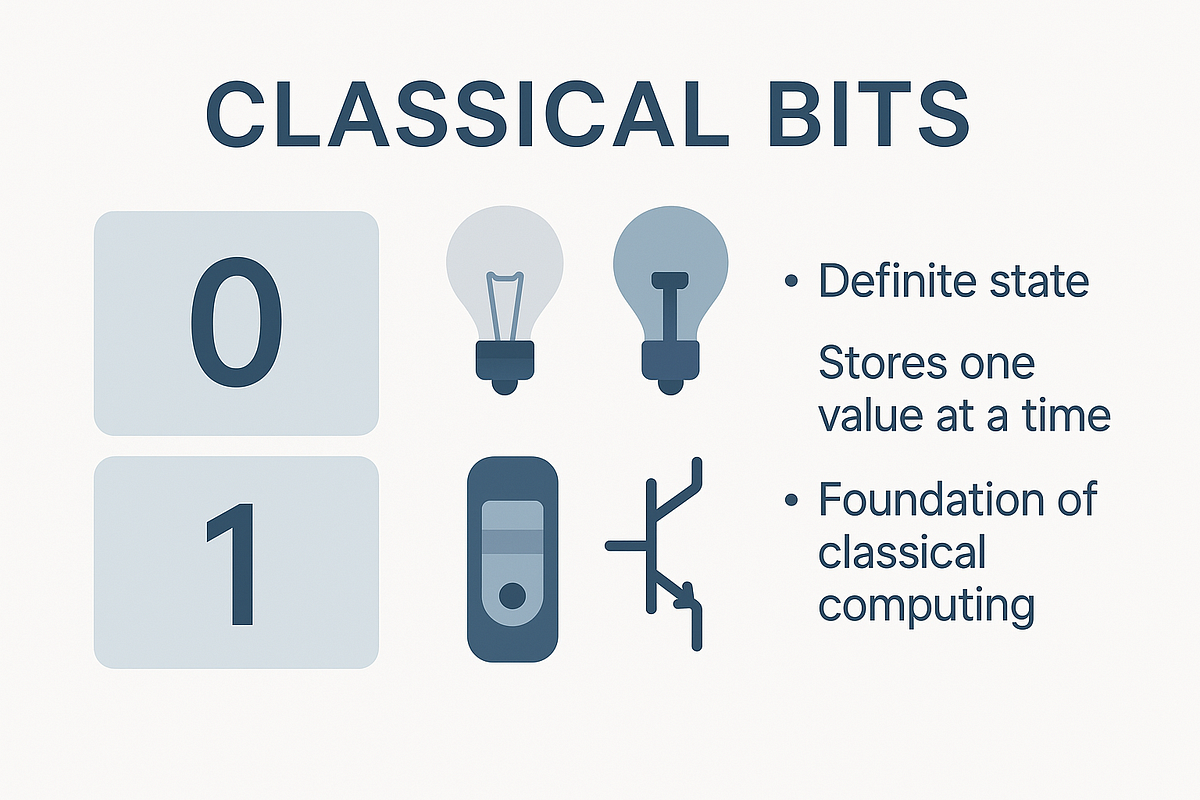
A classical bit (binary digit) is the smallest unit of data in traditional computing systems. A bit can exist in only one of two possible states:
- 0
- 1
These binary values represent electrical signals inside digital circuits:
- 0 → Low voltage or OFF state
- 1 → High voltage or ON state
Every piece of digital information — including text, images, videos, and software — is ultimately represented using combinations of classical bits.
How Classical Bits Work
Classical bits operate according to the principles of classical physics and Boolean logic. In digital electronics, transistors switch between two stable states to represent binary values.
Binary Representation
For example:
| Decimal Number | Binary Representation |
|---|---|
| 1 | 0001 |
| 2 | 0010 |
| 5 | 0101 |
| 10 | 1010 |
Each digit in the binary sequence is a classical bit.
Logic Operations
Computers perform calculations using logic gates such as:
- AND
- OR
- NOT
- XOR
These operations manipulate classical bits to execute instructions and process data.
Characteristics of Classical Bits
1. Binary State
A classical bit can only be either 0 or 1 at any given moment.
2. Deterministic Behavior
Classical bits follow predictable rules and produce deterministic outcomes.
3. Easy Physical Representation
They can be represented using:
- Electrical voltage
- Magnetic polarity
- Optical pulses
- Mechanical switches
4. Reliable Data Storage
Classical bits are highly stable and suitable for long-term data storage.
Classical Bits in Computer Systems
Classical bits are used throughout modern computing infrastructure.
Memory Systems
RAM and storage devices use bits to store information.
Examples include:
- Hard Disk Drives (HDDs)
- Solid State Drives (SSDs)
- USB flash drives
CPUs and Processors
Processors manipulate billions of bits every second to execute programs.
Networking
Data transmitted across networks is converted into binary bit streams.
Operating Systems
Operating systems manage files, applications, and hardware using binary instructions.
Bit, Byte, and Data Measurement
A group of 8 classical bits forms a byte.
| Unit | Size |
|---|---|
| 1 Bit | 0 or 1 |
| 1 Byte | 8 bits |
| 1 Kilobyte (KB) | 1024 bytes |
| 1 Megabyte (MB) | 1024 KB |
| 1 Gigabyte (GB) | 1024 MB |
Bytes are commonly used to measure file sizes and memory capacity.
Classical Bits vs Quantum Bits
One of the most important modern comparisons is between classical bits and quantum bits (qubits).
| Feature | Classical Bits | Quantum Bits |
|---|---|---|
| State | 0 or 1 | 0, 1, or superposition |
| Physics | Classical physics | Quantum mechanics |
| Predictability | Deterministic | Probabilistic |
| Stability | Highly stable | Sensitive to noise |
| Usage | Traditional computing | Quantum computing |
While quantum computing is advancing rapidly, classical bits remain the core of nearly all practical computing systems today.
Some Advantages
- Simplicity – Binary systems are simple to implement and understand.
- Reliability – Classical computing systems are highly dependable.
- Scalability – Modern processors can handle billions of bits efficiently.
- Cost-Effective Technology – Classical computing infrastructure is mature and affordable.
Some Limitations
Despite their usefulness, classical bits also have limitations.
- Processing Constraints – Complex computations can require enormous computational power.
- Energy Consumption – Large data centers consume significant energy when processing massive bit streams.
- Limited Parallelism – Classical bits cannot achieve quantum superposition capabilities.
Applications of Classical Bits
Classical bits power virtually every digital technology today.
Examples Include:
- Personal computers
- Smartphones
- Internet infrastructure
- Cloud computing
- Embedded systems
- Banking systems
- Cybersecurity tools
- Artificial intelligence systems
Without classical bits, modern digital communication and computing would not exist.
Importance of Classical Bits in Networking
In computer networking, classical bits are essential for:
- Data transmission
- Packet switching
- Error detection
- Encryption
- Routing protocols
Protocols such as TCP/IP convert information into binary format for communication across networks.
Classical Bits and Cybersecurity
Cybersecurity technologies heavily depend on binary operations.
Security Functions Using Classical Bits
- Encryption algorithms
- Password hashing
- Firewall filtering
- Intrusion detection systems
- Digital authentication
Binary computation forms the backbone of modern security infrastructure.
Future of Classical Bits
Although quantum computing is gaining attention, classical bits will continue to dominate computing for decades because:
- Existing infrastructure is built on binary systems
- Classical computers are highly reliable
- Quantum systems still face scalability challenges
Future computing environments will likely combine classical and quantum technologies.
Conclusion
Classical bits are the foundation of modern digital technology. From computers and smartphones to cloud computing and cybersecurity systems, binary information processing drives the entire digital ecosystem.
Even as quantum computing evolves, classical bits remain essential because of their simplicity, stability, and widespread implementation. Understanding how classical bits work provides valuable insight into computer science, networking, and information technology as a whole.