Simplex Mode of Data Transmission: Definition, Examples, and Uses
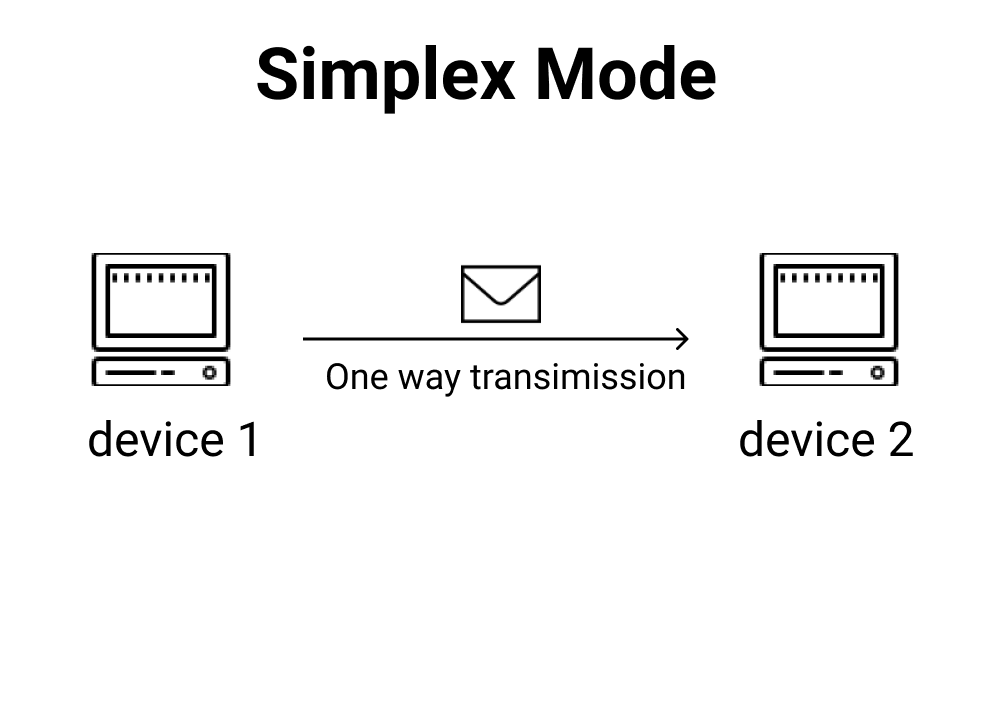
Simplex mode of data transmission is a communication method in which data travels in only one direction. One device is permanently the sender, while the other is permanently the receiver. The receiver does not send data back through the same communication channel. This one-way design is useful when a system only needs to distribute information, such as a radio broadcast, a digital display, or a sensor reporting readings to a monitoring station. Understanding simplex transmission also makes it easier to distinguish it from half-duplex and full-duplex communication.
What Is Simplex Mode in Data Transmission?
In simplex transmission, communication flows from a source to a destination only:
Sender → Receiver
The direction is fixed. A receiver can display, store, or process the information, but it cannot reply through that same link. If a return message is needed, the system requires a separate feedback channel or a different communication design.
For example, a radio station broadcasts audio to listeners. The station sends the signal, and listeners receive it. A listener cannot transmit a response back to the station using the broadcast signal.
How Simplex Data Transmission Works
A simplex system has three main parts:
- Sender: creates and transmits the data.
- Communication channel: carries the signal through a cable, fiber link, or radio frequency.
- Receiver: accepts the data and uses or stores it.
Because the channel works in one direction, the design can be straightforward. The system does not need to coordinate turn-taking between two devices. However, the sender may have no direct way to know whether the receiver successfully received the message unless a separate feedback path is available.
Common Simplex Mode Examples
- Radio and television broadcasting – Broadcast stations send audio or video to many receivers at once. The audience receives the content but does not reply over the broadcast channel.
- Digital signage and public displays – Airport screens, train-station boards, and electronic billboards receive information from a central system. Their job is to show updates, not to communicate back over the display feed.
- Satellite and navigation broadcasts – Navigation satellites transmit timing and positioning signals to receivers. A GPS receiver listens to these signals to determine its location; it does not transmit a reply to the satellite as part of that positioning signal.
- One-way monitoring and telemetry links – Some industrial or environmental systems send readings from a field device to a central monitoring point. A one-way link is suitable when the device only needs to report data and cannot be controlled remotely through that connection.
- Keyboard-style input in a basic computer model – In the traditional communication-mode example, a keyboard sends keystrokes to a computer, making it a one-way input device. Modern hardware may use separate control or status channels, but the basic input flow remains a useful simplex illustration.
Key Characteristics of Simplex Transmission
- One-way communication: Data moves only from sender to receiver.
- Fixed roles: Sender and receiver do not switch roles on the channel.
- No built-in reply path: Acknowledgments, commands, and error reports need another channel.
- Simple operation: The system does not have to manage two-way traffic.
- Efficient for distribution: One source can send the same information to one or many receivers.
Advantages of Simplex Mode
- Simpler system design – With no reverse traffic to coordinate, the communication arrangement can be less complex. This can reduce equipment requirements and make the system easier to operate.
- Lower cost for one-way applications – Applications such as broadcasting and public displays do not need every receiver to include return-transmission capability. This can lower deployment costs at scale.
- Dedicated direction for data flow – All channel capacity is used to send data in the required direction. This is useful for continuous broadcasts and one-way data feeds.
- Reduced exposure of the receiving side – In some high-security environments, a deliberately one-way connection can help prevent data from leaving a protected network. This still requires careful engineering; a “one-way” label alone does not guarantee security.
Limitations of Simplex Mode
The primary drawback is its lack of interaction.
- The receiver cannot acknowledge delivery through the same channel.
- The sender cannot request information or make remote changes through the link.
- Error detection and recovery may be limited without a separate feedback channel.
- It is unsuitable for interactive tasks such as video calls, online gaming, and most web applications.
If both devices need to send information, a duplex mode is normally more appropriate.
Simplex vs. Half-Duplex vs. Full-Duplex
| Mode | Direction of data flow | Can both sides send? | Typical example |
|---|---|---|---|
| Simplex | One direction only | No | Radio broadcast |
| Half-duplex | Both directions, one at a time | Yes, alternately | Two-way radio |
| Full-duplex | Both directions simultaneously | Yes | Telephone or video call |
In a half-duplex system, each device can send and receive but must wait for its turn to transmit. In a full-duplex system, both devices can send and receive at the same time. Simplex transmission differs because its communication roles stay one-way and fixed.
When Should You Use Simplex Transmission?
Use simplex mode when the goal is to publish, distribute, or report information without needing a response on the same channel. It is well suited to:
- Broadcasting announcements, audio, or video
- Feeding content to digital displays
- Sending one-way alerts or status updates
- Collecting data from devices that only need to report
- Creating controlled, purpose-built one-way data paths
Do not use simplex mode when users, devices, or systems need to confirm receipt, send commands, or exchange information in real time. In those cases, consider half-duplex or full-duplex communication.
Conclusion
Simplex mode of data transmission is a one-way communication method with a fixed sender and receiver. It is ideal for systems that only need to distribute or report information, including broadcasts, digital signage, navigation signals, and selected monitoring links.
When choosing a transmission mode, start with one question: Does the receiver need to reply? If the answer is no, simplex transmission may be the most practical solution.