Address Space Layout Randomization (ASLR): How It Works and Why It Matters
Address space layout randomization (ASLR) is a security technique that makes memory-based attacks harder to carry out. It works by placing key parts of a program – such as its executable code, libraries, stack, and heap – at unpredictable memory addresses each time the program runs. Without ASLR, an attacker who discovers where a useful function or library is loaded may be able to reuse that information in future attacks. With ASLR enabled, those locations change, forcing the attacker to guess or first obtain a memory disclosure. ASLR is widely used in modern operating systems and is an important layer in a defense-in-depth security strategy.
What is Address Space Layout Randomization?
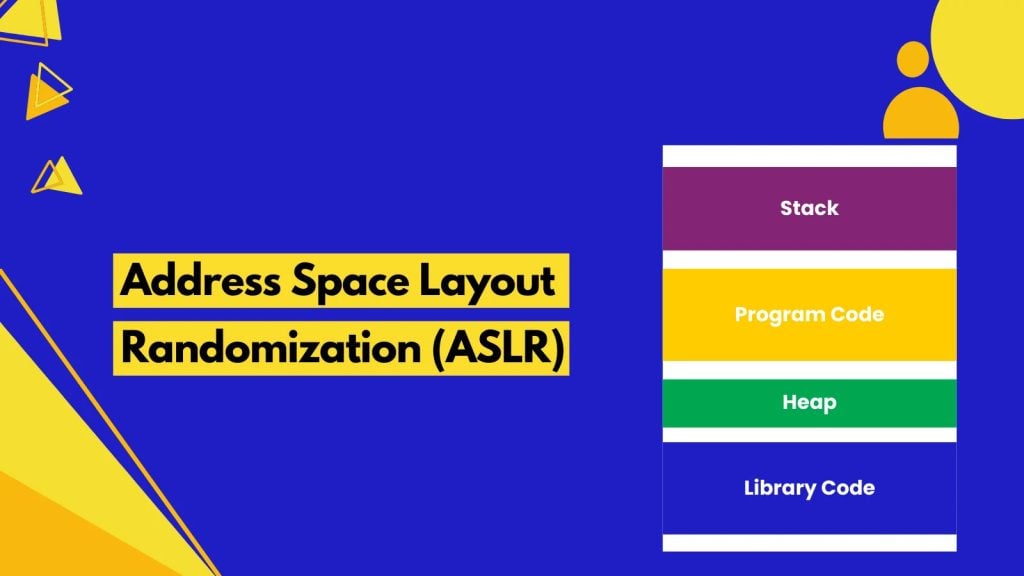
Every running application receives a virtual address space: a range of memory addresses it can use while it executes. This address space commonly contains:
- The application’s executable code
- Shared libraries
- The stack
- The heap
- Memory-mapped files and allocations
Address space layout randomization changes where these components are located. Instead of loading a library at the same address every time, the operating system selects a different valid location.
The result is uncertainty. An attacker may know that a vulnerable application uses a particular library, but cannot reliably know where that library resides in memory during a specific run.
How ASLR works
ASLR introduces randomness, often called entropy, into a process’s memory layout. When a program starts, the operating system can randomize the base addresses of:
- Executable images
- Shared libraries
- Stack memory
- Heap memory
- Dynamic memory mappings
For example, an exploit may attempt to redirect execution to a known function inside a shared library. If the library always loads at a fixed location, the attacker can hard-code that address. ASLR disrupts this assumption by loading the library elsewhere on the next execution.
The larger the available address space and the more entropy applied, the more difficult it is to make a successful guess. This is one reason 64-bit processes generally provide stronger ASLR protection than 32-bit processes: they have far more address space available for randomization. Microsoft notes that the smaller 32-bit address space imposes practical limits on ASLR entropy.
What attacks does ASLR help prevent?
ASLR primarily raises the difficulty of exploiting memory-corruption vulnerabilities, including:
- Buffer overflows
- Use-after-free vulnerabilities
- Return-oriented programming (ROP) attacks
- Return-to-libc attacks
- Some code-reuse attacks
In a code-reuse attack, an adversary attempts to chain together instructions or functions that already exist in memory. These attacks can sometimes avoid protections that stop newly injected code from running. ASLR makes this approach less reliable by concealing the addresses the attacker needs.
Windows describes ASLR as a mitigation for attacks that rely on knowledge of a process’s memory layout to execute code already present and executable in memory.
Address Space Layout Randomization is important—but it is not enough by itself
ASLR is a probabilistic defense, not an absolute barrier. Its effectiveness depends on the amount of randomization, the platform, and whether an attacker can expose memory addresses.
A memory disclosure vulnerability can weaken ASLR by revealing the location of libraries, stack data, or other important structures. Attackers may also use repeated attempts, partial address overwrites, or platform-specific weaknesses to reduce the uncertainty.
For that reason, ASLR should be combined with other protections, including:
- Data Execution Prevention (DEP) or non-executable memory protections
- Control-flow integrity or Control Flow Guard (CFG)
- Stack canaries
- Memory-safe languages where practical
- Secure compiler and linker settings
- Prompt patching and vulnerability remediation
Together, these safeguards make exploitation substantially more difficult than any one control can alone.
ASLR on Linux
Linux supports ASLR through the randomize_va_space kernel setting. On supported systems, the setting controls randomization of memory mappings, the stack, shared libraries, PIE-linked executables, and, at the strongest standard setting, the heap.
The common values are:
0: ASLR disabled1: Randomizes memory mappings, stack, VDSO, shared libraries, and PIE executable locations2: Adds heap randomization
Linux documents 2 as the usual full-ASLR setting on systems not configured with legacy compatibility behavior.
For a production system, avoid disabling ASLR. Temporarily changing it can be useful in a tightly controlled debugging or research environment, but it lowers resistance to memory-exploitation attacks.
Address Space Layout Randomization and Position-independent Executables: a key distinction
Position-independent executables (PIE) are designed to run correctly from different base addresses. ASLR is most effective when application binaries and libraries can be relocated safely.
In practice:
- Shared libraries are commonly built as position-independent code.
- A non-PIE executable may have more limited layout randomization.
- A PIE-enabled executable can be loaded at a randomized base address.
For developers, enabling PIE during the build process is often an essential companion to relying on operating-system ASLR.
ASLR vs. KASLR
ASLR usually refers to randomizing the memory layout of user-space applications. Kernel Address Space Layout Randomization (KASLR) applies the same concept to the operating system kernel.
KASLR helps make kernel code and module locations less predictable. It is valuable because kernel vulnerabilities can have severe consequences, but it is still a probabilistic control and should be supported by kernel hardening, patch management, least privilege, and strong access controls.
Best practices for developers and security teams
To get the most value from ASLR:
- Build applications with modern compiler and linker hardening options, including PIE where appropriate.
- Keep operating systems, compilers, runtimes, and dependencies patched.
- Do not disable ASLR in production to work around compatibility issues without a documented risk decision.
- Pair ASLR with DEP, control-flow protections, stack protections, and code-signing policies where available.
- Test older applications before enforcing stronger enterprise-wide memory protections.
- Treat memory disclosures as high-priority vulnerabilities because they can undermine ASLR.
- Prefer memory-safe design and languages for new security-sensitive components when feasible.
Conclusion
Address space layout randomization is a foundational memory-exploitation mitigation. By moving code, libraries, stacks, heaps, and other memory regions to unpredictable locations, ASLR makes attacks based on known addresses far less dependable. It is not a substitute for secure coding or patching, but it is an essential layer of modern application and operating-system security. For the strongest protection, use ASLR alongside PIE, non-executable memory, control-flow protections, stack defenses, and a disciplined vulnerability-management process.