Carrier Ethernet Explained: Services, Benefits, and Use Cases
Reliable connectivity is no longer a back-office concern. It supports cloud applications, voice and video, branch operations, data replication, and customer-facing systems. For organizations that need more predictable performance than standard business internet can provide, Carrier Ethernet offers a familiar Ethernet experience delivered as a managed wide-area service. This guide explains what Carrier Ethernet is, the major service types, where it fits, and what to evaluate before buying it.
What Is Carrier Ethernet?
Carrier Ethernet is a standardized, provider-delivered Layer 2 connectivity service that uses Ethernet interfaces and service constructs across a metropolitan, regional, or wide-area network. In plain language, it extends the Ethernet model businesses use inside a local network to connect sites, data centers, cloud on-ramps, or partner locations.
The important distinction is that Carrier Ethernet is a service, not one specific transport technology. A provider may use fiber, MPLS, EVPN, or another underlying network technology to deliver it. What the customer buys is the defined Ethernet service, its handoff, and its performance commitments.
Modern Carrier Ethernet services are commonly described using MEF standards. MEF defines technology-agnostic Layer 2 services for enterprises and for providers connecting across one another’s networks. Those service definitions make it easier to compare offerings and understand the topology being purchased.
Why Businesses Use Carrier Ethernet
Carrier Ethernet is designed for organizations that need more control and assurance than a best-effort internet connection typically provides. Exact features vary by provider and service level, but common benefits include:
- Predictable performance: A service agreement can specify committed bandwidth and performance objectives for measures such as delay, delay variation, and frame loss.
- Scalability: Ethernet bandwidth and virtual connections can be expanded as application demand grows, subject to provider availability.
- Simple handoff: The customer-facing interface uses Ethernet, reducing friction when connecting switches, routers, firewalls, and data-center equipment.
- Flexible topology: Services can link two locations, many peer locations, or a central hub with branch sites.
- Traffic separation: VLAN-based services can logically separate applications or customers while sharing an access interface.
- Provider-grade operations: Providers may offer 24/7 monitoring, defined support processes, and contractual availability targets.
Carrier Ethernet is often used for private site-to-site connectivity, data-center interconnection, cloud access, mobile backhaul, and business networks with real-time or bandwidth-intensive workloads.
Carrier Ethernet Service Types: E-Line, E-LAN, and E-Tree
The right Carrier Ethernet service starts with the traffic pattern. MEF’s three core subscriber service types are E-Line, E-LAN, and E-Tree.
E-Line: Point-to-Point Ethernet Connectivity
An E-Line service connects two endpoints. It is a natural fit for a headquarters-to-data-center link, a point-to-point connection between two offices, or a dedicated cloud access path.
Two terms often appear in E-Line proposals:
- Ethernet Private Line (EPL): A port-based E-Line service. It is intended to be highly transparent, with minimal modification to frames crossing the service.
- Ethernet Virtual Private Line (EVPL): A VLAN-based E-Line service. It supports more granular virtual connections and can be useful when multiple services share a single physical access port.
Choose E-Line when each location primarily needs to communicate with one other location and you want an uncomplicated, direct topology.
E-LAN: Any-to-Any Multipoint Connectivity
An E-LAN service provides multipoint-to-multipoint connectivity. Each connected site can communicate with the other sites in the same Ethernet service, subject to the service configuration and customer network design.
E-LAN can suit organizations with several offices that need broad peer connectivity, such as distributed business systems, collaborative applications, or an enterprise network that requires sites to exchange local traffic. It can simplify the WAN topology compared with deploying many separate point-to-point circuits.
The named service variants are Ethernet Private LAN (EP-LAN) for port-based service and Ethernet Virtual Private LAN (EVP-LAN) for VLAN-based service.
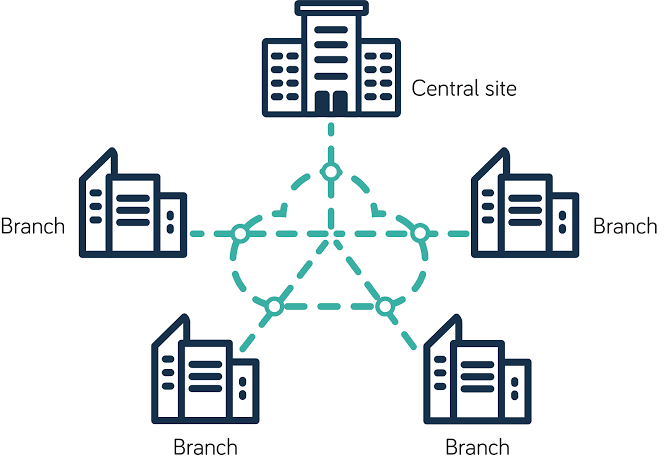
E-Tree: Hub-and-Spoke Ethernet Connectivity
An E-Tree service is a rooted multipoint design. It distinguishes between root and leaf endpoints: roots can communicate with roots and leaves, while leaves can communicate with roots but not directly with other leaves.
That structure suits hub-and-spoke environments, such as connecting branch locations to a central data center, a shared-services site, or a central application platform. It can also help enforce a topology in which branch-to-branch Layer 2 traffic is not wanted.
The corresponding variants are Ethernet Private Tree (EP-Tree) and Ethernet Virtual Private Tree (EVP-Tree).
| Service type | Connectivity model | Typical use case |
|---|---|---|
| E-Line | Point-to-point | Office-to-data-center, two-site link, cloud access |
| E-LAN | Multipoint to multipoint | Multi-site enterprise connectivity |
| E-Tree | Rooted multipoint | Hub-and-spoke branches or centralized services |
Carrier Ethernet vs. Business Internet, MPLS, and SD-WAN
These options can work together, so they should not be treated as interchangeable labels.
Carrier Ethernet vs. Business Internet
Business internet provides Internet Protocol connectivity to the public internet; Carrier Ethernet provides a defined Layer 2 service between nominated endpoints. Internet access can be highly capable, but it is generally not the same as a private Ethernet service with a specific end-to-end topology and carrier performance objectives.
Carrier Ethernet vs. MPLS
MPLS is often used to describe managed private WAN services at Layer 3, and it may also be part of the provider network that carries an Ethernet service. The practical comparison is usually between a Layer 3 managed VPN and a Layer 2 Carrier Ethernet service. Carrier Ethernet gives the customer greater control over Layer 3 routing and addressing; a managed Layer 3 service can reduce operational responsibility.
Carrier Ethernet vs. SD-WAN
SD-WAN is an overlay and control approach that can use Carrier Ethernet, broadband internet, cellular, and other underlays. A business might use Carrier Ethernet for critical paths while SD-WAN steers traffic across multiple links based on policy and measured conditions. The best design depends on the applications, resilience objectives, location footprint, and operating model.
Common Carrier Ethernet Use Cases
- Connect Offices and Data Centers – E-Line offers a private Ethernet path between two key locations. For a larger footprint, E-LAN or E-Tree can connect multiple sites without building a mesh of individual circuits.
- Build a Cloud Access Architecture – Organizations may use Carrier Ethernet to reach a cloud provider or cloud exchange from a data center or primary office. This approach can offer a more controlled private path than sending critical workloads over the public internet. Confirm the provider’s available cloud destinations, handoff options, redundancy design, and responsibility boundaries.
- Support Voice, Video, and Real-Time Applications – Real-time workloads are sensitive to latency, jitter, and packet loss. A Carrier Ethernet service can be appropriate when its committed performance objectives and traffic-management design match the application’s requirements. Quality of service must be designed end to end; a circuit alone does not guarantee application quality.
- Extend Services Through Multiple Providers – Providers use access and transit Ethernet services to reach off-net locations and interconnect networks. For an enterprise, this matters when a single provider must deliver a service across a wider geography than its own network footprint.
How to Choose a Carrier Ethernet Service
Do not compare Carrier Ethernet quotes on bandwidth and monthly price alone. Use this checklist during evaluation:
- Map the traffic flow. Identify whether you need point-to-point, any-to-any, or hub-and-spoke connectivity. This establishes E-Line, E-LAN, or E-Tree as the likely starting point.
- Document application requirements. Record bandwidth, peak traffic, latency sensitivity, acceptable loss, and recovery objectives for each critical application.
- Review the SLA closely. Ask which metrics are committed, how they are measured, what exclusions apply, the restoration target, and the remedy process.
- Check access diversity. Validate the physical route, building entrance, local loop, provider network, and equipment design. “Redundant” circuits are not truly diverse if they share a failure point.
- Confirm the demarcation and handoff. Clarify the network interface, port speed, electrical or optical presentation, MTU, tagging model, and responsibility on each side of the handoff.
- Plan security and routing. Carrier Ethernet is a connectivity service, not a replacement for segmentation, firewalls, encryption, routing policy, or monitoring.
- Validate growth and change processes. Ask how quickly bandwidth, sites, and cloud connections can be added, and whether burst or elastic options are available.
The Bottom Line
Carrier Ethernet brings a standardized Layer 2 service model to wide-area connectivity. Its real value is not simply an Ethernet port: it is the combination of a defined topology, service attributes, operational support, and performance commitments. Choose E-Line for a direct two-site link, E-LAN for broad multipoint connectivity, and E-Tree for a controlled hub-and-spoke model. Then validate the SLA, physical diversity, handoff details, security responsibilities, and growth path before committing to a provider.