Bit-Map Protocol in Computer Networks: Definition, Working, Advantages, and Disadvantages
The bit-map protocol is a channel access control protocol used in computer networks to coordinate access to a shared communication channel. It allows multiple devices to transmit data in an organized manner, reducing the possibility of collisions when several devices need to send data simultaneously. Bit-map protocol is a reservation-based medium access control (MAC) protocol. Before transmitting data, stations indicate whether they have frames to send by setting specific bits in a shared reservation map. This process helps determine the order in which devices can use the communication channel. Understanding the bit-map protocol is useful for learning about network access methods, collision avoidance, and the development of medium access control techniques.
What Is Bit-Map Protocol?
The bit-map protocol is a multiple access protocol in which each station is assigned a dedicated bit to announce its intention to transmit data. The bits collectively form a bitmap that identifies which stations are ready to send frames.
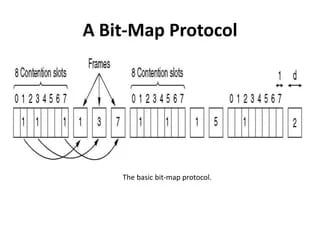
In a network with \(N\) stations, the reservation phase consists of \(N\) bits, with one bit assigned to each station. A station sets its bit to 1 if it has data to transmit and leaves it at 0 otherwise.
After all stations have had the opportunity to indicate their transmission requirements, the stations that set their bits to 1 transmit their frames in a predetermined order.
Unlike contention-based protocols, such as traditional Ethernet’s CSMA/CD, the bit-map protocol does not require stations to compete randomly for the channel during the data transmission phase. Instead, stations reserve transmission opportunities through the bitmap.
How Does It Work?
The bit-map protocol operates through a reservation phase followed by a data transmission phase. The exact implementation may vary, but the general process involves the following steps.
1. Assign a Bit to Each Station
Each station in the network receives a unique position in the bitmap. For example, a network containing eight stations uses an eight-bit reservation map.
Each bit represents one station and indicates whether that station has data waiting to be transmitted.
2. Enter the Reservation Phase
At the beginning of a reservation cycle, stations indicate their transmission requirements in their assigned bit positions.
-
Bit 1: The station has a frame to transmit.
-
Bit 0: The station has no frame to transmit.
The resulting bitmap identifies the stations that want to access the shared channel.
3. Determine the Transmission Order
After the reservation phase, the network uses the bitmap to determine which stations can transmit. Stations that have set their bits to 1 receive transmission opportunities in a predefined sequence, commonly based on station numbers.
Because the transmission order is established before data transmission begins, stations do not need to compete for the channel during that phase.
4. Transmit Data Frames
Each station with a reservation transmits its frame when its turn arrives. Stations that have not reserved the channel remain silent.
Once the scheduled transmissions are complete, the network begins another reservation cycle to identify stations with additional data.
Types of Phases in Bit-Map Protocol
The bit-map protocol is generally described through two main phases.
Reservation Phase
During the reservation phase, each station announces whether it has data to transmit. The reservation map records these requests, allowing the network to identify which stations need access to the channel.
The duration of this phase depends on the number of stations. In a basic implementation with \(N\) stations, the reservation phase requires \(N\) bit positions.
Data Transmission Phase
During the data transmission phase, stations that reserved the channel transmit their frames according to the established order.
This phase avoids the repeated collisions and retransmissions associated with contention-based access methods. However, its efficiency depends on how many stations have data to send and how much time the reservation phase consumes.
Advantages of Bit-Map Protocol
The bit-map protocol offers several advantages for organized access to a shared communication channel.
-
Collision-free scheduled transmission: Stations transmit according to an established order, avoiding collisions during the scheduled data phase.
-
Fair channel access: Each station receives an opportunity to announce its transmission requirements during the reservation phase.
-
Predictable transmission order: The protocol makes it easier to determine which stations will transmit next.
-
Efficient under heavy traffic: When many stations have data to send, the reservation overhead can be small compared with the total time used for data transmission.
-
Simple reservation mechanism: The bitmap provides a straightforward way to represent transmission requests across multiple stations.
Disadvantages of Bit-Map Protocol
Despite its benefits, the bit-map protocol has several limitations.
-
Reservation overhead: Every station requires a bit position, even if it has no data to transmit.
-
Poor efficiency under light traffic: When only a few stations have data, the reservation phase may consume a significant portion of the available channel time.
-
Scalability concerns: As the number of stations increases, the reservation map becomes longer, increasing coordination overhead.
-
Potential waiting time: A station may need to wait for the reservation phase and for other stations earlier in the transmission order to finish.
-
Coordination requirements: Stations must follow a consistent reservation and transmission procedure for the protocol to operate correctly.
Bit-Map Protocol vs. Other Channel Access Protocols
The bit-map protocol differs from other medium access control methods in how devices obtain permission to transmit.
| Feature | Bit-Map Protocol | ALOHA | CSMA/CD |
|---|---|---|---|
| Access method | Reservation-based | Contention-based | Carrier sensing with collision detection |
| Collision handling | Avoids collisions during scheduled data transmission | Retransmits after collisions | Detects collisions and retries |
| Reservation phase | Required | Not required | Not required |
| Performance under heavy traffic | Can be efficient | Collisions can reduce throughput | Contention can reduce throughput |
| Performance under light traffic | Reservation overhead may be significant | Low access overhead | Low access overhead when the channel is idle |
| Transmission order | Predetermined | Uncoordinated | Depends on channel availability and contention |
CSMA/CD is associated with traditional shared, half-duplex Ethernet. Modern switched full-duplex Ethernet does not use CSMA/CD for normal operation.
Applications of Bit-Map Protocol
The bit-map protocol is primarily studied as a theoretical and educational example of reservation-based channel access. It helps explain how a network can coordinate multiple stations sharing the same communication medium.
Its concepts are relevant to understanding:
-
Medium access control (MAC) protocols.
-
Reservation-based channel allocation.
-
Shared-medium communication systems.
-
Collision avoidance and transmission scheduling.
-
Trade-offs between coordination overhead and channel utilization.
The basic bit-map protocol should not be confused with a universally deployed modern networking standard. Contemporary wireless and wired networks generally use other access-control mechanisms tailored to their specific requirements.
Conclusion
The bit-map protocol is a reservation-based multiple access protocol that organizes communication by assigning a bit to each station. Stations use the reservation bitmap to announce their intention to transmit, after which active stations send data in a predetermined order. Its primary strengths are predictable channel access, fairness, and collision-free scheduled data transmission. However, reservation overhead can reduce efficiency when network traffic is light or the number of stations is large. Understanding the bit-map protocol provides a useful foundation for studying MAC protocols, channel allocation, and the design of efficient shared communication systems.