Virtual Circuit Identifier (VCI): Definition, How It Works, and Examples
A Virtual Circuit Identifier (VCI) is a numerical label used in virtual-circuit-based networking to identify a logical connection over a network link. It helps network devices determine which virtual circuit a data cell belongs to, allowing traffic to be forwarded efficiently without relying on a complete destination address in every cell. VCIs are commonly associated with Asynchronous Transfer Mode (ATM) networks and are also relevant to understanding virtual circuit switching, label-based forwarding, and connection-oriented communication. In ATM, the VCI works together with the Virtual Path Identifier (VPI) to identify a virtual connection. In this article, we explain what a virtual circuit identifier is, how it works, its relationship with VPI, and its advantages and limitations in computer networking.
What Is a Virtual Circuit Identifier (VCI)?
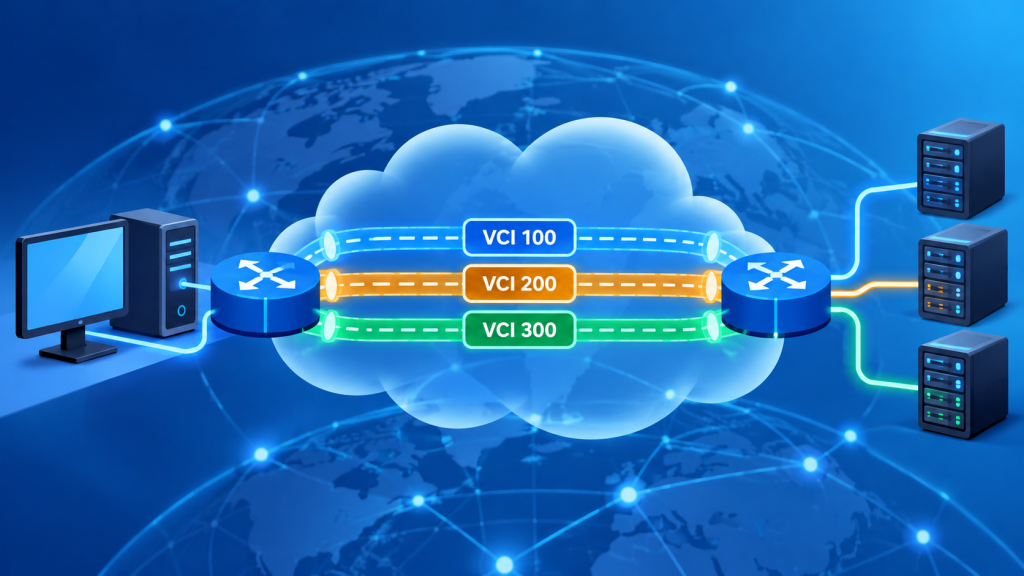
A Virtual Circuit Identifier (VCI) is a field in a network packet or cell header that identifies a particular virtual circuit on a link. A virtual circuit is a logical communication path established between network endpoints, allowing data to travel through a network as if it were using a dedicated connection.
Unlike traditional IP routing, which typically uses destination IP addresses to forward packets, virtual circuit networks can use short identifiers to determine how incoming data should be handled.
For example, in an ATM network, each cell contains a VCI field. A switch examines the identifier and uses its forwarding table to determine the appropriate outgoing interface and identifier for the next hop.
The VCI is generally locally significant, meaning that its value identifies a connection within a particular link or network segment rather than serving as a globally unique address.
How Does a Virtual Circuit Identifier Work?
A virtual circuit identifier operates as part of a connection-oriented forwarding process. Before data transmission begins, the network establishes a virtual circuit and configures the necessary forwarding information in the switches along the path.
The process generally follows these steps:
- Connection establishment: A virtual circuit is established between the communicating endpoints, either through signaling or network configuration.
- Identifier assignment: The network assigns appropriate VCI values to identify the connection on individual links.
- Data transmission: The sender transmits data cells or packets containing the relevant virtual circuit identifier.
- Identifier lookup: Each intermediate switch examines the incoming interface and identifier, then consults its forwarding table.
- Forwarding: The switch forwards the data through the selected outgoing interface. The identifier may be replaced with a different value for the next link.
- Connection termination: When the virtual circuit is no longer required, its resources and forwarding entries can be released.
This process reduces the need to perform a full destination-address lookup for every cell in technologies such as ATM.
Example of VCI-Based Forwarding
Consider a virtual circuit that passes through two ATM switches. The connection can use different VCI values on different links.
| Network segment | Incoming VCI | Outgoing VCI |
|---|---|---|
| Sender to Switch 1 | 100 | 200 |
| Switch 1 to Switch 2 | 200 | 350 |
| Switch 2 to Receiver | 350 | — |
In this example, Switch 1 receives cells with VCI 100 and forwards them using VCI 200. Switch 2 then receives those cells with VCI 200 and forwards them using VCI 350.
The identifiers do not have to remain the same throughout the connection. Each switch uses the identifier associated with the incoming link and maps it to the appropriate outgoing connection.
This approach allows a network to reuse identifier values on different links while maintaining correct forwarding behavior.
Virtual Circuit Identifier in ATM Networks
Asynchronous Transfer Mode (ATM) is a networking technology that transmits information in fixed-length cells of 53 bytes. Each cell consists of a 5-byte header and a 48-byte payload.
The ATM header contains the VCI field, which helps switches identify the virtual circuit associated with a cell.
In the standard ATM cell header, the VCI field is 16 bits long. However, some bit patterns and identifier values have special meanings or are reserved, so not every possible value is available for ordinary virtual circuit assignment.
ATM also uses a Virtual Path Identifier (VPI). Together, VPI and VCI identify a virtual connection within the relevant ATM link context.
The combination allows ATM switches to support two levels of logical grouping:
- Virtual path: Groups multiple virtual channels that share a common path.
- Virtual channel: Represents an individual logical connection within a virtual path.
This hierarchical arrangement helps simplify connection management and forwarding in ATM networks.
VCI vs. VPI: What Is the Difference?
The Virtual Circuit Identifier and Virtual Path Identifier serve related but distinct purposes in ATM networks.
| Feature | Virtual Circuit Identifier (VCI) | Virtual Path Identifier (VPI) |
|---|---|---|
| Full name | Virtual Circuit Identifier | Virtual Path Identifier |
| Primary purpose | Identifies a virtual channel or circuit | Identifies a virtual path containing one or more virtual channels |
| ATM header size | 16 bits | 8 bits in the UNI header; 12 bits in the NNI header |
| Relationship | Identifies a connection within the relevant path and link context | Groups virtual channels under a shared virtual path |
| Forwarding role | Supports virtual-channel-level forwarding | Supports virtual-path-level forwarding and switching |
The VPI and VCI fields are interpreted together in ATM. Their values are meaningful within the applicable interface and connection context.
For example, two virtual channels may share the same VPI but have different VCIs. This allows them to belong to the same virtual path while remaining separate logical connections.
VCI vs. IP Address
A VCI and an IP address both help network devices deliver data, but they work differently.
An IP address identifies a network interface or endpoint within an IP network. Routers generally use destination IP addresses and routing information to determine where packets should go.
A VCI, by contrast, identifies a virtual connection within a virtual-circuit network. It is typically meaningful only within the relevant link or interface context.
The main differences include:
- Scope: IP addresses are used for addressing across IP networks, while VCIs are generally locally significant.
- Forwarding: IP routers commonly make forwarding decisions using destination addresses and routing tables; ATM switches use VPI/VCI mappings.
- Connection setup: Traditional IP forwarding does not require a dedicated virtual circuit to be established for each communication flow. Virtual-circuit technologies generally establish or configure connection state before forwarding traffic.
- Identifier changes: An IP packet’s source and destination addresses normally remain unchanged across routed links, except when mechanisms such as Network Address Translation modify them. VCI values can change at each virtual circuit switching point.
Therefore, a VCI should not be treated as a replacement for an IP address. The two identifiers serve different roles in different networking architectures.
VCI and Virtual Circuit Switching
Virtual circuit switching is a networking method in which a logical path is established before data is transferred. Once the connection is available, packets or cells are forwarded according to the connection’s configured state.
The VCI plays an important role in this process by allowing switches to associate incoming traffic with a specific virtual connection.
Virtual circuit switching can provide several benefits:
- Efficient forwarding: Short identifiers can simplify forwarding decisions.
- Predictable traffic handling: Established connections can use configured paths and forwarding state.
- Traffic management: Connection-oriented technologies may support resource reservation, traffic contracts, and quality-of-service controls.
- Logical separation: Multiple connections can share the same physical network infrastructure.
However, these characteristics depend on the networking technology and its configuration. A VCI by itself does not guarantee bandwidth, low latency, or quality of service.
Advantages of a Virtual Circuit Identifier
Using VCIs in virtual-circuit-based networks offers several practical advantages.
- Efficient Data Forwarding – A switch can use a compact identifier to locate the appropriate forwarding entry. In ATM, this supports fast processing of fixed-size cells.
- Local Identifier Reuse – Because VCIs are generally locally significant, the same numeric value can be assigned to different connections on separate links, provided the forwarding contexts remain unambiguous.
- Support for Connection-Oriented Communication – VCIs help switches associate data with an established logical connection. This makes it easier to maintain per-connection forwarding state.
- Simplified Traffic Management – When combined with appropriate network mechanisms, virtual circuits can support traffic engineering, service differentiation, and resource management.
- Logical Connections over Shared Infrastructure – Multiple virtual circuits can operate over the same physical link, allowing network resources to be shared among different communication sessions.
Limitations of a Virtual Circuit Identifier
Although VCIs are useful in virtual-circuit technologies, they also have limitations.
- Limited Identifier Space – The VCI field has a finite size. In ATM, it is 16 bits, and some values are reserved or used for special purposes. Network equipment must manage assignments carefully to avoid conflicts within a forwarding context.
- Dependence on Forwarding State – Switches must maintain the appropriate mappings for active virtual circuits. Incorrect or missing entries can prevent traffic from reaching its destination.
- Connection Setup Requirements – Virtual-circuit-based communication generally requires a connection to be established or configured before normal data forwarding can take place.
- Local Significance – A VCI alone is not sufficient to identify a connection across an entire network. Its meaning depends on the incoming interface and, in ATM, the associated VPI.
- Technology-Specific Usage – VCIs are strongly associated with technologies such as ATM. Other networking technologies may use different mechanisms, including labels, tunnel identifiers, or packet headers.
Is VCI Still Used in Modern Networks?
VCI is most closely associated with ATM networks, which are now far less common in general-purpose networking than Ethernet and IP-based technologies. However, understanding VCIs remains useful for studying networking fundamentals, telecommunications infrastructure, legacy systems, and the development of connection-oriented switching.
Modern networks also use other forms of connection or forwarding identifiers. For example, Multiprotocol Label Switching (MPLS) uses labels to forward packets along label-switched paths. These labels share some conceptual similarities with VCIs because they help identify forwarding state, but they are not the same mechanism. Likewise, tunnel identifiers and other protocol-specific fields can distinguish logical connections within shared network infrastructure.
Understanding the VCI concept helps explain how networks can forward traffic using compact identifiers rather than relying exclusively on full destination addresses at every switching step.
Conclusion
A Virtual Circuit Identifier (VCI) is an important concept in connection-oriented networking, particularly in ATM systems. It enables switches to identify virtual channels, map incoming traffic to outgoing links, and forward data efficiently using compact identifiers. Working alongside the Virtual Path Identifier, the VCI supports hierarchical connection management and the sharing of physical network resources. Although ATM is less prevalent in modern networks, understanding VCI provides useful insight into virtual circuit switching and the broader evolution of network forwarding technologies.