Destination NAT (DNAT): Everything You Need to Know
As organizations increasingly rely on cloud computing, remote access, and internet-facing applications, network address translation (NAT) has become a fundamental technology for connecting private networks to public networks securely and efficiently. Among the various types of NAT, Destination NAT (DNAT) plays a crucial role in making internal services accessible from external networks. Whether you’re hosting a web server, publishing applications, configuring load balancers, or deploying firewalls, understanding Destination NAT is essential for network administrators and IT professionals.
This comprehensive guide explains everything you need to know about Destination NAT, including how it works, real-world use cases, advantages, limitations, security best practices, and configuration examples.
What Is Destination NAT?
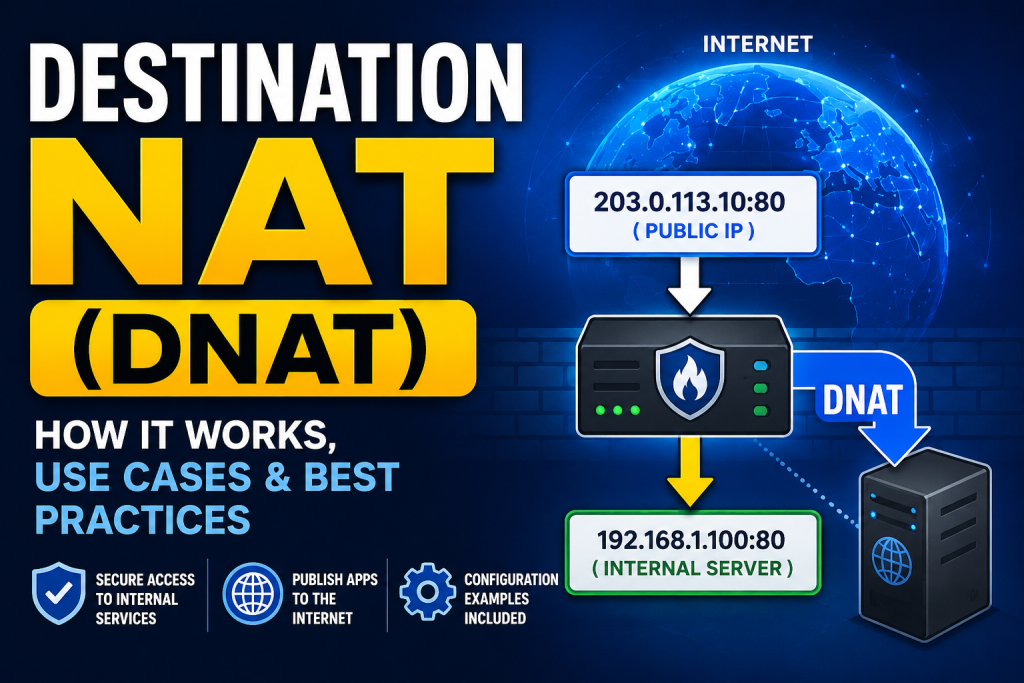
Destination NAT (DNAT) is a Network Address Translation technique that changes the destination IP address of incoming packets before they reach their intended destination. Instead of sending traffic directly to a private IP address, users connect to a public IP address. A router or firewall then translates that public destination address into the private IP address of the internal server.
For example:
- Public IP: 203.0.113.10
- Internal Web Server: 192.168.1.100
A client connects to:
203.0.113.10:80The firewall performs DNAT:
203.0.113.10 → 192.168.1.100The web server receives the request without knowing the client originally targeted the public IP.
How Does Destination NAT Work?
Destination NAT occurs on incoming traffic.
The process typically follows these steps:
- An external client sends a request.
- The request reaches the firewall or NAT gateway.
- The firewall checks its NAT rules.
- The destination IP address is rewritten.
- The packet is forwarded to the internal server.
- The server responds.
- Source NAT (or reverse translation) ensures replies return correctly.
Flow example:
Internet Client
      │
      ▼
203.0.113.10
      │
      ▼
Firewall
DNAT:
203.0.113.10
        ↓
192.168.1.100
      │
      ▼
Internal Web Server
The client never sees the internal private IP.
Why Is DNAT Important?
Without Destination NAT:
- Internal servers remain unreachable.
- Private IP addresses cannot be routed over the Internet.
- Hosting internal applications becomes difficult.
DNAT enables organizations to:
- Publish websites
- Provide remote access
- Host email servers
- Enable VPN gateways
- Expose APIs
- Support cloud applications
How DNAT Differs from Source NAT
| Feature | Destination NAT | Source NAT |
|---|---|---|
| Modifies | Destination IP | Source IP |
| Traffic Direction | Incoming | Outgoing |
| Primary Purpose | Publish internal resources | Internet access |
| Common Example | Port forwarding | Home router NAT |
| Used For | Web servers, VPN, APIs | User internet browsing |
Many enterprise firewalls use both simultaneously.
Destination NAT vs Static NAT
Although both involve address translation, they serve different purposes.
Destination NAT
- Changes destination address
- Usually affects inbound traffic
- Often combined with port forwarding
- Rule-based translation
Example:
203.0.113.20:443
↓
192.168.5.25:8443
Static NAT
- One-to-one permanent mapping
- Bidirectional translation
- Entire IP address mapping
Example:
203.0.113.20
↔
192.168.5.25
Static NAT does not necessarily include port translation.
Destination NAT vs Port Forwarding
Many people use these terms interchangeably.
Technically:
Port forwarding is a form of Destination NAT.
Example:
203.0.113.50:443
        ↓
192.168.10.15:8443
Both IP and port can be translated.
Common Destination NAT Use Cases
1. Hosting Web Servers
One of the most common uses.
Internet users visit:
example.comDNS resolves to:
198.51.100.25Firewall translates:
198.51.100.25
↓
10.10.20.15
2. Publishing Mail Servers
Organizations expose:
- SMTP
- IMAP
- POP3
using Destination NAT rules.
3. Remote Desktop Access
Instead of exposing internal IP addresses:
Public IP
↓
DNAT
↓
Internal Windows Server
4. VPN Gateways
Firewalls commonly publish:
- IPsec
- SSL VPN
- WireGuard
- OpenVPN
through DNAT.
5. API Hosting
Cloud APIs often use:
Public Load Balancer
↓
DNAT
↓
Private API Servers
6. Camera Systems
Security cameras inside private networks can be accessed remotely through carefully configured DNAT rules.
7. Gaming Servers
Home users often configure:
- Minecraft
- Valheim
- Counter-Strike
- ARK
using port forwarding.
Advantages of Destination NAT
Enables Public Access
Organizations can safely expose selected internal services.
Hides Internal Network
Users never see:
10.x.x.x
172.16.x.x
192.168.x.x
This provides an additional layer of abstraction.
Conserves IPv4 Addresses
Multiple services can share one public IP using different ports.
Example:
203.0.113.10:80
→ Web Server

203.0.113.10:25
→ Mail Server

203.0.113.10:22
→ SSH Gateway
Flexible Service Publishing
Administrators can expose:
- Entire servers
- Individual applications
- Specific ports
- Multiple services
without redesigning the network.
Supports Hybrid Cloud
DNAT simplifies publishing:
- Cloud workloads
- On-premises servers
- Hybrid infrastructure
Limitations of Destination NAT
Despite its advantages, DNAT has limitations.
- Increased Complexity – Large environments may contain hundreds of NAT rules. Proper documentation becomes essential.
- Troubleshooting Challenges – Problems may occur because of: Firewall rules, Routing, ACLs, DNS, NAT order, Session tracking…
- Application Compatibility – Some legacy applications embed IP addresses inside payloads. Additional helpers (Application Layer Gateways) may be required.
- Security Risks – Improperly configured DNAT can expose management interfaces, databases, and internal services to the Internet.
Destination NAT in Cloud Environments
Cloud providers implement DNAT concepts through managed networking services.
Examples include:
- Public load balancers
- NAT gateways
- Reverse proxies
- Ingress controllers
- Kubernetes Services
- Cloud firewalls
Traffic arriving at a public endpoint is translated and forwarded to private compute instances or containers.
Destination NAT and IPv6
IPv6 significantly reduces the need for traditional NAT because of its vast address space. However, DNAT-like functionality is still used in some scenarios, including:
- Reverse proxy deployments
- Load balancing
- Firewall policy enforcement
- Service publishing
- Container networking
As a result, while classic NAT is less common in IPv6 networks, address translation and traffic redirection remain relevant in modern architectures.
Conclusion
Destination NAT (DNAT) is a foundational networking technology that enables secure access to internal services from external networks by translating the destination address of incoming traffic. It is widely used to publish websites, APIs, VPNs, email servers, and other applications while keeping private IP addresses hidden.
When combined with robust firewall rules, HTTPS, logging, and regular rule audits, DNAT provides a flexible and secure way to expose internal resources without compromising network architecture. Whether you’re managing an enterprise data center, a cloud deployment, or a small office network, understanding how Destination NAT works is an essential skill for designing scalable and secure network infrastructures.