Source NAT (SNAT): What It Is, How It Works, Benefits, and Best Practices
Modern networks rely on source NAT (SNAT) to allow thousands – or even millions – of private devices to communicate with the internet using a limited number of public IP addresses. Whether you’re managing an enterprise firewall, cloud infrastructure, Kubernetes cluster, or home router, Source NAT plays a critical role in enabling outbound connectivity.
This guide explains everything you need to know about source NAT, including how it works, real-world examples, advantages, disadvantages, configuration scenarios, and best practices.
What Is Source NAT?
Source NAT (SNAT), or Source Network Address Translation, is a networking technique that modifies the source IP address of packets before they leave a network. Instead of exposing the original private IP address, SNAT replaces it with another IP address – typically a public IP address – allowing internal devices to communicate with external networks.
For example:
Original Packet
- Source IP: 192.168.10.15
- Destination IP: 8.8.8.8
After SNAT
- Source IP: 203.0.113.5
- Destination IP: 8.8.8.8
The destination server sees the packet as originating from the translated public IP instead of the private address.
Why Is Source NAT Necessary?
Private IP addresses defined in RFC 1918 cannot be routed across the public internet.
Examples include:
- 10.0.0.0/8
- 172.16.0.0–172.31.255.255
- 192.168.0.0/16
Without SNAT:
- Internet routers would discard packets with private source addresses.
- External servers could not send responses.
- Internal users would lose internet access.
SNAT solves this problem by translating private addresses into routable public addresses.
How Source NAT Works
The SNAT process typically follows these steps:
Step 1: Client Sends a Packet
An internal computer initiates communication.
- Source:
192.168.1.100 - Destination:
142.250.x.x
Step 2: Firewall Performs Translation
The firewall changes: 192.168.1.100 to 198.51.100.10
The firewall records this mapping in its NAT table.
Step 3: The Internet Receives a Packet
The remote server believes the packet originated from: 198.51.100.10
Step 4: Response Returns
The server replies to: 198.51.100.10
Step 5: Reverse Translation
The firewall checks its NAT table and forwards the response back to: 192.168.1.100
The entire translation process is transparent to both endpoints.
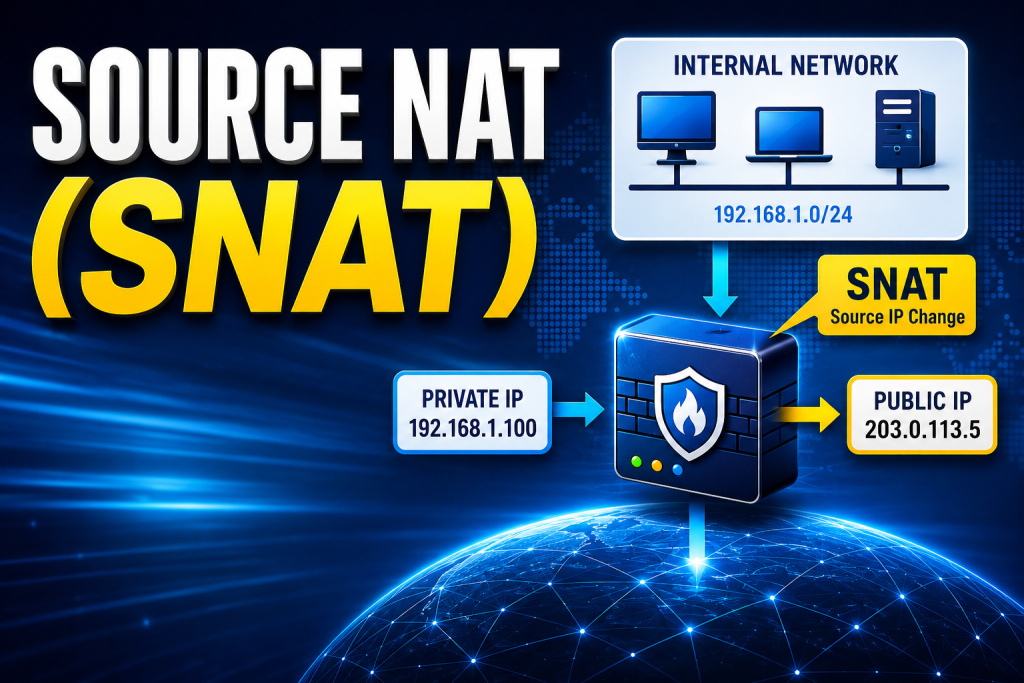
Source NAT Packet Flow
Internal PC
192.168.1.100
      │
      ▼
Firewall
SNAT:
192.168.1.100
        ↓
198.51.100.10
      │
      ▼
Internet
      │
      ▼
Web Server
Responses follow the reverse path using the NAT table.
Types of Source NAT
Static SNAT
A single internal IP always maps to one public IP.
Example:
192.168.1.20
↓
203.0.113.20
Useful for:
- Application servers
- Email gateways
- VPN appliances
Dynamic SNAT
Addresses are assigned from a pool.
Example:
Internal Users
↓
Public Pool
203.0.113.10
203.0.113.11
203.0.113.12PAT (Port Address Translation)
Also called:
- NAT Overload
- Many-to-One NAT
Multiple devices share one public IP.
Example:
| Device | Private IP | Public IP |
|---|---|---|
| PC1 | 192.168.1.10 | 203.0.113.5:40001 |
| PC2 | 192.168.1.11 | 203.0.113.5:40002 |
| PC3 | 192.168.1.12 | 203.0.113.5:40003 |
Ports distinguish simultaneous sessions.
PAT is the most common form of Source NAT.
SNAT vs DNAT
| Feature | SNAT | DNAT |
|---|---|---|
| Changes | Source IP | Destination IP |
| Traffic Direction | Outbound | Inbound |
| Common Use | Internet access | Port forwarding |
| Performed On | Internal clients | Public services |
| Example | Office users browsing the web | Public access to the web server |
SNAT manages outbound traffic, while DNAT directs inbound traffic to internal resources.
Benefits of Source NAT
- Conserves IPv4 Addresses – Organizations can support thousands of devices using only a few public IP addresses.
- Improves Security – Private IP addresses remain hidden from external networks. Attackers cannot directly discover internal addressing schemes.
- Simplifies Network Management – Internal IP addressing can change without affecting public connectivity.
- Supports ISP Changes – Organizations can switch internet providers while preserving internal IP addressing.
- Enables Internet Connectivity – Private networks can communicate with public services without requiring globally routable addresses.
Limitations of Source NAT
- Breaks End-to-End Connectivity – Applications expecting direct communication may require additional configuration.
- Protocol Compatibility Issues – Protocols embedding IP addresses inside payloads may require Application Layer Gateways (ALGs). Examples include: FTP, SIP, H.323…
- Logging Complexity – Multiple users may appear under the same public IP, making user identification dependent on NAT logs.
- Additional Processing – Every translated packet requires NAT table lookups, consuming firewall resources.
Source NAT in Cloud Computing
Cloud providers extensively use SNAT.
Common examples include:
- Virtual machines accessing the internet
- Containers download software packages
- Managed Kubernetes clusters
- Cloud gateways
Cloud NAT services eliminate the need to assign public IPs to every workload while still enabling outbound internet access.
Source NAT in Kubernetes
Kubernetes often performs SNAT when Pods communicate outside the cluster.
Reasons include:
- Internet access
- Communication with external APIs
- Access to cloud services
- Cross-network routing
Cluster networking solutions may automatically perform SNAT unless configured otherwise.
Source NAT in Enterprise Firewalls
Nearly every enterprise firewall supports SNAT.
Common platforms include:
- Cisco Secure Firewall
- Palo Alto Networks
- Fortinet FortiGate
- Check Point
- Juniper SRX
- Sophos Firewall
- pfSense
- OPNsense
Typical policies include:
- Employee internet access
- Guest Wi-Fi
- VPN client access
- Data center outbound traffic
- Cloud connectivity
Common Use Cases
Organizations use Source NAT for:
- Office internet browsing
- Cloud virtual machines
- VPN users
- Remote workers
- Kubernetes clusters
- Branch office connectivity
- Hybrid cloud networking
- ISP redundancy
- Internet gateways
- SD-WAN deployments
Conclusion
Source NAT (SNAT) is a foundational networking technology that enables private networks to access external resources while conserving public IPv4 addresses. By translating the source IP address of outbound packets, SNAT allows organizations to scale internet connectivity, simplify network administration, and support modern environments such as cloud platforms, VPNs, and Kubernetes clusters. Although SNAT offers operational benefits and helps conceal internal addressing, it is not a substitute for comprehensive network security. Combining well-designed SNAT policies with robust firewalls, monitoring, logging, and routing practices ensures reliable and secure communication across enterprise and cloud infrastructures.
For network administrators, cloud architects, and security professionals, understanding how source NAT works is essential for designing scalable, high-performance, and resilient networks.